For the win?

Challenge or for the win?

Challenge Spirit or for the win?

The NFAS 3D championship is just round the corner and yes I hope to shoot well but in reality I know I am a long way off placing. 
For those not familiar with the event it is a 2 day shoot which sees approximately 600 archers of different styles shooting two courses one each day. It’s called a 3D championship as all targets are 3Ds.  You can see previous year reviews here for 2013 and 2012

This doesn’t mean I don’t want to aim to do well though. This thought got me thinking about how different people measure success.

So here are a couple of questions to all readers. 

How do you measure your own success in archery?

Is the win important or not so important to you as you just want to enjoy the day?

Is it about getting a placing or medal or having a good shoot?

Is it the possibility of recording a personal best or just getting round the course?  I know last year I just wanted to get round following the problems with my shoulder.

For me I think it is nice to place at shoots but in truth I’m competing against myself each time I go out. 
If I start thinking of how others are doing or what my score is it plays with my head and negatively affects my shooting. 
I know I’m very self critical and if I don’t feel I’m shooting well tend to beat myself up. Not good and something I try and get my students to avoid. Easier said than done though. 
I tend to have in mind what I think I should score in total and after each shot. 
These goals have changed over time though. 
When I started I was happy not to blank half the targets on a course. I now get cross with myself if I blank any!
My next goal was to reduce the number of third arrows I was taking.  Still working on that one.

I started looking at average scores for shoots but realised this didn’t factor in the course difficulty, weather etc. We all know some shoots are more challenging than others so averages have to be taken with a pinch of salt. 
Best measure I found was identifying someone in your shooting class who you know shoots consistently that you can match your score against. They become your base line. This gives you a guide to the difficulty level of the course. 
But scoring isn’t the only thing you have to enjoy the day or why do the hobby?

As always thanks for reading and if you have any comments or thoughts let me know.

Course and Target Laying – Distance

In this series of posts I’ve been looking at course laying and shot selection.  The last post covered some thoughts on elevation and in this one I’m going to cover distance.

Society Rules

In the NFAS (National Field Archery Society)  you shoot over unmarked distances so it is down to the archers own skills in distance judgement to calculate how far the target is. You aren’t allowed to use any range finding equipment and only a few classes are allowed to use sights. I know other societies allow the use of range finders or shoot marked distances. Likewise some societies specify you have to have x number of 30 yard shots, y number of 40 yard etc.
On this topic some would say the role of the course layer is to try and make the judgement of distance difficult by using dead ground or the like. Personally I would say a good course layer should be able to lay a course that encourages sighted archers to change their sight marks or pins.

What effect does distance have?

Well the further the shot the longer time in air the arrow has and therefore more chance for environment to effect the arrows flight. What I mean by environment is  maybe gust of wind or when  shooting in the rain. The other thing to consider is a shot can’t be too close.
Why?
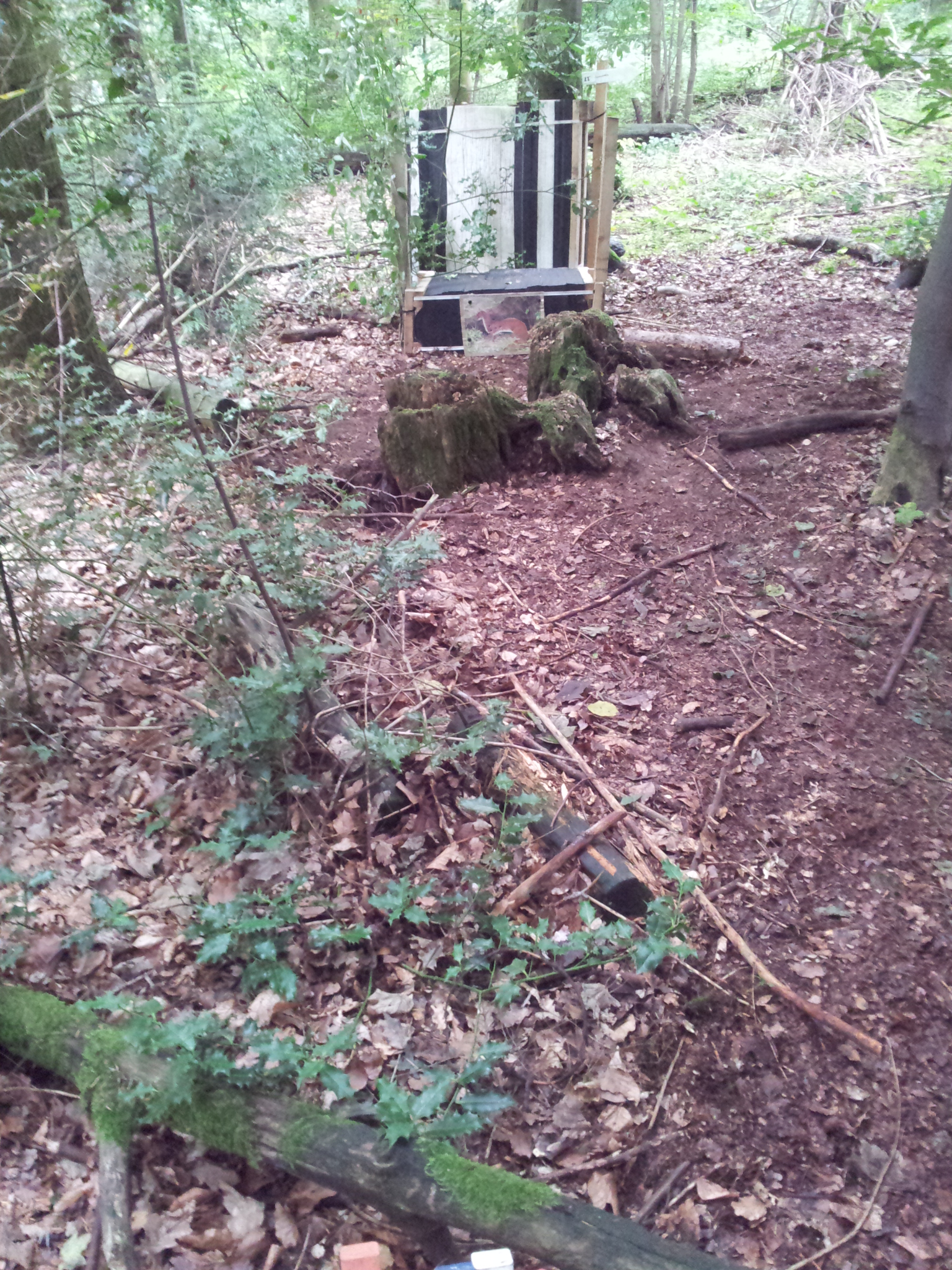
Well think of the archers paradox, you need to give the arrow chance to straighten, for this reason I would say never put a shot in closer that 3 yards. Look at this weasel shot form the 2013 Nationals.
Paper Ermin

Paper Ermin

It was only a few yards away from the shooting pegs but the level it was set at and height off the ground along with proximity to the stumps made you think.  It goes to show that a long distance relative to target size is obvious but sometimes a close shot can challenging.

Below is a good example of a medium shot of just about 30 yards. The reason I include this here is it also highlights the effect tree branches can have. If you putting a longish shot in keep a thought for overhanging tree branches, you might need to clear a few to ensure the shot is safe.

First view from Red peg

First view from Red peg

Stretched shot

I can’t cover distance without saying a word or two on stretched shots. Stretched shot are not challenging, simply beyond the distance it should be. This differs from a long shot, which can be challenging if there is a good chance of hitting.
The 3d tiger was a long shot as far as distance is concerned being over 50 yards but as it’s a large target its still hittable.
3D tiger from red peg

3D tiger from red peg

Wolverine Archers are famous for their long shot Kong. Just to give you an idea here is a video of the distance
)

What is long or is considered long varies. Personally I think anything over 40 yards is boarding on long for most archers. Don’t get me wrong I like the occasional longer shot, so long as the target size is appropriate.

In the next post on course and target planning I will address the ideas and issues associated with identifying suitable target size.

If you find this useful or have any questions then please contact me.

As always thanks for reading.