In this series of posts I’ve been looking at course laying and shot selection. The last post covered some thoughts on elevation and in this one I’m going to cover distance.
Society Rules
In the NFAS (National Field Archery Society) you shoot over unmarked distances so it is down to the archers own skills in distance judgement to calculate how far the target is. You aren’t allowed to use any range finding equipment and only a few classes are allowed to use sights. I know other societies allow the use of range finders or shoot marked distances. Likewise some societies specify you have to have x number of 30 yard shots, y number of 40 yard etc.
On this topic some would say the role of the course layer is to try and make the judgement of distance difficult by using dead ground or the like. Personally I would say a good course layer should be able to lay a course that encourages sighted archers to change their sight marks or pins.
What effect does distance have?
Well the further the shot the longer time in air the arrow has and therefore more chance for environment to effect the arrows flight. What I mean by environment is maybe gust of wind or when shooting in the rain. The other thing to consider is a shot can’t be too close.
Why?
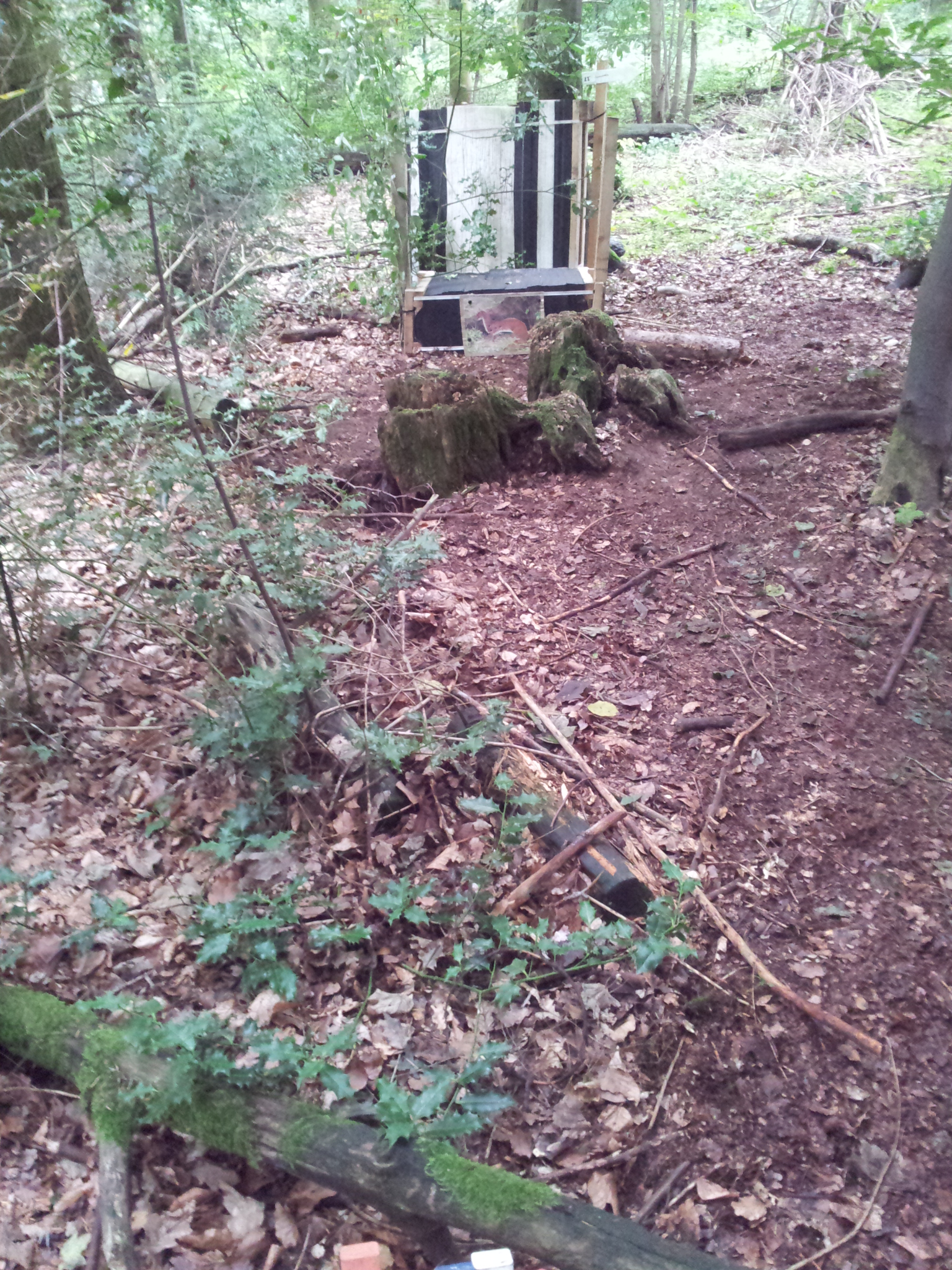
Well think of the archers paradox, you need to give the arrow chance to straighten, for this reason I would say never put a shot in closer that 3 yards. Look at this weasel shot form the 2013 Nationals.
Paper Ermin
It was only a few yards away from the shooting pegs but the level it was set at and height off the ground along with proximity to the stumps made you think. It goes to show that a long distance relative to target size is obvious but sometimes a close shot can challenging.
Below is a good example of a medium shot of just about 30 yards. The reason I include this here is it also highlights the effect tree branches can have. If you putting a longish shot in keep a thought for overhanging tree branches, you might need to clear a few to ensure the shot is safe.
First view from Red peg
Stretched shot
I can’t cover distance without saying a word or two on stretched shots. Stretched shot are not challenging, simply beyond the distance it should be. This differs from a long shot, which can be challenging if there is a good chance of hitting.
The 3d tiger was a long shot as far as distance is concerned being over 50 yards but as it’s a large target its still hittable.
3D tiger from red peg
Wolverine Archers are famous for their long shot Kong. Just to give you an idea here is a video of the distance
)
What is long or is considered long varies. Personally I think anything over 40 yards is boarding on long for most archers. Don’t get me wrong I like the occasional longer shot, so long as the target size is appropriate.
In the next post on course and target planning I will address the ideas and issues associated with identifying suitable target size.
If you find this useful or have any questions then please contact me.
My personal view is there are several ways in which you can make a shot challenging. Instinctively you will sometimes see how the land and vegetation can combine to make a good shot. But that doesn’t make it very easy to explain here or to new course layers developing their skills.
The art is combining one or two of them together to make a shot challenging without being too hard. In essence there is a fine balance between challenging and demoralising and as a course layer you need to judge this carefully.
In the next few posts I will look at different options from target distance to size of target, intervening terrain to footing on the peg.
First off though I’m going to give some comments on elevation.
So what do I mean by elevation?
Any shot that is not along flat ground and requires you to change your stance or aiming because it is down a hillside or hung in a tree.
Shooting along the flat is one thing but in field archery you have the opportunity depending on terrain to introduce a shot that goes down or uphill and it confuses people. Shots across the slope also increase difficulty as you have to judge the angle and distance to the target.
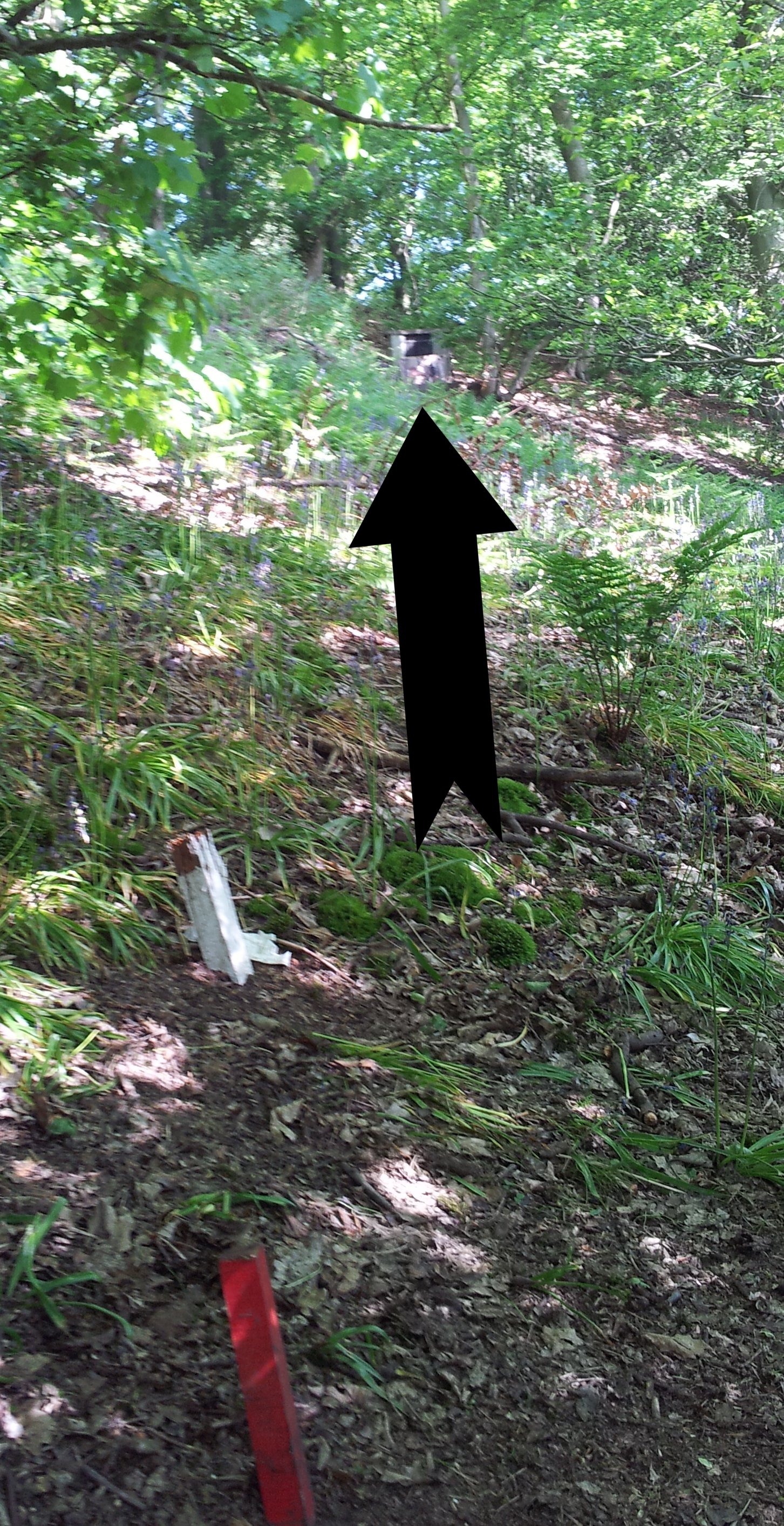
An example of this can be seen here, where it looks a straight shot up a hill to a target by the tree.
View from the red peg
This isn’t a straight up hill shot though, but one at about a 30 degree angle across the slope.
Arrows shows the target
Though it doesn’t look it, it is a largish paper target of a Ram too from the Merlin archery range of faces, shown below. Many archers will judge the distance but not necessarily the elevation. When setting this shot we decided that a paper face mounted on a target boss was better than a 3D target. Why, I hear you ask?
We thought that a boss would mean people would find arrows more easily rather than them skipping along the ground, also a target boss deceases the chance of an arrow skipping off the top of the target and traveling on.
Merlin Ram
Raising a target can also work as was the case in the tree shot. You will notice we have put a lower target in for juniors.
Elevated shot for adults
This isn’t a long shot, being approximately 7-9 yards, but because of its elevation in a tree it often throws peoples judgement.
I hope these ideas help and generate some ideas of your own. Have a walk round your wood this weekend and see if you can apply any of these ideas. If so then let me know, via the the message for Rob.




 My Archery Experiences