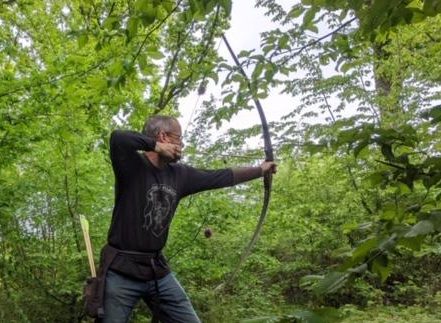
A walk with Roger
Some readers might recall I wrote a few “Walks with Rob” articles where I interviewed different archers about how they started, their motivation, set-up, etc. Well I thought I would produce another one, but this time as a virtual form as we aren’t allowed to physically wonder round our woods shooting due to the current pandemic.
So, without further delay I’d like to have Roger Massey introduce himself. For convenience my questions are shown in bold.
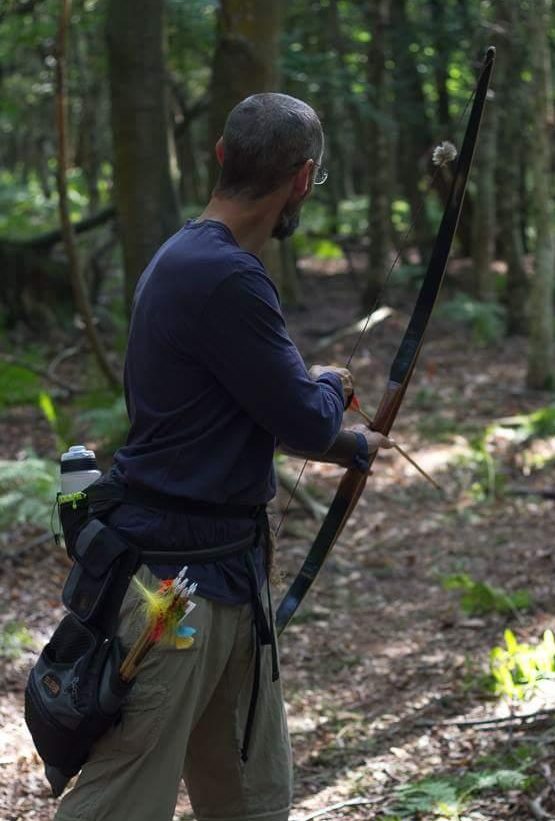
Roger preparing to shoot
Rob – For the readers who might not have heard of you Roger, how about introducing yourself?
I’m Roger Massey. I live with my family down near Battle in East Sussex and am totally addicted to traditional field archery. By traditional, I mean any kind of bendy bow without sights.
Two years ago, I got fed up with doing a job I had lost the passion for and so set up a small field archery focused business called 1066 Field Archery and now make and sell bows, arrows, strings and targets for a living. To be honest I think it was finding field archery that made me feel unsatisfied with my old job since I was so happy when I was out shooting in the woods with friends and just wanted to do more of it!
In terms of shooting achievements, both myself and son Jack have attended the National Field Archery Society 3D championships for the last 3 years and between us have managed to bag 4 Golds and 2 Silvers shooting either HT or AFB. Last year was a bit special since we both won Gold and it was done with bows, I’d made myself. Just for the record, the other two Golds are Jacks!
Rob – I think there are plenty of us who find archery a great release from working life. How long have you been shooting and how did you first get into archery?
I sort of stumbled across archery. I bought Jack what I would consider a toy archery set for about £12 and a hay bale and we had a go in the back garden. We were hopeless and struggled to hit the bale. I don’t often blame my tools but in that case the bow and arrows were useless and totally un-matched. Anyway, that experience frustrated me so much I signed us both up with an archery experience at the local archery shop. That was fun so I ended up signing us up for a 12 hr beginners course spread over 4 weekends. That course was horrendously dull and very slow. The material could have been covered in a quarter of the time including a 2 hour lunch break!
Anyway, whilst on the course I saw a field full of 3D targets and thought that looked like more fun than the boss we were repetitively shooting at 20 yards. Course over we returned home and I bought us both starter recurves and a 3D Zombie target and we just had fun pummelling that in the garden for a while. Realising there must be more out there I looked up field archery clubs and discovered there was one about 2 miles from the house called Archers of Battle. The rest they say is history, Jack and I joined the club, met some friendly members who introduced us to Senlac Field Bowmen which was another club about 5 miles from the house and we’ve been active members of both clubs ever since. I know it will surprise a few people to know both Jack and I only started shooting late 2015 so we’ve only been doing it 4.5 years. It feels a lot longer!
Rob – I think it is one of those hobbies that if you click with, then it becomes very addictive. Can you explain what your love or passion is that drives your interest in archery?
That’s quite a tricky one to answer. I guess it scratches lots of different itches for me. I had the initial curiosity of trying to understand why we were missing that hay bale 4.5 years ago. I then started making things and I do enjoy making things and understanding how they work. First it was arrows, then strings, then 3D targets and then bows! The feeling I get from shooting arrows I’ve made from a bow I’ve also made and consistently hitting things well is fantastic. Going down to the woods and shooting with friends is just part of it for me but it is a part I really love.
Rob – You’ve been putting out quite a few videos recently in the Facebook group (Traditional Archery Fellowship) on different archery topics. What was the driving force behind that?
I think when people start shooting, it’s very hard to find your feet. Field archery is a minority sport and there aren’t many places you can go to get really solid advice. I learnt a lot of good things from watching YouTube videos when we first started out and I was also lucky to have two very local clubs to shoot at which meant I could learn from others.
I really liked watching the videos on shooting form, improving technique, and useful hints and tips, and that is what I try to do in my short vids. I don’t like watching people being totally prescriptive in their advice and commerciality really switches me off. If I do include products in anything I film it’s because I really believe they are great and I’m trying to save people time learning from going down other routes!
In the early days I use to really enjoy Wolfie Hughes vids. The two archers I really enjoy watching now are Jimmy Blackmon and Jeff Kavanagh. Both are real quality acts. Alex Newness has also got a YouTube Channel called How2Longbow which also has some great material on it. In doing the videos I’m basically just trying to pass on useful info to people, and have a bit of fun myself!
Rob – So what are you shooting now? I’m sure people would be interested in hearing what your set up is right now? What kind of bow, poundage etc. Are you shooting ones you’ve made yourself?
I tend to flip around a lot with bows. I enjoy shooting lots of different bows and like the challenge of trying to learn a bow as quickly as possible. Some days I may start shooting one bow and change to shoot another. I actually struggle to shoot the same bow for a long period of time since I start to get a bit bored of it and hanker after shooting something different. The only time I stick with one bow for any length of time is in the run up to the 3D champs. For myself and many others in the NFAS, the 3D champs is the biggy.
I will usually decide on my set up in March and then try and focus on shooting just the one bow for a couple of months until the 3Ds. It’s quite funny, once the 3Ds is over I actually feel like someone has removed a shackle from my leg and I can go and play with other bows!!
In terms of what I’m shooting at the moment, the two bows I’m really enjoying are my 68” glass risered AFB. It’s only 37lb at 28” but is very swift. I made it from the Blackbrook Sigma bow form. The other is a bow I have developed myself called the Honey Badger. It’s only the 2nd bow I made from the form, having tweaked the design from the first one a little. Again, it’s only 37lb and I can shoot it all day and will be smiling most of the day. It’s a 63” carbon backed hybrid which falls into what I have heard referred to as the “super reflex” category.

Building the bows
Rob – I have seen some of the pictures you’ve posted on Facebook of the Honey Badger and it does look very nice. I have a couple of Blackbrook Sigma bows and enjoy shooting them immensely.
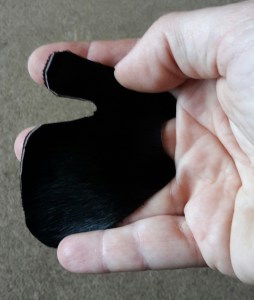
In terms of arrows, I enjoy shooting woods the most and always shoot with a mediterranean (split finger) loose. I’ve spent a lot of time trying to make my woods fly like carbons and am a big fan of bobtail tapering.
Rob – Matching your arrows to the bow are a huge factor that many archers don’t always get right. The difference when you do get it right are amazing. I’ve played around with tapering over the years, but find I now stick with parallel shafts. Have you changed your set up and is so how has this changed over the years?
A couple of years ago I was shooting a very fast 46lb Blackbrook recurve with woods but damaged my shoulder from shooting too much. I think I had a 12-day period where I shot every day apart from one!! It was in the run up to the nationals in 2018 and I was really on it. I still went but I hadn’t shot an arrow for the 6 weeks leading up to the National Champs but wanted to go anyway so I turned up with my sons old 25lb recurve and some arrows I had just knocked up. First arrow I shot was on the bosses on the first day! At the end of the two days I hadn’t done too badly and was only 36 points off a medal.
The whole experience taught me that I needed to look after myself if I wanted to be shooting a lot, and until I was very old, and that draw weight wasn’t that important for field archery.
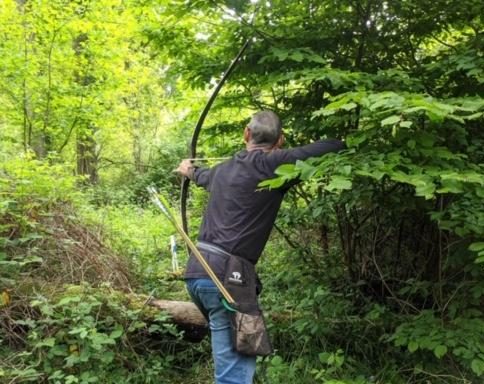
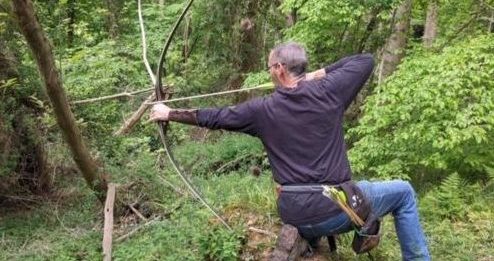
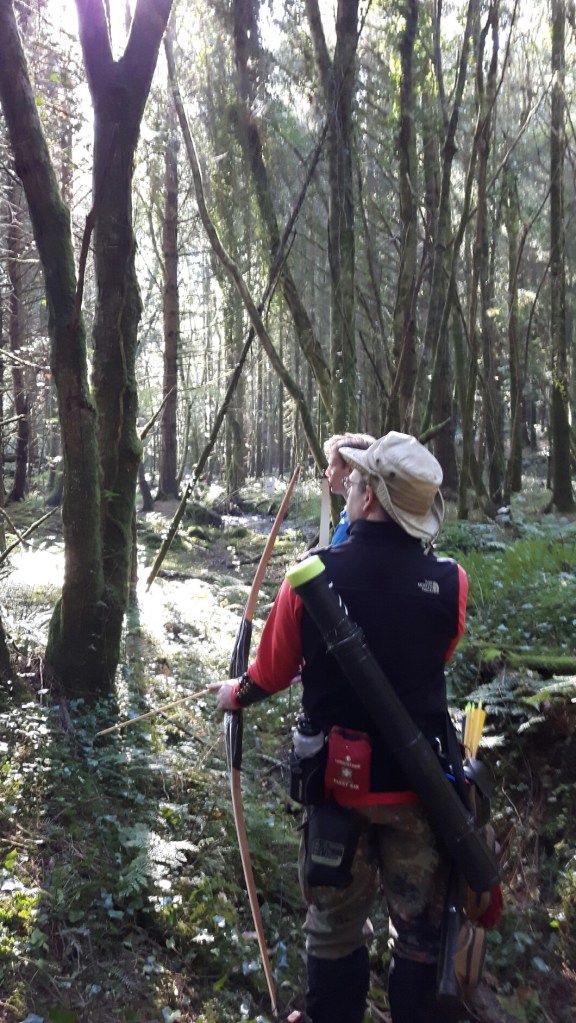
Roger shooting in the woods
Rob – I think there can be a bit of a macho element with some archers or the belief that heavier poundage equals better scores. In reality I have found its more about matching your kit and having the right mindset.
Rob – If ten years ago I’d have told you where you’d be today, how do you think you’d have responded?
I would have asked where I went wrong. I left University with a First in Maths and Psychology and then studied for 6 years to become a Fellow of the Institute of Actuaries. I then did a 2nd Masters degree and had a city focused career path. I now make bows and arrows for living. I couldn’t be happier than I am right now, but I definitely wouldn’t have believed you if you did have a crystal ball 10 years ago!
Rob – We’ve talked about your bows and bit about your arrows. From a shooting stand point, do you consider yourself an instinctive archer basing shooting on how it feels at the time, rather than a conscious process of steps which some people follow for distance judgement etc.?
I think the word instinctive is used far to often and means so many different things to different people. In terms of how I shoot, it is with both eyes open. For most shots, anything under about 40 yards, I have a little routine I know I go through but no longer think about (unless things start going wrong).
This starts with my footing feeling right, I then give a little tug on the string to confirm my fingers feel placed right and the grip on the bow feels right. I then raise my bow arm and draw fairly slowly and in a controlled way, always just focusing on the spot I’ve chosen on the target. I’m aware of the arrow in my sight picture but not consciously looking at it or gapping and when it feels right I loose.
Ahead of this I will have weighed up the lay of the shot but I don’t consciously try and work out the distance, I just know what the picture will look like before I loose the arrow. For longer shots I follow a similar routine but my arrow is much more prominent in the picture and I am very aware of it and the gap with the target. For very long shots where my point needs to be over the target, I will put the time in to try and estimate the distance and think about where I need to put the point of my arrow. Most archers do so few very long shots, that they have too few “long shot memories” to shoot instinctively and expect to hit a target well.
Rob – We all face our own challenges in life. What do feel has been the biggest challenge you’ve encountered to date with your archery? How did you overcome this challenge?
To be honest I don’t think I’ve really had any major challenge. I do go through periods of forgetting how to shoot well and have to continually re-learn things and when things aren’t going well, I do need to remind myself that it’s a hobby and should be fun!
Rob – I think we all have days like that.
Most of the performance issues with myself are either down to being too serious about my shooting or being too relaxed. I have to find that happy place where I want to shoot well but am not that bothered if I don’t. Leading up to the 3D champs in 2018 I was shooting really well and then had a shocking start to the first day. The first target (peg 13) was a long one and I went about a foot high and foot to the right but luckily hit a dinosaur in the head! 2nd target was another long one and I put two arrows about an inch over the back of a deer and heard them both snap and I never really felt relaxed for the entire day. 2nd day I found that really happy place, had a really nice shooting group, and the day went superbly. I only missed with one arrow all day and was only 10 points off the Gold. I probably haven’t been shooting long enough to have any major issues.
Rob – It’s interesting how a bad start to a days shooting can have such an effect on your entire day.
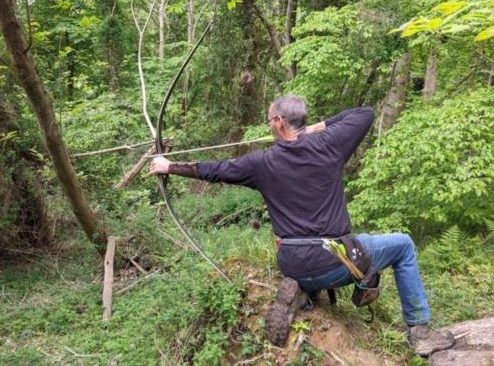
Roger shooting on the knee
Rob – I know there is more than just archery. When not out shooting or coordinating a national society what do you enjoy doing? Are you out walking or a secret foodie at heart?
Family life takes up most of my non-archery time. I enjoy woodland or hill walks, mountain biking and brewing. I use to ride and restore old motor bikes but they’ve taken a back seat since the archery came along. In terms of watching sport, the only sport I really follow is motorcycle racing – moto-GP, BSB, WSB and I like the proper Road Racing. I’ve been to the Isle of Man several times for both the TT and Manx GP and to Northern Ireland a couple of times to watch. I also read a lot. I’m not too fussy about what I read. If I like it, I’ll probably finish it within a week, and if I don’t like the first few chapters it gets put down.
Rob – You’ve talked about your early experiences, and beginners course. If you could reach every newbie archer out there with one single piece of advice what would it be?
If you want to shoot well then make life easy for yourself. Start with a low draw weight (20-30lb) trainer bow and some cheap carbon arrows and shoot with a rest. Learn to shoot reasonably well before you start thinking about shooting a harder style of bow like a Flatbow or a Longbow and stay away from wooden arrows until you’re prepared to spend the time learning how to make them fly well and keep them straight! That’s about 5 pieces of advice rolled into one paragraph!
Rob – That is some good advice though. I always find peoples answers to this interesting. I started with a 37lb recurve, which I know now was quite a high poundage, but I immediately knew I wanted to shoot wooden arrows. Within 3 months I’d started making wooden arrows and by 6 months I’d swapped the recurve for an old flatbow.
Rob – Thanks for your time Roger. If readers would like to get in touch with you how can they?
I’m always happy to help anyone interested in Field Archery with my thoughts and advice. Email is the best way to get in touch roger@1066fieldarchery.co.uk.
Rob – Thanks again and good luck with all the developments. I am really looking forward to seeing the honey badger bow.
As always thanks everyone for reading and stay safe, stay well.






 My Archery Experiences