image of Archer arrow speed check at recent shoot

Bow speed checks

At our recent club shoot (Briar Rose Field Archers) in July, we made the decision that we wanted to run speed checks on compound bows and crossbows, so we set up the club chrono.

For those of you unfamiliar with a chrono, it measures the speed of an arrow and under the NFAS the maximum speed allowed is 300 FPS (feet per second) as per the shooting rules. There is a 3% allowance for variance in chronograph equipment being used. This means a bow reading 309 FPS is still legal.

The chrono has a sensor at either end between metal V rods that are used to offer a guide to the archer as to where to shoot. The archer shoots over the top of the chrono, crossing the 2 sensors between the two V with their arrows. The archers shoot a few feet from the chrono into a boss as shown in the picture below, where you can see the chrono mounted on a tripod and the target boss beyond. It’s important that the chrono is set up level and there is sufficient light for the sensors to register the arrow passing above.

image of Archer arrow speed check at recent shoot
Archer arrow speed check at recent shoot

Anyone over the speed limit would be asked to slow the bow down or not be allowed to shoot.

There were a few interesting observations

  • All compounds and crossbows we tested were legal i.e. speed less than 300 fps.
  • The reaction and feedback from the attending archers were very positive, not just from those who were shooting compound or crossbows, but traditional archers shooting recurves or longbows. These were curious to see what speed their bows were producing.
  • It generated lots of discussion with some about how they might increase their speed. How the weight of arrows affects speed. How shooting light arrows increases speed but can damage bows and so on.
  • Several had never seen or were even aware of what a chrono is or why it’s important. Possible because they were shooting styles other than compound or crossbow.

The latter point is worth revisiting as unless you frequent national championships or 3Ds it’s unlikely you will have encountered one. Few clubs have them or if they do I haven’t seen them often at shoots. This raises the question of whether there are bows out there being shot that are exceeding the speed limits through no fault of the archers.

For those interested you can see the results of the Briar Rose shoot on the club website. Also wanted to say a special thanks to Rich Clarke who manned the chrono. You might know Rich from Archery Geek outdoors Podcasts.

Anyway, thanks for reading.

Archery Backstop Net

Archery backstop nets – some thoughts

In an earlier post I provided an overview of a few of the sort of things to consider when you are setting up a target boss. In this one I am going to talk about my views of backstop nets, including trying my hand at  busting some myths associated with them.
Backstop nets can be a useful addition to any range, but there a few things to consider about their use, so I will start with some mythbusting on the topic of backstop netting and what they can do.
A backstop net will stop the arrow. 
Not always. I shot a 11/32 diameter wooden arrow from my 45lb flatbow, which comes out at 180 feet per second. So it;s not as fast as an arrow off a barebow or compound bow, nor is it as small a diameter as a carbon arrow. Yet my bow has launched an arrow through backstop nets on more than one occasion and said arrow has travelled a considerable distance beyond.
The net, if hung correctly and in good condition may slow and possibly stop an arrow. Key words there are “hung correctly”, “good condition” and “possibly stop”. There are no guarantees.
Putting up a net make a dangerous shot safe. 
WRONG in so many ways!! If a shot is unsafe then adding a net isn’t going to suddenly make it safe. Nets are not there to make dangerous shots safe, they are there to reduce the risk.
Stretching out a net to cover as large an area as possible does not increase safety.
In fact it makes the net less effective as it needs to be both free hanging and pleated, much like a net curtain in the window. So if you have a 5 metre gap to fill you need a 10 metre wide net.
The more material the more likely it will slow an arrow.
It doesn’t matter if it’s trailing on the floor.
 Ideally you want the net to be free hanging and only just touching the ground so it can move slightly when the arrow hits, thereby absorbing some of the arrows energy. If the net is taught or lots of it is on the ground, then it won’t be bale to move.
Old  carpet work just as well. As someone who is using some old carpet as an extra layer of protection to stop arrows, it may sound strange to say old carpets don’t work. The truth is they don’t work as well a proper net. I use a double thickness carpet at the end of my range. The thing to remember is this is 60ft behind the target boss on the fence line. Before any arrow gets that far it has to go through 50ft wide copse of trees as shown in this photo.

Close up of Sharon shooting

Close up of Sharon shooting

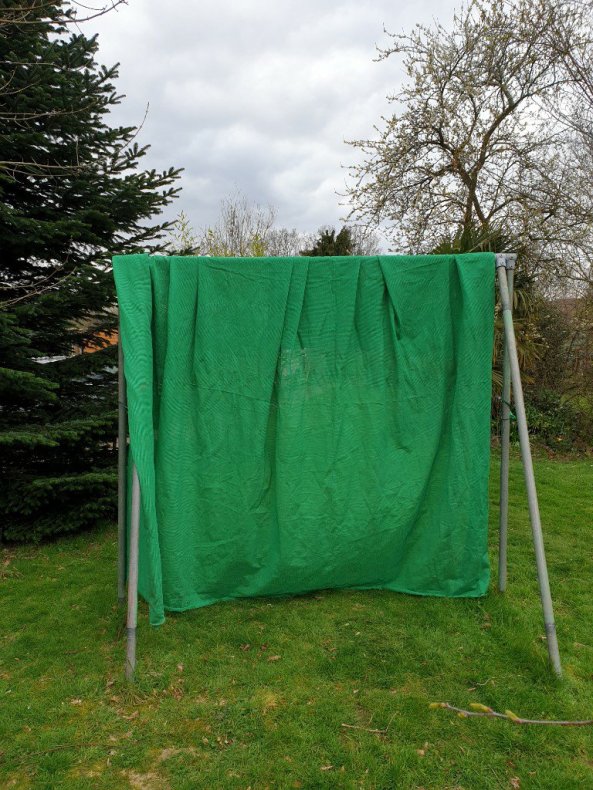
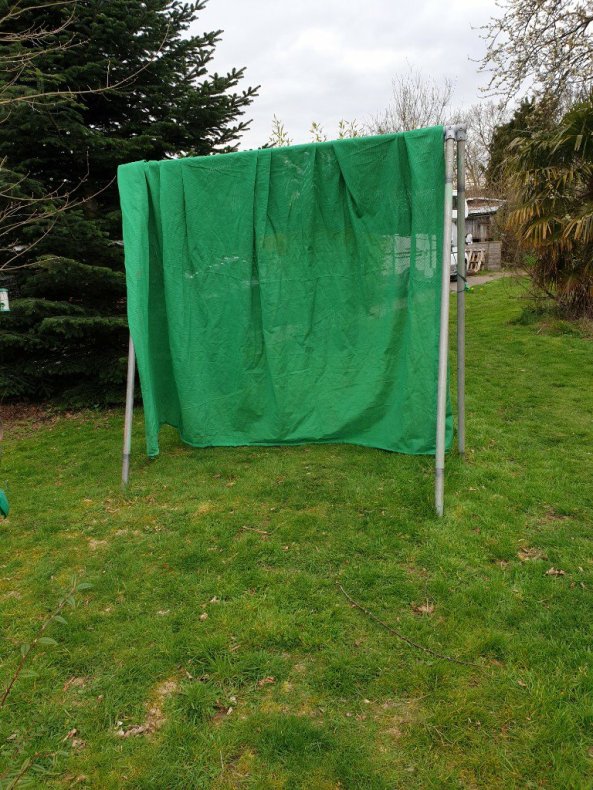
Lets have a quick look at a set up as an example. In this photograph we can see a net hung ready to be used. What do people think? Can you see any problems or issues?

Archery Backstop Net

Archery Backstop Net

Here’s a thought, what’s behind the net? You can see from the second photo there are vehicles behind so any arrow passing through the net is likely to impact one of the vehicles.

Archery Backstop Net - different angle

Archery Backstop Net – different angle

The other thing to consider is the net is strung up quite tight, with no pleats so any arrow hitting the net is likely to pass through.
By the way, this is not where the net normally hangs as I had just put it up to dry out after it being used on our clubs course the week before.
I hope this provides an insight into the use of backstop nets. It’s not a definitive list of topics but hopefully an eye opener.
Stay safe and thanks for reading.