
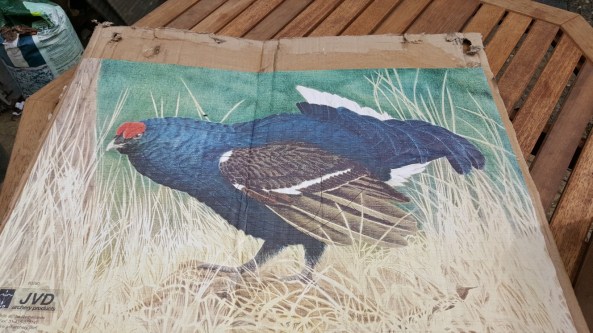
The number of different target faces for field archery courses is quite simply astounding, probably numbering in the hundreds when you consider the different suppliers. I’m not talking about the round ones of different sizes and colours, but those depicting animal targets. So the JVD, Merlin, Delta etc. Over the last 12 months the National Field Archery Society, here in the UK has designed and produced a series of its own target faces to fit their needs.
These new faces were designed from the outset to be suitable for the NFAS championships and available for clubs to buy. The results of all this hard work being a collection of 80 custom faces, across 4 size groups giving organisers 20 target faces in each size group to choose from.
These faces can be printed on either paper or a plastic like mesh, (more on the mesh later) depending on the clubs requirements. The target faces have been designed with individual scoring zones ideal for NFAS competitions covering wound, kill and inner kill.
Explanation of Scoring zones
It’s worth noting NFAS made the decision when creating these faces that they wanted to make the scorings zones in some ways generous whilst still being challenging. The result was a series of target faces where the wound lines are running round the edge of the animal, thereby making the possibility of scoring a wound significantly easier than with other faces, This means not only the head and body area scores but also the legs, something very different to many other target faces currently on the market. Having said this the kill and especially the inner kill is small, making it challenging to get an inner kill,
At this point it might be worth explaining how the most common NFAS field course round – The Big Game round is scored. Everything is shot over unmarked distances and no range finding equipment is allowed. The goal for all archers is to go round and hit the target with their first arrow. Something I have never achieved. Courses are usually 36 or 40 targets set at distances from 5 yards to 70 plus yards. Yes, I did say 5 yards. Courses are set mostly in woodland and unlike other societies who insist on clear shooting lanes NFAS course layers will use all the vegetation and terrain to disguise the distances and make for a challenging shot.
The shooting distances are the same for all genders, the only difference being the age of the archer. younger archers shoot from junior pegs. This means you could have a compound archer shooting from the same peg as a longbow or Olympic recurve.
When you hit, what you score is dependent on which arrow you first hit with. Therefore if you hit the target with
- First arrow wound is 16 points a kill 20 points inner kill 24 points, if you miss you go again.
- Second arrow wound is 10 points a kill 14 points inner kill 14 points, if you miss you go again.
- Third arrow wound is 4 points a kill 8 points inner kill 8 points. If you miss with your third attempt then you blank the target and move on.
The inner kill area only bestowing a bonus score on the first shot, after that point it scores the same as the kill zone.
On a personal note I would like to see the faces organised in a northern / southern hemisphere . This simple is because I prefer seeing target faces in woodlands I could imagine being present historically in the country. So wolves, bears, deer, etc I’m not a fan of a lion, zebra or hippo. This is an entirely personal point of view.
The faces can be bought from the NFAS website https://nfas.net/
To give you an idea of the cost a group 1 target, printed on the mesh is £9.76 and a group 2 is £8.66 (this is at December 2022)
The testing of the mesh
Over the past few months the field Archery club (Briar Rose Field Archers) I belong to have had some of these new NFAS target faces out in our woodland course, as well as using them for the open competition a few months ago.
The bison shown below has been out since our clubs open shoot and lasted really well. The target is on a 1300 mm x 1300 mm boss so you can get an idea of size.

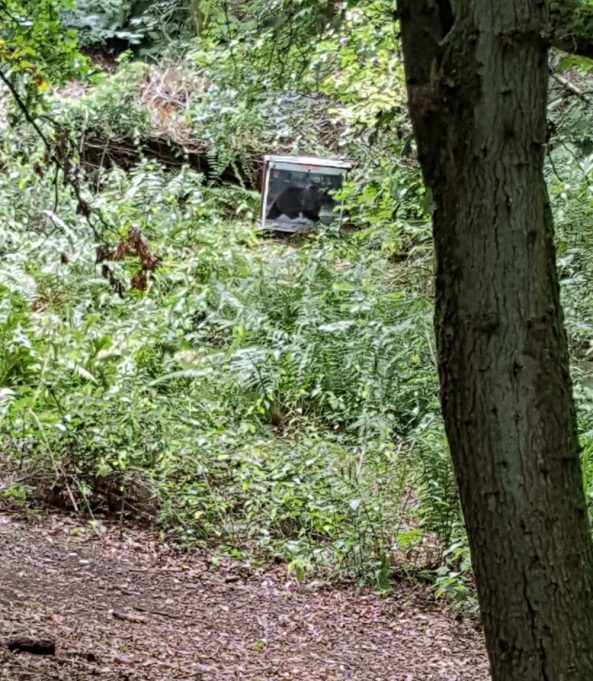
To give you an idea of what the target looks like from the shooting peg, I’ve taken the photo below. On the day of the shoot we had to fit a catching net at the back of the target due to so many people misjudging the distances. It is actually under 40 yard shot.

These target faces are printed not on paper but a plastic mess, which according to NFAS website can last several months or even a couple of years. It has certainly lasted a couple of months so far.

There has been a few discussions about the line colours being a little hard to see at a distance or the contrast being a little unclear on some faces.
The mesh has proved to be a lot more resistant to the wet weather we’ve been experiencing. Unlike some printed faces these mesh ones don’t seem to be eaten by slugs and snails. A big problem with some of the old JVD faces which when they get wet seem to disappear due to slugs and snails almost overnight.
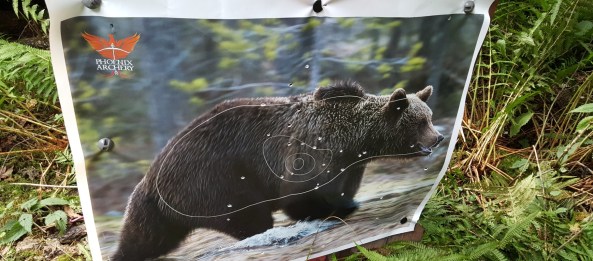
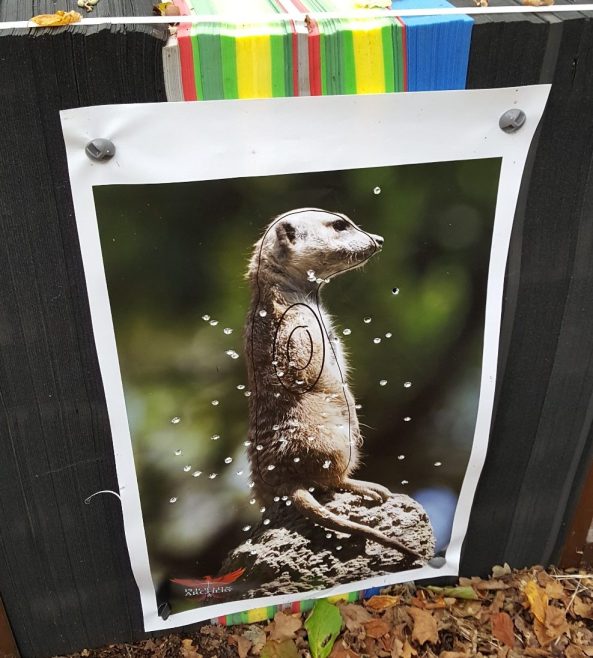
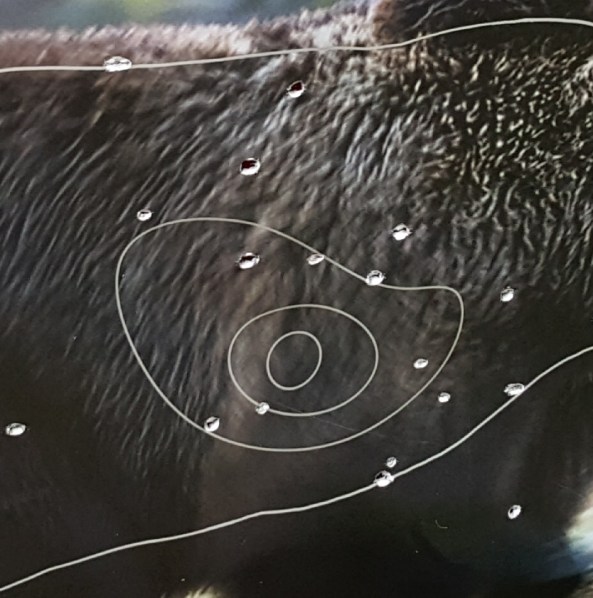
I’m reviewing the mess faces here, but you can order them printed on paper if you rather. Below you can see a closeup of the target face, showing the holes in the mesh. This highlights the only drawback with the target face we’ve found. Our experience has shown that the weave closes up pretty well for most arrows but some wooden arrows where the pile can sometimes snag when the arrow is drawn out. This can create a slightly larger hole, which is visible in the photo below. It;s not for all wooden arrows just those where there is almost a groove behind the pile, so not quite flush to the shaft.

I’ve recorded a couple YouTube videos available on my channel, showing a couple of the target faces we have been using at the wood.
One tip I’d like to offer anyone considering using these faces, is covering the target bosses with black fabric. This may sound a little strange, but consider this. Many target bosses are made up of layered foam, sometimes of different colours. By wrapping or covering the bosses you don’t see the different colours and said bosses are less visually intrusive in the woods. It also means when holes are made in the target face the brightly coloured foam is not visible. To keep costs down we use the weed suppressing material available online or from garden centres.
So are they worth the money?
At a time where every penny counts this is of vital importance for many clubs and individuals alike. I don’t think the mesh is worth it for small target faces (group 4) as I think they would be shot out too quickly. For our club where paper faces are likely to be eaten by slugs and snails, before they are shot out. Then yes there is a benefit. If you are looking for a target faces that is weather resistant and look good then they work well. I’ll freely admit that I was a bit skeptical originally largely due to the costs and concerns on how long they last but they have lasted well and still going.
It’s also nice to see some new faces, with very friendly wound lines. It might encourage more clubs to use paper faces. I think the 24 are small and could do with being a little larger. I don’t know if NFAS are going to add more faces over time, but that I think would be great idea.
Thanks for reading.





 My Archery Experiences