Aim small, miss small

Nice video by Jim Grizzly Kent about aiming and focus with archery, which is worth viewing.


Some readers might remember I wrote something a while back Aiming for the Fish’s eye

Thanks for reading

Shoot Report – Wolverine – March 2015

No shooting over Easter Weekend,which was a shame as the weather has been wonderful, bright warm and dry. This enabled us to finally set the range up in the field. A complete contrast to the previous week. With the clocks changing last weekend to British summer time, it was an early start for us on Sunday as we headed north to the Wolverine club grounds not far from Stoke on Trent.
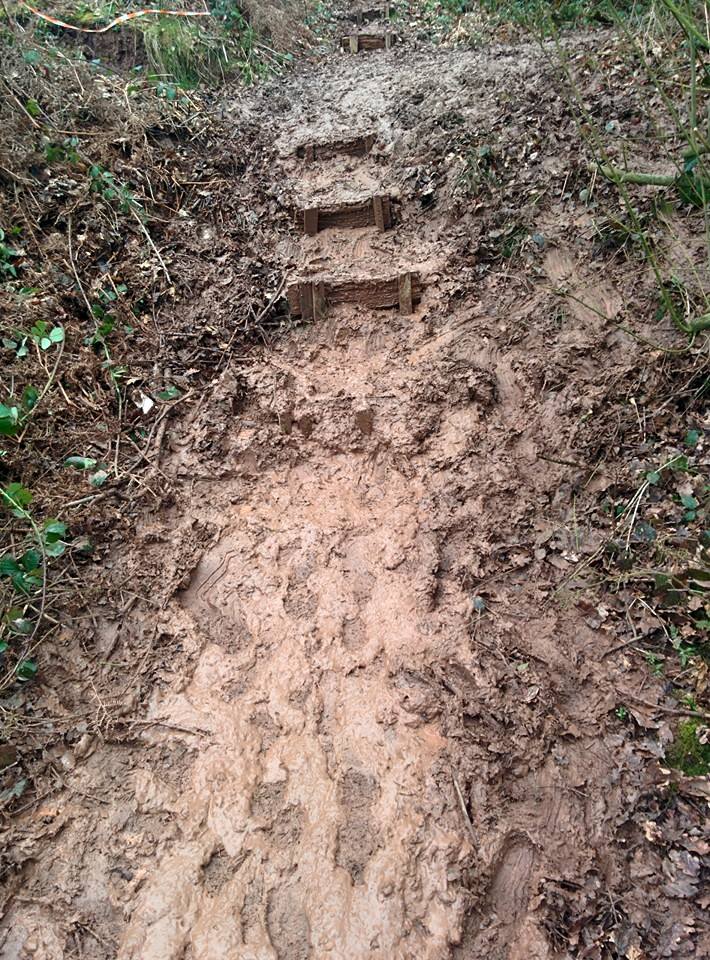
Anyone who attended the shoot will agree it was wet, very wet. I think it stopped raining for about an hour over the whole day. Added to this was the strong gusts which blew in and the Somme like mud in parts.
Despite the weather and mud Wolverine did their best to put on a good course.
The weather had a negative effect on the archery with scores for most classes being significantly down.
As for the course I thought it was overall good maybe not the best they have set as I  feel there were a couple of shots that could have had arrow nets or bosses up to catch stray arrows. This would have sped the search for arrows up for many. I  also think there were a couple of shots where the overshoots had not been fully considered. I don’t think they were unsafe but it is very distracting to see fellow archers collecting or searching for arrows in your peripheral vision when on the peg about to shoot.
The course was the standard mixed 3d and paper faces with a couple I think slightly stretched for the size of face. Our group was made up of the two of us, John shooting crossbow and Richard shooting freestyle. Overall it wasn’t too bad a course or day despite the British weather.
One entertainment feature of all the rain was watching a variety of cars trying to drive back up the entry slope. Of the several that attempted it only a couple were successful. Just to explain, Wolverine car park is in a field which you enter from a slope which tends to get quite muddy with all the traffic. Archers exit the car park from a different route, the only problem is due to the size of the car park, cars have to be parked in front of the exit, resulting in no-one leaving until the blocking cars leave. A few people decided not to stay until the end and tried to leave via the entrance slope.  The rest of us waited until after the end of prize giving and left via the exit route.
Neither of us shot particularly well and think it was lack of  practice and conditions.
Sorry there aren’t any photos of the course, but with the wet weather I had my phone buried under lots of layers to keep it dry. I did get a copy of a  photos from a friend and fellow SVYF member showing the muddy paths.
Muddy Path

Muddy Path

The video is a bit of fun and shows a friend of ours trying to get up the bank.
Thanks for reading.

Question from a reader – Improving grouping

Last week I posted a response to a readers question concerning aiming and focus. This is  the second part of my response and in this I will try and address another question
I practice very very much and I can not reduce the diameter of my groups
I know this feeling all too well and I used to spend hours quietly practicing at the range at Black Arrow and now at home.

Reducing the diameter of the group comes with practice. Lots of practice in my case. It takes time and consistency in equipment and techniques.
Here are a  few tips I’ve picked up along the way. I  hope they help.

Know your Equipment

If your equipment is not consistent then you have a constantly changing variable to any practice you undertake.

If you shoot a takedown recurve each time you dismantle and reassemble your bow you run the risk of accidentally changing settings. Whether this be the bracing height or dropping twists in the string. So take care and time to make sure everything is right. I have found a camera phone invaluable aid for checking brace height or nock position. Set the bow up, making sure everything is right  and then take a few photos of the bracing height, nocking point etc. It provides you with a quick easy to check reference.

Photo of recurve set up

Photo of recurve set up

If you do change anything make sure you change one thing at a time. However if you change bracing height you might need to immediately change your nocking point as well.

Weather can play a part on equipment too. Traditional English longbow archers will tell you that in warm weather the bow will behave differently to when it’s cool.

Arrow weight and quality

  • Are all the arrows you are using straight and in good condition re nocks and fletching wear?
  • Do they weigh the same?
  • Do they really have the same spine?

I had one student who was struggling with grouping and when we weighed his arrows we found a huge weight variation which explained his issue at longer distances. Additionally, the spine shown on the boxes of wooden shafts  can vary, (in some cases we have found a 20lb variation in a single box that is theoretically ranged within 5lb.) This can be caused for a number of reasons from storage to temperature.

A good idea is to number the arrows and note where they hit. That way if you find one that always goes left or drops short you know it’s the arrow not the archer. I also make a note on each arrow how much they weigh in grains and match shooting sets of the same weight. (Definition of Grain)

This is obviously more of a problem with wooden arrows than with carbon or aluminium arrows.

Equipment consistency is easy compared to archers.

Are you consistent in draw, anchor and release?
If you aren’t being consistent here then getting a good group is impossible.
Light is right and going back sometimes to a lightweight bow means you can focus on draw, release and overall technique.

Take your time between shots don’t rush to shoot as your muscles take time to recover after each shot.  A rushed shot is seldom on target but can often infuriate you.

One technique I use is to start at short distance say 5 yards. And focus on bringing the group in. I then move back 2-3 yards and work on grouping at that distance.  Gradually you move further back. This builds an image bank in your brain of where you should be at different distances. I would practice at, 5,7,10,13,15,17,20,23 and  25 yards shooting 3-6 arrows. Not until I would get at least 5 arrows constantly in a group of 3 inch diameter would I move to next distance. This took months of practice and patience, lots of patience and quite a few replacement nocks. Some days I would shoot 40 arrows others 120 depending on how I was feeling and whether I could focus on the practice. no good practicing if you aren’t focused.

Jim Grizzly Kent recorded a video for YouTube a while back on cup shooting which is another good practice technique.
 Finally, if you can get a friend to video you shooting this might help identify any inconsistencies that you have (once you get past being self concious of being recorded). I am thinking of doing an article on the use of video in the near future.

I hope this helps once again thanks for reading.