3D Deer between the trees

Continuing the New Year goals

The woods

The woods are calling

In my last posting I wrote about the setting of New Year goals and how you could start to monitor your progress as you develop in your archery life. In this post I’d like to take this a little further and explore some general advice along with some metrics beginners or experienced archers may consider suitable.

Poor equipment = poor shooting

First thing you can do is to get your equipment right, your bow, glove, tab, arrows etc. Now this doesn’t mean going out and spending a small fortune on the latest carbon arrows of only 6 grains per inch or new bow limbs that promise to launch your arrows even faster. It is about getting what you have working the best it can. As my old coach told me “Learn to shoot the bow you have.

Every archers knows that having confidence in your kit helps in your shooting. If you are worried that the bows not performing or just ignorant of possible problems, it’s unlikely you’ll be consistent in your shots.

With my coaching hat I’d like to give you an example of how not knowing your kit can have an effect on your shooting and make you doubt yourself.

Many years ago I was asked by a newly signed off archer why he couldn’t get a grouping at a distance past about 20 yards. So we wondered down to the range and I got him shooting at a few distances, asking him to shoot each arrow exactly the same, adjusting just for the distance but not for the flight of the previous arrow.

His form was fine and his bow set up was correct with the appropriate brace height, etc. I noticed his line was fine but some arrows flew high others low. He’d bought the wooden arrows from a local stockist as he’d not yet started making his own. I asked if he’d checked the mass weight of the arrows. He hadn’t, so we dug out my grain scales and measured them. When we did we discovered that of the 8 he was shooting there was approximately 90 grains difference, with the other 4 talking the range up to over 100.
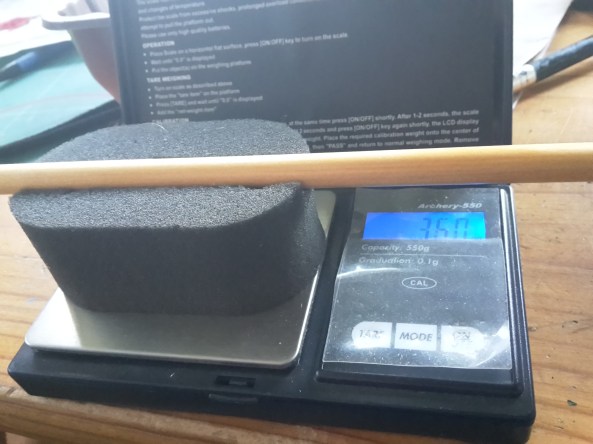
Grain scales with sponge

You can’t hope to get a consistent grouping if all your arrows are different weights. This is why I spend time matching the arrows I make, I try to match arrows both in mass weight and spinning for mine and Sharon’s bows. (Quick call out to Marc at longbow emporium for a great matching service in arrow shafts)

QUICK TIP – A useful tip when setting up your bow is to use your mobile phone camera, to  photograph your brace height or button settings. This way you have a pictorial record you can use when setting up your bow, arrow rest, replacing the string etc.

Photo of recurve set up

Photo of recurve set up

Club ground – the Good and Bad points

There is no doubt that practise is important, in fact it is very important. For this reason I think it is worth mentioning the merits and flaws of club practise grounds and trying to use it to judge your progression and development.

So the good part of having a home course is pretty obvious, it gives you a practise area that is relatively static and unchanging day in day out, meaning you can judge your progress, week on week. You can go back to a target again and again until you get it right.

I always remember in my first club, where there was a deer 3D that I always struggled with and I would go back and shoot it again and again.
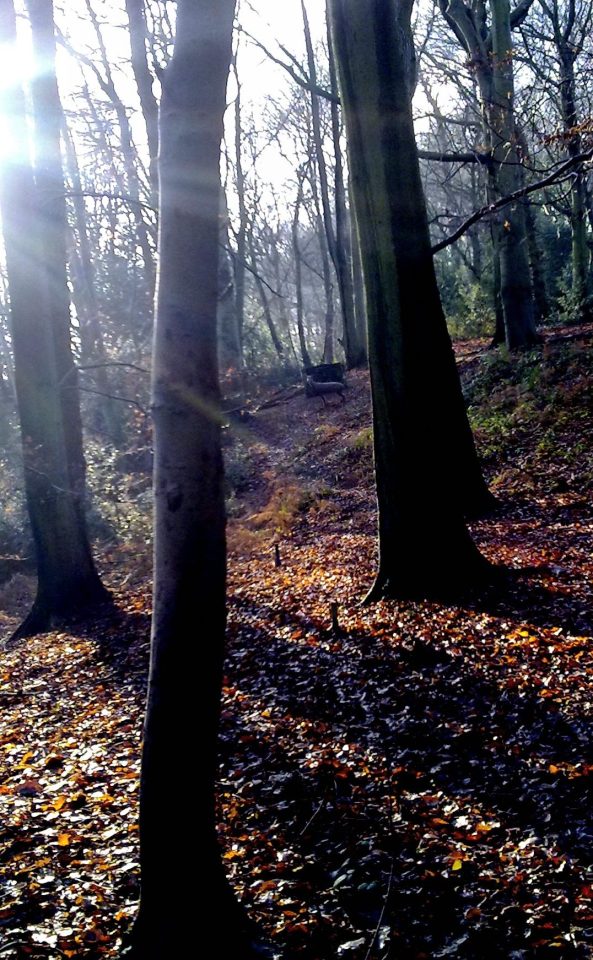
3D Deer between the trees

3D Deer between the trees

The downside of practise on the same ground can be you end up shooting targets on a sort of autopilot as you’ve shot it so many times before you don’t appraise the shot as you would or should if presented for the first time at a competition. In essence you shoot the shot from memory and in turn it becomes too easy, as you don’t spend the time to read the ground or judge the shot.

One technique you can use to keep the course shots fresh is to shoot 3 arrows at all the targets, even if you hit with your first. So for an adult you would shoot, one from the red, white and blue pegs. This is a technique I have used for several years at club grounds and found it works for me. It forces me to keep testing my distance judgement and makes me adapt as I’m moving from one peg to another. It also builds your stamina in your muscles as you are shooting more arrows. I’ll cover more about physical fitness in my next article.

Competition Courses and Base lines

Ok so you have been shooting at your club grounds and you now want to go out to try other clubs and enter a few competitions. Maybe there is a group of you and you’ve been to a few shoots but not sure how you are doing. Thing is how can you judge how you are doing when you are at different courses? Sure you can look at your score and if it’s higher than your last shoot you are improving right? Well maybe, maybe not.

Due to the nature of the NFAS, the club courses you shoot change over time, year on year.  In fact this is somewhat expected by archers. A club that doesn’t change its course can often receive negative comments from some like “It’s just the same as last time” or “They haven’t bothered to change the course from last time we shot it”.

On courses that do change you can shoot the course one day and score over 500, but the next time you return to that club, a few months later, it might be a different story with a changed course. There will be different targets and distance, the result is you might score more or less. This means it can be very hard to accurately judge your own progress when you revisit a clubs grounds.

So what can you do, to judge how well you are shooting?

As courses change it can be a good idea to identify some kind a base line for comparison. One method is identifying one or two people, ideally shooting in the same class as you and track their scores in comparison to yours.

A second method is keeping track of the scores of the archers who came in first, second and third in your class, this can help to give you an idea of what is possible. Often the placings and scores are posted on the hosting club or NFAS website.

One very important point to remember here when talking about scores and is equally important, whether you are newbies and experienced archers alike is DON’T get disheartened when you may have scored 300 and the winner scored 600 plus. Check the scores of other people, and the 3 placing. The winner might have got 600+ but the person in second might have just over 500 points. The winner might be on top form and had a personal best, so it is important to try and get the bigger picture. I can assure you this method of tracking can help and Sharon always looks out for the gents scores in American Flatbow when at a competition as there are more male archers in the class than female. She used to track the gents in Hunting Tackle when she shot that style.

A third method is to track your average points score, based on your total score divided by the number of targets. When I first started shooting several years ago my aim was to get an average per target into double figures and being really happy  with my average started going up from 8 points to 9 and then 10. When I broke 400 on a 36 target course, it was great. Several years later, with a lot of practise and shooting day in day out, I now have different objectives. I hope to get 16 point average on a course. The advantage of using this method is it can provide you with a baseline comparison of progress for a 36 target or 40 target course.

I have learnt that these averages will vary dependent on the club I’m shooting at, as now with a little more experience I know that some club courses are more challenging than others. Other facts like the weather on the day, or whether it’s a slow day with lots of holdups all plays a part.

The important thing to remember and this will sound a bit corny so sorry in advance. Your life in archery is a journey and it takes time. You will have good days, you’ll have great days and you will have bad days, just don’t rush it or beat yourself up over it.

Last Tip

Don’t worry about what others are scoring. What! You just said for me to track the scores of first, second and thirds! Or work out my averages. Yes I said that, so you can get an idea of how tough the course was, but while you are shooting forget about it.

Go out and do these two things

  1. Enjoy yourself; you are out in the woods, shooting a bow, hopefully in good weather and company.
  2. Shoot your shot when on the peg, with your bow. Don’t be thinking about anything else, just your shot.

One of the reasons I love archery is it offers you the opportunity to compete against myself, yes you can compete against others true, but for me I’m there to shoot my bow the best I can and to make the best shot I can. If my arrow lands where I want it to, whether it’s the top scoring area or not, I’ve made my shot.

Ok, so in the last article in this series I am going to be looking at resilience physical and mental, along with shooting form and technique.

Thanks for reading

Instinctive Archery – is that the right description?

Sharon on the range

Sharon on the range

Lots has been written over the years and probably will be for years to comes on the theory of what instinctive archery is. Often the authors of articles or books try to define what they view as instinctive shooting, this means there are countless definitions on YouTube, the net, archery books etc. these range from subconscious gapping to shooting without thinking. Many archers question if there is actually anything that is truly instinctive about it.

I recently watched a YouTube video by Jim Grizzly Kent (https://www.youtube.com/watch?v=rDCldJ_YqMk&t=2s) and he used the phrase intuitive archery and this stuck with me.

The reason I think it did was a couple of days earlier I’d been helping a friend who gap shoots set up his bow. He’s recently had to drop his bow draw weight due to an ongoing shoulder injury and had bought some new limbs of a different and lighter poundage to his old ones. Since we have a range which allows archers to shoot back to 40 yards plus it seemed a logical location to help him get himself sorted.

I was watching Steve shoot, noting the arrow flight, release, noting down where the arrows fell for each shot. All starting at 5 yards and moving back in increments of 5 yards. I’d give him feedback on whether I saw him throw his arm or not get a clean release on the shot which would give a false reading etc.

view of the range

view of the range

Just so you know Steve shoots barebow under the NFAS banner, this means he is not using a sight on his bow, but can use metal or carbon arrows. In Steve’s case he shoots carbon arrows off a very nice Andy Soars Black Brook take down recurve bow.

During the process Steve explained how at 5 yards he would be aiming say an inch or so below the spot, then at 10 yards it might be half inch below, 20 yards it might be point on. This went on all the way back to 50 yards, with him shooting three arrows at each distance, then taking a break before shooting another three. With me noting the distance and observing his form on each shot.

It was as he said at this stage a very conscious process of working out and focusing on aiming but as he said. “The more familiar I become with shooting the new limbs, the less conscious the aiming will be. I’ll stop having to think I need to be 3 inches above”

For me it was interesting for two reasons.

Firstly from a coaching perspective, hearing how he explains his approach and process, along watching him execute this shot. Steve is very good at explaining his shooting cycle and stages.

Secondly from an instinctive archers viewpoint it was interesting to hear his explanations of how he gaps and works out how to aim or rather where to aim.

One advantage to this process of shooting Steve highlighted was it gives the archer a fall back plan if for any reason they to take a break from shooting due to work / life / health reasons. Their gaps will remain the same (so long as the arrow specs, draw dynamic and limbs are the same). The downside of this technique I’ve been able to identify cover consistency of the archer or equipment. Like all archers you must ensure you can perform your shoot cycle consistently.

If you change your arrow spec this may and probably will affect your gaps as a heavier arrow would fall faster so for longer shots you’d aim higher.

From my viewpoint

Whilst I don’t gap shot I do know that when I shoot I try and do a couple of things.

On longer shots I try to envisage the arrow flight to the target. How it will climb and fall hopefully into where I’m wanting it to land.

Shorter shots I know how it will appear in the target as if by magic. A friend when he saw me shot once said you don’t anchor you draw up set and release in one movement, which is something I know I do when either at short shots or when I’ve been practising a lot and on form.

I know when I stop shooting for a couple of weeks or longer then my eye, subconscious distance judgement, instinctive aiming  or whatever you want to call it goes and I feel I’m a bit rusty.

Anyway I thought some of you might find this interesting, have a look at Jims video and a read of the different authors thoughts on instinctive and a gap shooting.

Thanks for reading.

Bows, bows and more bows

What bow is good for a beginner archer?

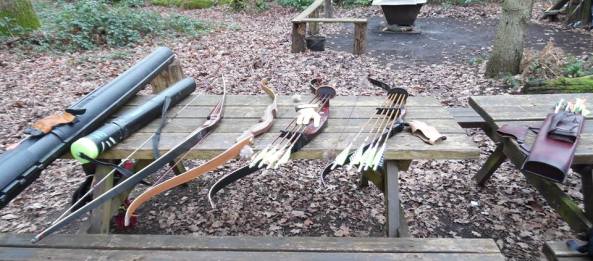
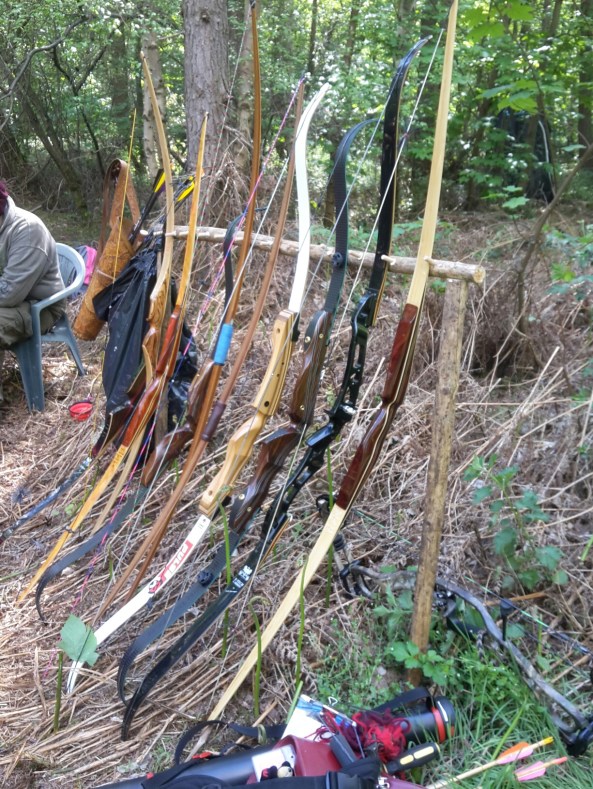
Selection of bows

Selection of bows

This is a question that most archery coaches are asked at some point by their students.
What bow should I should get?
Like all good answers it is both simple and at the same time complex. In simple answer terms, it should be a bow that works for you. Knowing what works for you is the difficult part. So here are a few thoughts that might help, I hope you find them useful.
Buying your first bow is such a personal decision for anyone to make,  it is very hard for me to say buy this bow over another. Each of us is different, for that reason I have to say it is up to the archer which bow they choose. But, yes there is a but, I will  try and give some advice on what to look out for and to consider when buying the bow.
When I can I tend to go with my students to the archery shop when they want to buy their bow, so they can ask advice or my opinion. Also it is so I can be sure they get good service, not something that is a problem with good archery shops.
So for your first bow I would suggest you go with something that will develop with you and give you the opportunity to develop and not restrict you. Ideally you are looking for something that is not too heavy a draw weight so you aren’t over-bowed and not too heavy in the hand that you you struggle to hold it.
You want to have a bow that can support your development.  Sadly too often I have seen new archers who have bought a bow and then found it to be too heavy a draw weight, too demanding to shoot or even the wrong hand.
sharon - old bow

Sharon – shooting her first bow

For this reason I would tend to point archers to a basic take down recurve bow initially. Why?
Well I believe there are a number of advantages of this type of bow for a beginner.
  • Entry level take down recurves are relatively inexpensive as bows go, being about £65 to £85 depending where you get them.
  • You can up bow draw weights if you want too as your muscles develop. On this point I’d like to say you need to watch the draw weight though, so you don’t buy too light a limb and have to change them within a few weeks, but then don’t go to heavy that you strain. A good coach or shop will advise you as specifics vary for individuals. My students have ranged from 18lbs to 28lbs. My first bow was 32lbs but I had been shooting around that weight of club bow for several weeks and knew it was comfortable.
  • One piece bow or take down recurve. You can’t change the limbs with a one piece bow unless you buy a whole new bow so buying a one piece might not be the best investment for a starting archer.
  • Take down recurves tend to be pretty easy to shoot allowing the archer to develop an understanding of what is involved in archery  and bow set up.
  • It  is worth mentioning entry level  take down recurve bow maintenance is pretty straight forward too and allows a new archer to learn how to maintain their bow.
  • It also allows them to  develop good form as pretty easy bow to shoot compared with flatbows or British longbows.
Swapping limbs
It is worth remembering that not all manufacturers limbs fit all other manufacturer bow risers and it is something that can be an issue when looking to upgrade limbs. The limbs can be too wide or the screw thread alignment might be different.Unless they are ILF limbs and riser (i’ll cover that later)
A piece of advice I give some is not to trade in your old lighter limbs when you upgrade to a heavier draw weight. Some shops offer a discount if you do this but I would suggest you keep them as sparer, which you can go back too should you need too. Say after a break from archery due to holiday,work pressure or I’ll health.
Limb pocket and bolt

Limb pocket and bolt

So what is ILF?
ILF – stands for international limb fitting. ILF limbs are a standard design which bow manufacturers produce to. This allows ILF bows risers and ILF limbs to be quickly and easily swamped between bows so you could have KAP limbs on a Samick riser. Or Samick limbs on a Sebastian flute riser and so on.
By the way, for those interested there is something called a Warf bow. Nothing to do with the character from Star Trek, he was Worf.
A Warf bow is one made from a compound riser, but been modified to house ILF limbs.
There are some downside of these beginner bows.
  • The limb weights tend to be limited from about 18lbs to 32lbs.
  • The basic take down bows limb performance is limited as the limbs aren’t that high performance, tending to be made of wood, rather than carbon fibre etc so they don’t have the same speed.

So this is a brief overview of a few things to consider. I hope this proves helpful and as always thanks for reading.