Range Set up

I’ve had a few discussions recently about range set up and how I’ve set up our range. I thought I would share how my range is set up to support both marked and unmarked distances practice.

We as a club don’t have any indoor facilities so our range is outdoor and this means we need to consider how it can be used all year round. Currently all the trees are in full leaf, but in winter months it can be quite cold.

Range image

We have only 2 bosses unlike other clubs that have several. These are in static positions, meaning we don’t have to set them up each time we want to use them. There are only 2 due to the space available.

These are arranged in 2 shooting lanes.

Each has a 60 ft overshoot behind, which enters into a small cop of trees, with catching mats at 30 feet behind each boss in the trees. These catching mats are sections of old carpet hung to act as a simple arrow stop. Beyond the 60 ft overshoot there is a 30ft high earth embankment. Most of the time arrows don’t reach the backstop mat but they are there just in case. If necessary, I can rig a backstop net between the trees, though I’ve found this seldom necessary.

The 2 shooting lanes are set up near parallel to each other with approximately 10 yards apart at boss end and 15 yards approximately at the furthest shooting pegs.

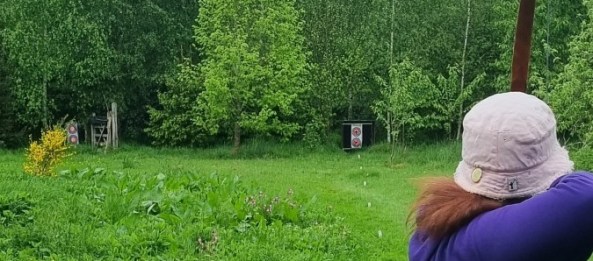
One shooting lane is marked and pegged at 5-yard increments for archers to develop their eye for fixed distance, to calculate their gaps or set up their sights. This is the one shown in the photograph above.

The other is unmarked distances with coloured pegs used by NFAS adults, so red, white and blue. You can just see the target boss beyond the yellow shrub in the above photograph. These are set to use the available ground and vegetation to simulate what you might encounter on a shoot. So, the red is by a tree, which forces the archer to adjust stance to avoid branches as they draw up. The white is on a small mound of earth so the forward foot touching the peg is higher than back foot. This helps archer develop their stance and balance on uneven terrain.

The blue peg is in the open but with trees between the peg and target giving an optical illusion on distance.

Periodically I move these coloured pegs slightly so they are slightly different. So, I might move the white peg forward, resulting in the archers back foot now being higher. This ensures archers don’t get complacent.

The coloured pegs are not set at 5-yard distances so the red is around 33 yards, white 27 and blue 21. This is deliberate again, so not at 20, 25, 30-yard distances that they might have practiced on the marked distance.

This has proved to help archers who want to get these gaps in and then practice unmarked distances with feedback being positive.

I hope this helps, thanks for reading.

Scoring in NFAS paper faces

I’ve recorded this brief video following a few discussions on how scoring for NFAS (National Field Archery Society) Big Game round works. Along with what the different scoring lines are.
I know the audios not perfect and if I do others in the future it will be something I need to look at in more detail, but in the meantime let me know what you think.
Thanks for listening

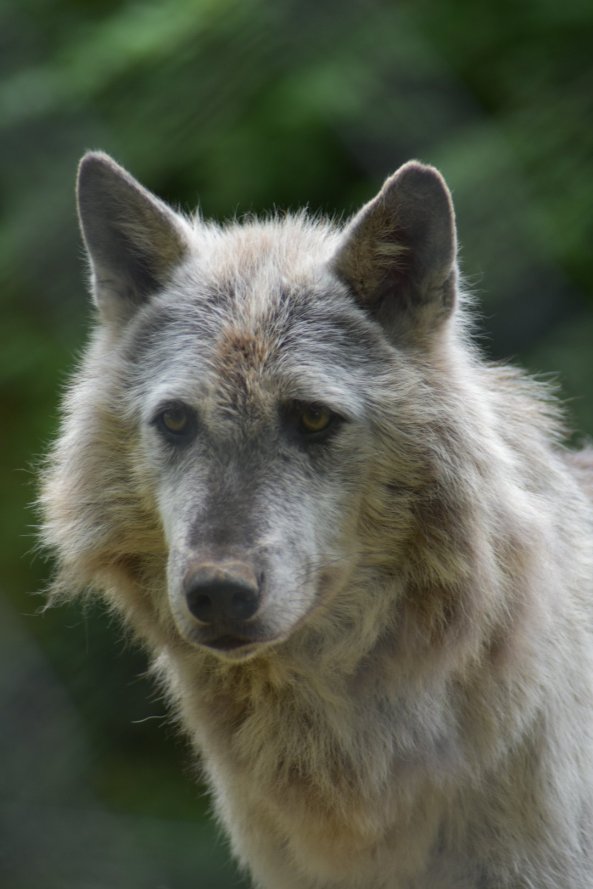
Old wolf

Original rule of 6 had nothing to do with COVID-19

Old wolf

old wolf – just because I like the photo

It was a concept I think I heard of years ago and think it was north American Indian culture from memory. though I may well be wrong. It was concerning looking at something, a problem or concept and identifying 6 possible reasons, outcomes or possible rationales for actions. Effectively expanding your understanding and perception of the activities

So, if you take this onboard I have found it very useful when looking at computer systems, working processes and from coaching. Some of the ideas might be pretty straight forward or sensible others might be more out of the box, but it is a good exercise to broaden your perspective.

To give you an example of what I mean let’s look at why someone might post something on Facebook or a blog

  1. To share their thoughts / experiences – we are social creatures and some like to share ideas, concerns and thoughts.
  2. To be seen as knowledgeable in an area – possibly when talking about specific topics or theories, often something seen in work places.
  3. To building their fan base – you see this with internet social influencers, they wish to boost their own presence or perceived standing online or in the specific area, whether they have knowledge in the area or not.
  4. They might be trying to build self-confidence – COVID-19 has seen an impact on the mental health of many and some might find posting on social media or other sites help boost confidence.
  5. Doom bringers – some come across as always wanting to be negative and pull everyone down, destroy ideas.
  6. Like to hear own voice – possible gregarious and like talking and expressing views on everything.

As I have said I have a tendency of doing this, I would say almost naturally in that I do try and look at things from multiple angles, I think partly due to my struggles with health and education over the years, from childhood and onward. I have found this approach useful when coaching archery and in my working life.

So why am I talking about this?

The last few months have not been easy for many people and the new restrictions of group sizes due to arrive on the 14th of September in the UK, local lockdowns, return to office work after working from home, and more  is affecting lots of people so my example 4 of self-confidence is possibly even more important.

Lots of people are struggling with their stress levels, physical and more importantly mental health. I know personally I have been and am struggling a bit, probably more than a bit, if I am truly honest. I miss being out and about in woods. I really miss the coaching and social interactions that come with helping people. I think that was one of the instigators of me starting the podcasts in an attempt to reach out and support people.

I started this site and more recently podcasts to share thoughts and experiences, not to be seen as knowledgeable or expert,  as the one thing I have learnt is the more you learn, the more there is to know. I have no interest in being a social influencer and despite what some think I don’t want to be negative or enjoy hearing my own voice. Yes, I often see the possible problems but this is because I want to be aware of them and have counter measures, plans or ideas to overcome them. A problem shared is sometimes a problem halved as others contribute to the solution or offer support.

So, next time when you read something, hear something or have a problem to solve, take a moment and try to note down 6 options. You might not be able to come up with 6 initially, but over time you will find you broaden your perspective. You never know it might help.

Stay safe, stay well and thanks for reading.