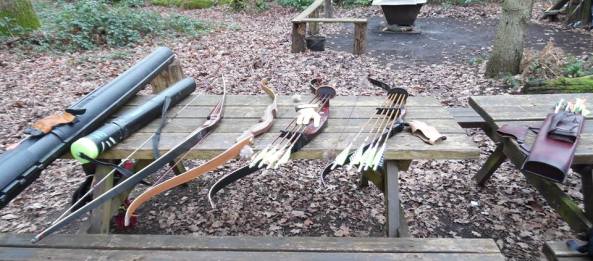
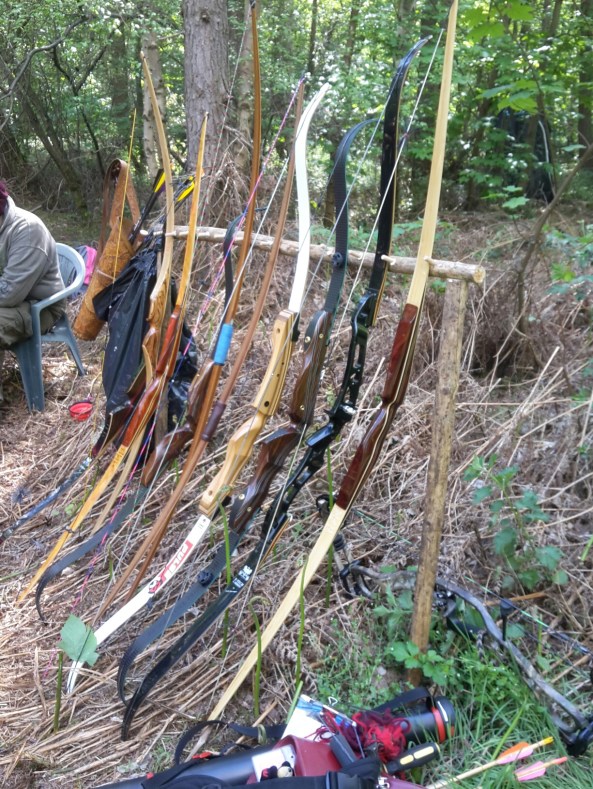
Bows, bows and more bows

What bow is good for a beginner archer?

Selection of bows

Selection of bows

This is a question that most archery coaches are asked at some point by their students.
What bow should I should get?
Like all good answers it is both simple and at the same time complex. In simple answer terms, it should be a bow that works for you. Knowing what works for you is the difficult part. So here are a few thoughts that might help, I hope you find them useful.
Buying your first bow is such a personal decision for anyone to make,  it is very hard for me to say buy this bow over another. Each of us is different, for that reason I have to say it is up to the archer which bow they choose. But, yes there is a but, I will  try and give some advice on what to look out for and to consider when buying the bow.
When I can I tend to go with my students to the archery shop when they want to buy their bow, so they can ask advice or my opinion. Also it is so I can be sure they get good service, not something that is a problem with good archery shops.
So for your first bow I would suggest you go with something that will develop with you and give you the opportunity to develop and not restrict you. Ideally you are looking for something that is not too heavy a draw weight so you aren’t over-bowed and not too heavy in the hand that you you struggle to hold it.
You want to have a bow that can support your development.  Sadly too often I have seen new archers who have bought a bow and then found it to be too heavy a draw weight, too demanding to shoot or even the wrong hand.
sharon - old bow

Sharon – shooting her first bow

For this reason I would tend to point archers to a basic take down recurve bow initially. Why?
Well I believe there are a number of advantages of this type of bow for a beginner.
  • Entry level take down recurves are relatively inexpensive as bows go, being about £65 to £85 depending where you get them.
  • You can up bow draw weights if you want too as your muscles develop. On this point I’d like to say you need to watch the draw weight though, so you don’t buy too light a limb and have to change them within a few weeks, but then don’t go to heavy that you strain. A good coach or shop will advise you as specifics vary for individuals. My students have ranged from 18lbs to 28lbs. My first bow was 32lbs but I had been shooting around that weight of club bow for several weeks and knew it was comfortable.
  • One piece bow or take down recurve. You can’t change the limbs with a one piece bow unless you buy a whole new bow so buying a one piece might not be the best investment for a starting archer.
  • Take down recurves tend to be pretty easy to shoot allowing the archer to develop an understanding of what is involved in archery  and bow set up.
  • It  is worth mentioning entry level  take down recurve bow maintenance is pretty straight forward too and allows a new archer to learn how to maintain their bow.
  • It also allows them to  develop good form as pretty easy bow to shoot compared with flatbows or British longbows.
Swapping limbs
It is worth remembering that not all manufacturers limbs fit all other manufacturer bow risers and it is something that can be an issue when looking to upgrade limbs. The limbs can be too wide or the screw thread alignment might be different.Unless they are ILF limbs and riser (i’ll cover that later)
A piece of advice I give some is not to trade in your old lighter limbs when you upgrade to a heavier draw weight. Some shops offer a discount if you do this but I would suggest you keep them as sparer, which you can go back too should you need too. Say after a break from archery due to holiday,work pressure or I’ll health.
Limb pocket and bolt

Limb pocket and bolt

So what is ILF?
ILF – stands for international limb fitting. ILF limbs are a standard design which bow manufacturers produce to. This allows ILF bows risers and ILF limbs to be quickly and easily swamped between bows so you could have KAP limbs on a Samick riser. Or Samick limbs on a Sebastian flute riser and so on.
By the way, for those interested there is something called a Warf bow. Nothing to do with the character from Star Trek, he was Worf.
A Warf bow is one made from a compound riser, but been modified to house ILF limbs.
There are some downside of these beginner bows.
  • The limb weights tend to be limited from about 18lbs to 32lbs.
  • The basic take down bows limb performance is limited as the limbs aren’t that high performance, tending to be made of wood, rather than carbon fibre etc so they don’t have the same speed.

So this is a brief overview of a few things to consider. I hope this proves helpful and as always thanks for reading.

What is Field Archery?

Sharon Shooting off the tree stump at 3d

Sharon Shooting off the tree stump at 3d

A few months ago I received an email from a reader asking what actually happens on a field course, how they are organised, rules for scoring etc.
So I thought I might update one of the pages on the blog “What is Field Archery
First view from Red peg

Consider the tree cover and branches

It details the scoring of the NFAS Big game round (probably the most popular competition scoring rounds in the NFAS), along with what you can expect on a course and how the different shooting pegs work for different age ranges.
Hope it is of interest to people even if you don’t shoot NFAS
Thanks for reading
stream running through valley

Shoot Report – Bowmen of Bude

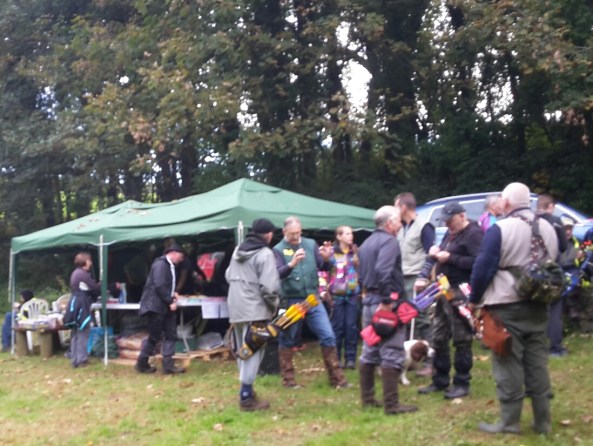
Catering tent at Bowmen of Bude

Catering tent at Bowmen of Bude

Sorry all for the delay in posting this shoot report. There is little doubt that Bowmen of Bude have a lovely ground, situated on a quiet wooded hillside a stones throw from the coastal town of Bude. This was the first time we had visited the club.
stream running through valley

The stream running through valley

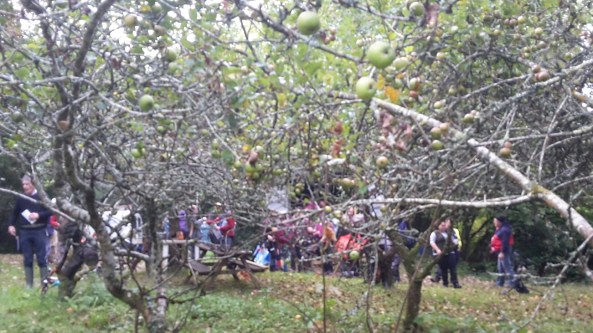
Admin and catering for the shoot was situated in what appears to be an abandoned orchard.  Luckily it wasn’t a windy day as we might have done a few impressions of Isaac Newton being bumped on the head with occasional apple.
Admin at Bude through the orchard

Admin at Bude through the orchard

As it was the weather was kind to us being bright and warm, allowing for some lovely views and photos.
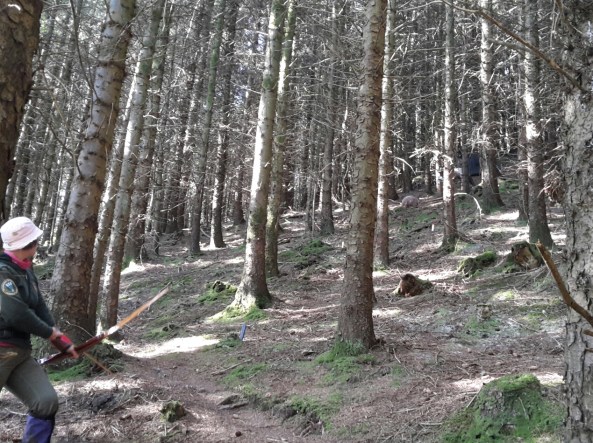
Target 1 second time round, Sharon shooting 3d

Target 1 second time round, Sharon shooting 3d

We would be joined by Chris shooting hunting tackle and Sandra in ladies longbow for our jaunt round. it’s always a good laugh shooting with Sandra and this was no exception.
Chris and Sandra sorting cards

Chris and Sandra sorting cards

All the marshals were very friendly and helpful, chatting with archers throughout the day. I also think they did enjoy watching archers shoot some of the longer shots set out on the course. Especially the elk and grizzly bear.
The 3D grizzly bear from red peg

The 3D grizzly bear from red peg, yes it is that far away.

Chris walking back from white peg Tfor the 3D grizzly bear

Chris walking back from white peg Tfor the 3D grizzly bear gives you an idea of distance.

The course was challenging thanks to clever and extensive use of the hillside and slopes , something they have in abundance.
Bowmen operated  a handicap system on the day which I’m not sure about. Each class is allocated a handicap which is added to your total score.
Chris on white peg shooting the 3D elk

Chris on white peg shooting the 3D elk

Sharon forcing me to pose for my shot on elk

Sharon forcing me to pose for my shot on elk. Managed to hit it with first arrow.

Personally I’d rather know what others scored in other classes without any handicap  but since the score called out includes the handicap level and you don’t know what the different classes handicap level is it’s hard to make sense of. I know they have since published a full listing on the Field archery news UK site.
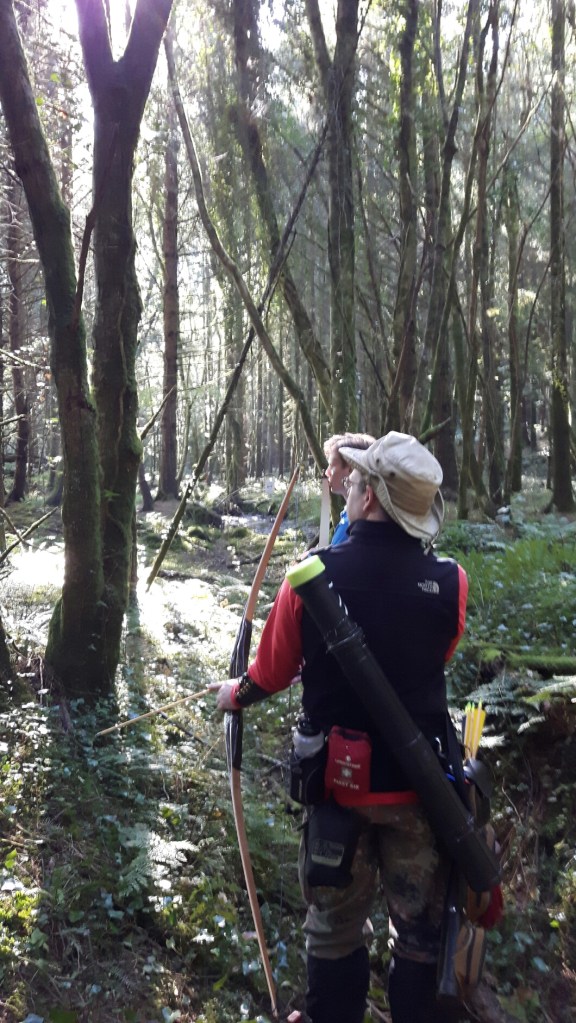
Rob trying to judge distance to a shot

Rob trying to judge distance to a shot

The course  would be a twice round 18 with a slight difference. The organisers had set each of the 18 targets as a predator prey, meaning the first time round you shot the target that was the predator and second time you go for the prey. This I thought was a good way of organising a twice round whilst still making it challenging. Though I guess if you are a gap shooter it makes the second time round a bit easier .
Rob trying to judge distance for 3D bear

Rob trying to judge distance for 3D bear

I  think the only thing I felt spoilt an otherwise very enjoyable shoot was the end and placing ceremony. All visitors ie those outside of a set postcode were allocated into one class independent of gender or shooting style. The handicap is applied and then places calculated  with there being a 1st, 2nd and 3rd awarded. This meant that despite shooting a higher score in gents afb I didn’t win the class and instead got third in the visitors class. Very strange way of doing things.
I don’t feel this is fair or would encourage others to attend. I also wonder if it is fair to locals as they don’t get to know how they fare against visitors. Image if you had shot a personal best and then found someone else had been recognised as being the winner on the day.
When I mentioned this to the organisers they said it was because it was the South West crown. If that’s the case give 1st, 2nd and third as normal and then award the crown separate. The Welsh and Scottish Champs don’t do this so why south west? Just my thoughts though.
Though I didn’t like the visitors element which I think spoilt the ending, in all it was a good day with a challenging course and great company.
Thanks for reading.