We were a little busy last weekend. Friday night a rock concert in Birmingham, bit of practice Saturday, then back in time to see the 6 nations rugby and off to trophy shoot Sunday.
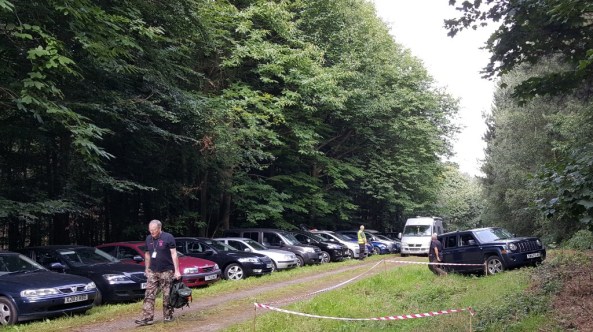
This meant on a chilly Sunday morning we packed the car and were off north to just outside Derby for the Centaura shoot.
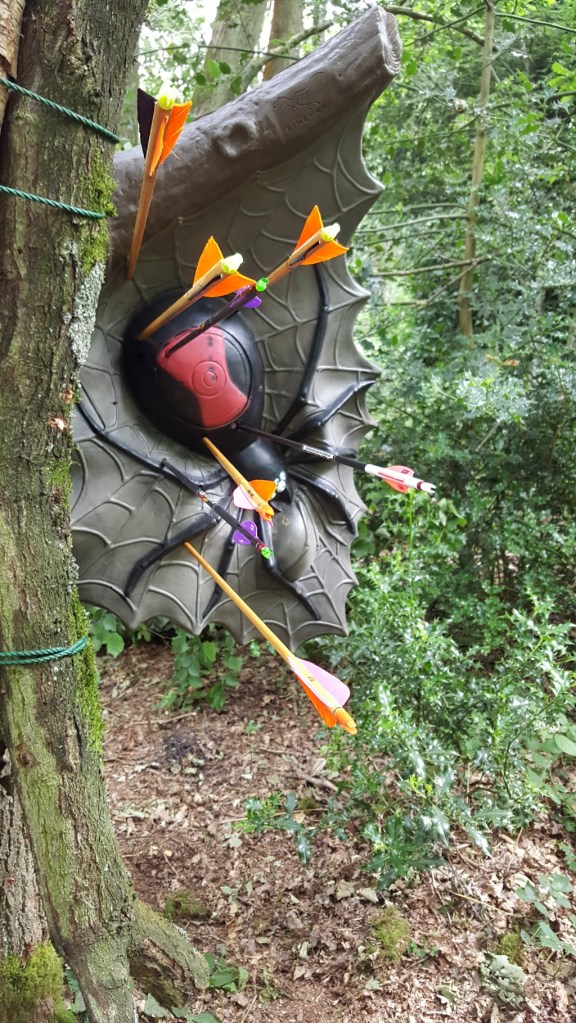
View of 3D
This was to be a bit different to a normal open shoot as it would be a 36 target wooden arrow only. So no crossbow or compounds, just longbows, afb and recurves in hunting tackle classes. (Sorry nearly forgot the primative class.) Still it saw over 80 people attend in the mix of classes. Here is a link to last years Trophy shoot report.
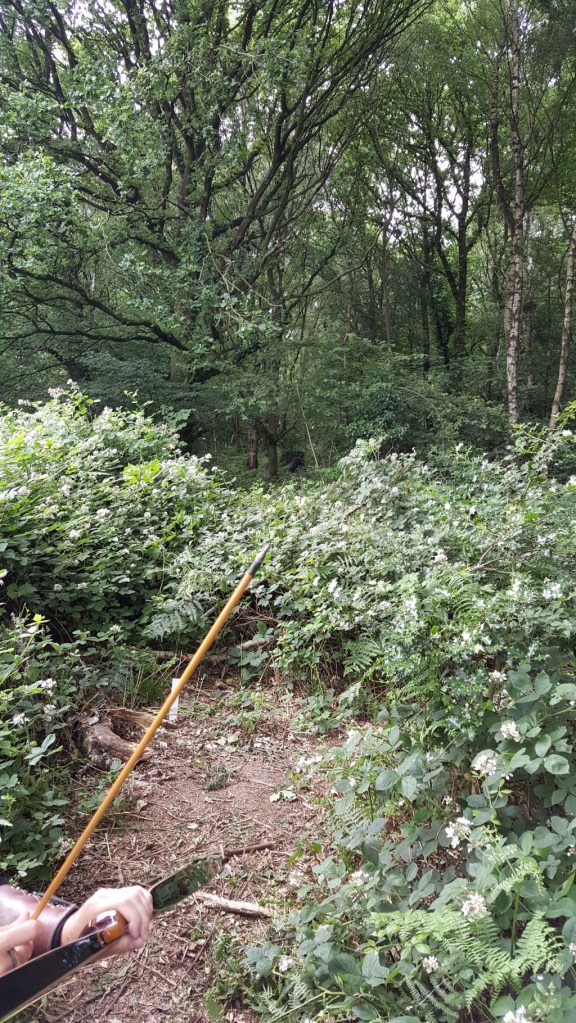
Me on the first target of the day
The course has seen some extensive work at one end of the wood due to essential tree felling after one tree blew down on top of their secondary hut and toilet block leaving only splinters and large logs. The result is it has really opened up the canopy in that part of the wood.
Area by the felled trees
The course itself comprised of some new and some very familiar shots.
The polo shot from behind
The now infamous polo shot returned, this time with a 3D owl target, though I think it was a little too close to the archers as I think some lower poundage bows might struggle to clear it.
The polo shot from the side
The course was a mix of 3d and paper faces set at sensible distances in the most part.
Sharon on one of the down hill shots
With a small shooting group of Sharon, myself and Alan form Pines Park we made good progress with few hold ups prior to lunch. Most groups were only 4 in number which made in all a good day that flowed fairly easily.
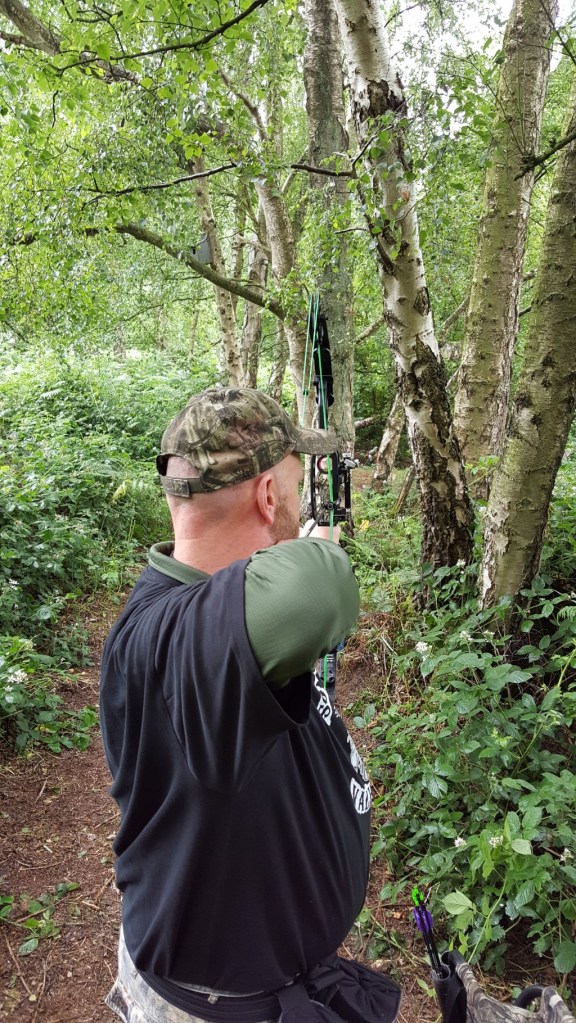
Alan shooting
Lunch break was from 12:30 -1:30 and this slowed down the day a little bit but we’d finished by 3 pm
Despite predictions the rain stayed away but it was a cold day.
Sadly there were no trophies for me this year, not surprising really as am still coming to grips with the flat bow and building my own confidence in it. Sharon won ladies hunting tackle again so the trophy returns for another year.
Thanks for reading
Last week I posted a response to a readers question concerning aiming and focus. This is the second part of my response and in this I will try and address another question
I practice very very much and I can not reduce the diameter of my groups
I know this feeling all too well and I used to spend hours quietly practicing at the range at Black Arrow and now at home.
Reducing the diameter of the group comes with practice. Lots of practice in my case. It takes time and consistency in equipment and techniques.
Here are a few tips I’ve picked up along the way. I hope they help.
Know your Equipment
If your equipment is not consistent then you have a constantly changing variable to any practice you undertake.
If you shoot a takedown recurve each time you dismantle and reassemble your bow you run the risk of accidentally changing settings. Whether this be the bracing height or dropping twists in the string. So take care and time to make sure everything is right. I have found a camera phone invaluable aid for checking brace height or nock position. Set the bow up, making sure everything is right and then take a few photos of the bracing height, nocking point etc. It provides you with a quick easy to check reference.
Photo of recurve set up
If you do change anything make sure you change one thing at a time. However if you change bracing height you might need to immediately change your nocking point as well.
Weather can play a part on equipment too. Traditional English longbow archers will tell you that in warm weather the bow will behave differently to when it’s cool.
Arrow weight and quality
Are all the arrows you are using straight and in good condition re nocks and fletching wear?
Do they weigh the same?
Do they really have the same spine?
I had one student who was struggling with grouping and when we weighed his arrows we found a huge weight variation which explained his issue at longer distances. Additionally, the spine shown on the boxes of wooden shafts can vary, (in some cases we have found a 20lb variation in a single box that is theoretically ranged within 5lb.) This can be caused for a number of reasons from storage to temperature.
A good idea is to number the arrows and note where they hit. That way if you find one that always goes left or drops short you know it’s the arrow not the archer. I also make a note on each arrow how much they weigh in grains and match shooting sets of the same weight. (Definition of Grain)
This is obviously more of a problem with wooden arrows than with carbon or aluminium arrows.
Equipment consistency is easy compared to archers.
Are you consistent in draw, anchor and release?
If you aren’t being consistent here then getting a good group is impossible.
Light is right and going back sometimes to a lightweight bow means you can focus on draw, release and overall technique.
Take your time between shots don’t rush to shoot as your muscles take time to recover after each shot. A rushed shot is seldom on target but can often infuriate you.
One technique I use is to start at short distance say 5 yards. And focus on bringing the group in. I then move back 2-3 yards and work on grouping at that distance. Gradually you move further back. This builds an image bank in your brain of where you should be at different distances. I would practice at, 5,7,10,13,15,17,20,23 and 25 yards shooting 3-6 arrows. Not until I would get at least 5 arrows constantly in a group of 3 inch diameter would I move to next distance. This took months of practice and patience, lots of patience and quite a few replacement nocks. Some days I would shoot 40 arrows others 120 depending on how I was feeling and whether I could focus on the practice. no good practicing if you aren’t focused.
Jim Grizzly Kent recorded a video for YouTube a while back on cup shooting which is another good practice technique.
Finally, if you can get a friend to video you shooting this might help identify any inconsistencies that you have (once you get past being self concious of being recorded). I am thinking of doing an article on the use of video in the near future.
Recently I had a couple of questions sent to the blog by one of my readers.
It’s always good to have feedback and if I can help I will. The subject matter of the questions posed are ones I think many would find interesting as one concerns the concepts of aiming and the other is on reducing the size of your grouping in the target.
I will try and answer each in turn over the next few weeks. Firstly I will discuss focus and aiming. The question was
“When you place your concentration on a small point at the target or animal, while you are pulling and about to get to your anchor point, do you take your eyes off the target for a second, and look at the aliment of arrow with it ,or simply never see nothing else but the target point…”
There are a couple of things to consider here. One is focus on target with the other being arrow alignment.
Arrow alignment
When I first started archery I was very aware of the arrow. Sighting down the arrow to ensure it was pointing the right way.
This is what is taught to most archers to ensure they are lined up with the target.
I find now that I only do this when using a new bow or one I’m unfamiliar with. The rest of the time it is purely subconscious.
I try to fix my focus on a spot on the target where I want my arrow to hit.
Focus
So the simple answer to this question is no I don’t let my focus wander. I try to keep my point of focus set on where I want to hit. This is far easier said than done and takes practice and concentration. I find if my eyes wander, then the arrow will follow where I am looking and not where I wanted it to go. Sharon and I both use this technique.
It takes discipline and practice, a lot of practise and I don’t think I have fully mastered the technique yet.
The only problem is when you can’t pick a point on the target due to poor lighting. Something that can happen on shoots or at the end of the day as the shadows increase and light begins to fade.
Some of you will be aware that I’m not a gap shooter and consider myself as instinctive archer. Subconsciously my brain or should that read brain cell ☺is calculating the distance and telling my limbs when to release when i have where drawn up to. Great in theory but requires constant practice to maintain that awareness and internal sight map. It is also very fatiguing as it takes concentration of all things to relax and not second guess yourself.
Obviously this method doesn’t work for those archers using scopes or sights as they have to calculate the distance to be able to adjust the sights accordingly.
One book I have found resonates with me is Beginners guide to traditional archery by Brian Sorrells (book review here)
The mindset of the author and style of writing is one I have found easy to follow and explain to others.
The concept of one arrow shooting I find beneficial for developing focus. Here the author explains how you shoot only one arrow and then retrieve it and shoot again. This helps you focus on the individual shot and your form.
Another useful article is this one on various forms of aiming. It covers different forms of aiming from instinctive to gap shooters.
In the next post I will try to answer the question on improving grouping.
Thanks for reading.