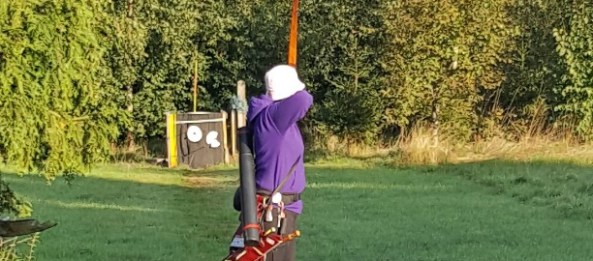

view of the range
No, I’m not talking about using it for bow making or even cutting it down for arrow shafts.
I’m talking about a training aid and how you can make use of it to help with both your distance judgement and bow or body alignment. Sounds too good to be true, well keep reading and find out what I mean. They are techniques I have used myself and to help other archers.
We all know that when shooting at longer distances we have to aim higher. The degree of elevation is dependent on bow weight, draw length, bow efficiency, arrow weight etc. The problem is how can we get a base line for how high should we aim if we aren’t using sights or even if we are instinctive archers. Add to this is the question how at the same time we are ensuring our bows and bodies are kept straight or vertical?
This is where the bamboo pole comes in.
Tip 1 – First tip is for keeping bow and body vertically aligned.
As you tilt your upper body, which is sometimes called Tea-potting, it’s very easy to inadvertently loose your vertical line of your body or bow. Several archers I know tend to lean slightly back on longer shots and then wonder why they lose the line of the shot. By positioning a pole behind the boss you can use it as a reference point to ensure your bow and body are straight as you draw up. I know that some people cant their bow but the pole can still be used as a guide.
Ideally you want to position the pole behind the boss and in line with the targets centre.
As you draw up on the target boss you can use the cane as a guide to ensure the bow is vertical and you aren’t leaning off line. Overtime and with patience you will find that both body position and bow alignment will improve.
Tip 2 – Distance and height judgement.
Marking the stick in 6 inch increments with coloured tape will help archers to see the pole from a distance and more importantly perceive the height. I have found that any smaller increments than 6 inches, say 4 inches, tends to make it harder to distinguish over longer distances past 35 yards say. So I advise using 6 inch increments.

The left is one colour the right in in 2 colours Yes that is a mug of coffee on top
This technique is especially useful if the archers are trying working out their gap distances. So if the archer is using their arrow tip as a sighting aid, rather than trying to imagine a distance about the target they can use the coloured bands to aid them.
Effectively the archer is able to put their arrow tip on a banding and see the effect of aiming 6 / 12/ 18 inches above the target has.
This technique may sound a bit strange for me as an instinctive archer to promote, but I do find it provides benefit.
I use bamboo gardening poles available from most garden centres as they are cheap and come in 6t and 8ft lengths. This means that behind a 90cm / 3ft high boss you have ample sticking up. The other advantage is if you hit them they are unlikely to damage your arrow and if they break they are easily replaced.

Black and silver tape
In the photos you can see I’ve used black and silver tape so it can be easily seen from a distance but you can use any contrasting colours so long as it can be seen from a distance.
I hope you find this useful and thanks for reading.