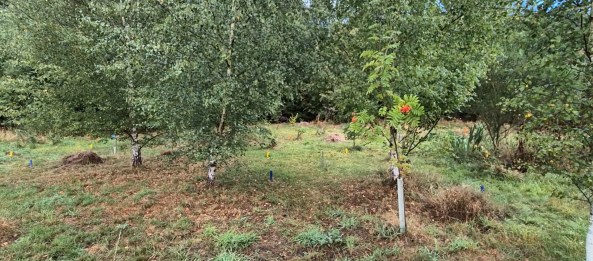
By far one of the most common questions I’m asked by new and sometimes experienced archers is concerning distance judgement and how to improve accuracy at varying distances in their shooting. Many will start shooting at a target of 15 to 20 yards and when presented with longer shots struggle. Over the years I’ve found many experienced archers all have a distance they struggle to shoot accurately.
How far is this shot?
As an introduction to the concept of distances and my use of rangefinder as a supportive tool I’d like you to watch the following video, showing 2 different distances to the same 3D target. One is from the Red peg (where an adult shoots their first arrow and normally furthest distance from the target). The other is from the Blue peg, the peg from which an adult would shoot their third arrow (last arrow) and is normally the closest peg to the target. In the video you will see a couple of other coloured pegs (yellow and orange) these are junior pegs.
Can you estimate how far these shots are? I know it’s harder to do from a video than in real life, but take a guess.
How did you get on? Did you manage to judge the distances?
Speaking to other archers I know several instinctive shooters, who past a certain distance, swap to some form of gapping as they don’t feel comfortable with their distance judgement past 40 yards.
To clarify before I go any further. I shoot the vast majority of my time under the NFAS organisation. Unlike other societies NFAS is entirely unmarked distances which means not only do you have to have good form and tuned equipment, but you also have to have an ability to read the ground, in order to judge the distance to your target.
When competing you can’t use a range finder of any description, as everything is shot on unmarked distances. Though you can use binoculars if you wish so long as there is no range finding facility inbuilt obviously.
This means if you want to score well, you need not only be able to shoot well, but also have a method to judge distances. Whether, consciously via gapping or subconsciously via instinctive / intuitive
In this article I am not going to be covering gap shooting techniques or instinctive shooting (you can check out some of the material I’ve produced on this another time)
In this I’m going to talk about the use of a rangefinder as a tool for both course laying and improving your ability to judge distances. Even though I am an instinctive shooter I frequently use a rangefinder to develop my distance judgement.
You don’t need to be at an archery club to develop this skill in fact you probably do this every day when driving or cycling, as you are having to judge the distance to the vehicle in front of you to ensure you have time to react, brake, overtake etc.
Here is one useful technique to try out. It requires you to carry your rangefinder with you when out walking your dog or on the way to work. You can pick a tree or lamppost in the distance, making a mental note as to how far you think it is and then check the actual distance using your rangefinder. You will be surprised how quickly you will begin to be more and more accurate in your estimations.
An alternative to this technique is to pick a point in the distance but rather than try to estimate the distance, you immediately range it. You then know the distance and try to work out why it is that distance. The advantage with this method is your brain will know what it is straight away so you aren’t trying to correct a misread distance.
How rangefinders help coaching archers
For years I have carried a rangefinder when coaching. As an instinctive shooter I find it hard to consciously judge distances or rather put a number to that distance, e.g. 23 yards. I tend to think its between 23 to 25 yards. So, I carry the rangefinder as a useful tool for more precision.
If I can give a student a definitive distance, they can either select their sight pin or identify their gap distance.
Course laying use.
When I go about setting a course it’s usually with a couple of club members. One of us will spot a shot line and another will move to a potential target location. I can then take a range measurement to that location.
You may wonder why I bother doing this, so allow me to explain
- It means we can log the distances for each shot on the course to check the balance of short, medium or long shots.
- It means we have an accurate record of the distance as a shot may look closer or further than it actually is thanks to the use of dead ground or vegetation.
- If anyone at our shoot queries or challenges distances we can provide a definitive and accurate response.
I’m sure there are other course layers who do this. I know some don’t and prefer to rely on their own judgement. I prefer to use the rangefinder to make sure the distance is accurate and I have a record of it.
How can you develop distance judgement?
Technique 1 – half, then double
One technique I explain in the video is to pick what you think is a mid-point to the target. How far is that? Lets same 10 yards. Then double that distance estimation, so in this case 20 yards. Take another look at the target. Does 20 yards sound right? Do you think it is further or closer?
If you have a rangefinder you can then range it and see how close you are.
The downside I have found with this technique is if you misjudge the initial mid point by a couple of yards, then when you double the distance you double the mistake.
Technique 2 – 10/20/30
A second technique is when presented with a target, you first judge what you feel is 10 yards to the target, then judge what another 10 yards towards the target would be, taking you to 20 yards in total. You then have to decided if you have reached your target, gone past the target or is it further? If further then ask yourself is it another 10 yards or less?
This technique can work pretty well on most targets, but can fall down if judging across large open ground or water.
The thing to remember is neither technique works 100% unless you practice it.
Do you use a rangefinder? If so let me know your thoughts. If you are interested in learning more about the rangefinder I use you can check out my review.
As always thanks for reading, supporting and following me. Take care and remember to enjoy your archery.




 My Archery Experiences