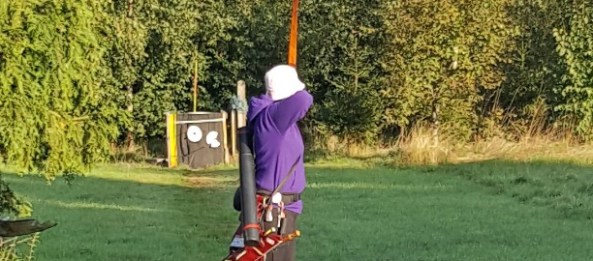
Sharon on the range

Before we start a quick reminder

So we have looked at two sides of the archers triangle, that of the arrow and bow. Now let’s look at what many see as the hardest element to gain control of, the archer.

archers triangle graphic

The archers triangle

Before we dive into this I want you to think for a moment about your mindset and how you approach these ideas.
It’s good to be optimistic when it comes to combating target panic but you have to temper this with a level of realism. So please be realistic in what you can achieve with the time you have available. Try and plan your activities so your time is used effectively and efficiently. Just like you need to allocate time for tuning your bow or making arrows you need to give yourself time to practice these techniques.
You will need to consider planning your time effectively. Don’t just go out and shoot lots of arrows believing it will cure your anxiety. It might build your muscle strength but I doubt it will solve the anxiety you feel.  Consider the fact that shooting 100 poor shots does not work as well as 30 well executed shots.

So think about practice regime and exercises you can do to help build confidence and resolve. Working on your chosen techniques whether these be focusing on your own form, shot sequence steps or exercises like drawing down off a shot have to be factored into your training regime.

view of the range

view of the range

Consider carefully how much time you can allocate to the techniques I will suggest. It may well require you to allocate 20 to 30 minutes a session in the early stages to get used to the drills. This is the sort of commitment required in the early stages.
Once you have regained control its still worth practicing the techniques every few sessions partly so they remain fresh in your mind and partly because they can help you remain in control.
Your objective is not to hit the target but to gain control over your target panic / shot anxiety – remember this. Don’t let your focus move to hitting the gold, it has to be on control.
Too often we focus and perceive success as making the shot score highly. That is an outcome from solving the anxiety, your true goal is to take back control of the shot.

Physical Practise is one way but remember we are training your brain too. I mentioned in the previous article about mindset and changing the way you think about things. This includes how we consider things such as how we recall what we consider to be good or bad shots, productive or unproductive practice. Often when we start experiencing target panic we tend to recall the poor shots, what we consider bad ones. These prey on your mind, possibly because you missed a shot or scored less than you wanted. In reality the shot has gone, its in the past. remember to learn from it and move on.
You may have heard of the phrase “Making mistakes is not failure unless you let it be.” or something similar.
I firmly believe that making mistakes should not be viewed as a failure as it can provide a great learning experience. The reality is if we don’t learn from our mistakes we are likely to repeat them. Think of this for a moment. Shooting the wrong spine of arrow and identifying this only comes about from the mistake of shooting the wrong arrows in the first place.
Where archery is concerned this is very important to remember as you might try a technique and it doesn’t gell with you for whatever reason. The crucial thing to remember is you’ve tried something and made a step in gaining back control.
One way you can think of it is as if you are going to a new restaurant. You decide to try something new on the menu that sounds interesting. You might like it or you might hate it, without trying you’ll never know.

Getting good at something takes practice.
Getting better at doing the same thing takes more good practice.
Getting to a level where you are a master, can take a lifetime.

This is true if you are field archer, target shooter, fisherman, golfer or even a surgeon.
It is equally true of physical and mental practices. They take time to learn and for you to develop.

Natural Aptitude and learnt skill

Basic talent or natural aptitude only goes so far, after that its perseverance and good practice. Someone with natural talent will often start off well or ahead of another who has to work on shooting a bow. The thing is the person who is a “natural” may struggle later in their progression as they may have relied on their talent rather than developing skill. I’ve seen it time and time before affect the archers confidence as they start to struggle, wondering why it’s become so hard all of a sudden.

Modern fix, quick fix

In a modern world where people are always looking for short cuts or quick answers to fix complex issues the concept of spending time ensuring we learn the skill properly is sometimes overlooked.
Increasingly society looks for the easy fast solution. Here is a fact, target panic requires time to overcome. There maybe some quick tips that can help you find your right road, which is why I started writing these articles but there are no shortcuts or magic arrow.
The important thing to remember is effort can work and will work if the effort is focused.
Knowledge and effort makes a difference or at least it can if effort is directed and focused correctly. These posts are here to help you gain some insight and ideas on how to focus on the correct way for you.
Be kind to yourself and give yourself time. You might have been struggling with anxiety for years so don’t expect to learn to control it in hours. Remember in the second post I said there were 3 things

Put some work in – there are no magic arrows that solve everything or a secret draw technique that quells the nerves.
Remember one size doesn’t fit all – what works for one person may or may not work for you.
Be patient – it takes time to work out what helps you and this means time spent working at it too.

In the next couple of posts I’m going to cover a few techniques that can help.

  • Blank boss work
  • Target fear (where specific target faces trigger anxiety)
  • Drawing down
  • Drawing up but not shooting immediately

I might throw a few other ideas in the mix too. I hope these ideas will help.
Thanks for reading

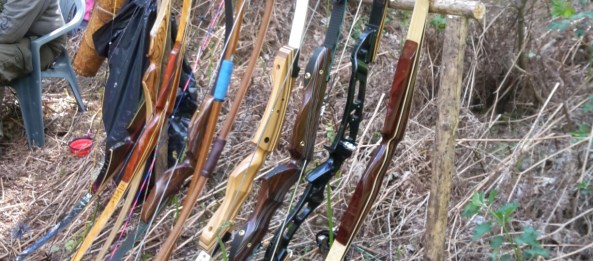
Selection of bows

Target panic and how knowing our bows can help

In the previous post on overcoming target panic I talked about building confidence and how knowing your arrows can help give you confidence. In this post lets look at the second side of the archers triangle the launcher of those projectiles, our bows.
archers triangle graphic

The archers triangle

Our bows come in all shapes and sizes. They can be a hand crafted traditional English longbows or the latest high tech compound from Bowtech. Yet they all share one or two key facts. They are all designed to perform one function, to launch a projectile effectively and hopefully deliver said projectile to the target. They all require correct setting up and maintenance at varying levels of complexity to ensure they perform this task. Just to be clear though I’m not going to go into detail about tuning bows in this post, that’s for another time. What I am will do is give you some points to consider,
So I want to start by pondering a couple of questions.
Does your bow perform exactly the same each time you use it? I’m not talking about how well you shoot it but how well it performs. Hopefully it does, but what if it doesn’t. If we take this question further and look at one element of set up as an example, the brace height.
How often do you check your bows brace height? Each shooting session, once in a while?
For traditional bows or take down recurves the question can be Is the brace height the same each time you string it? Its very easy to drop the string and loses a few twists. Alternatively if it is a new string it could stretch slightly as it beds in.
Without knowing the bow is performing consistently how can you have confidence in its behaviour and its delivery of the arrow to the target.
Definition of brace height – the brace height of a bow is the gap from the string (nocking point) to the riser. The actual brace height of different bows vary, but all manufacturers will provide an upper and lower limit. Normally for a recurve this will range from about 7 1/2 inches to 8 3/4 inches.

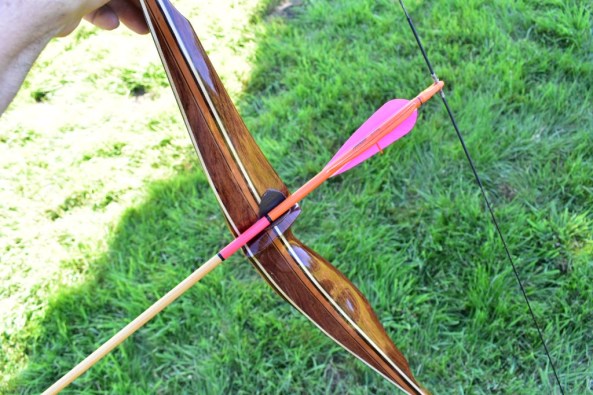
One tip I will share is using your arrows cresting to help you check the brace height of your bow, as shown in this photo. The black banding is set at the ideal brace height for the bow as it lines up with the white band you can see.

Sharons bow and arrow set up

Sharon’s bow and arrow set up

Tune don’t Twiddle

I would always suggest you spend some time and ensure the bow is set and working at its best, tweaking brace height, nocking point etc. until you reached the optimum. Once it’s tuned and working well stop. Yes, stop. Focus on learning to shoot that bow. If you are constantly altering elements of your bows set up, say the brace height or nocking point, then you will have an ever changing platform on which to try and learn to shoot. This twiddling or constant changing will not help you develop confidence in being able to shot the bow.
Top tip – If you have something that works please don’t be tempted to twiddle or tweak it, especially in the run up to a champs or competition. You might think it will help and get you those extra few points, but the flip side is it could cause all your training to be for nought if it has a negative effect on your setup.
I’ve seen lots of archers spending a fortune on kit, along with hours of time chasing the idea that a slightly different spinning of arrow shafts or couple of extra twists in the string will make the difference. When in reality they already have something that works really well and changing means quite often they lose confidence in their kit. As well as points on the score card.
“Learn to shoot with the bow you have” was something my old coach always said. Know that it works and your arrows work and this will give you confidence.
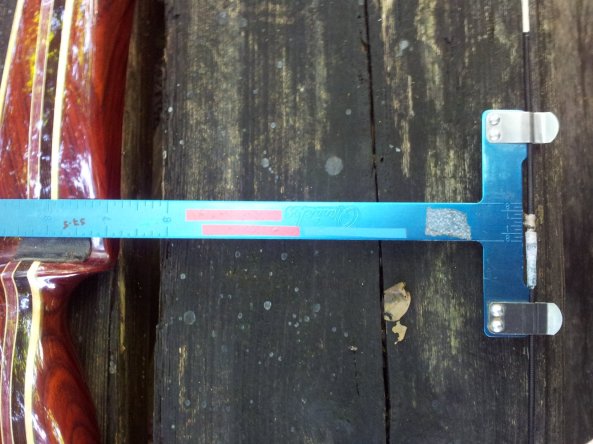
I tend to record what works well for each of my bows. This means I have a record of string length, brace height, plunger set up, etc. for all my bows and over the years I have found photographing the brace height and nocking point particularly useful. I have found this makes it much easier when setting up a new string. It provides visual guidance something that makes your life much easier. I tend to bring the image up on my tablet screen so it’s large enough to see easily.
Bracing on bow

Bracing on bow

Using your phone camera is one piece of advice I will offer as it can not only help with set up, but also monitoring any possible problems i.e. how much has the string stretched or worn over the space of a few sessions.
Bows like arrows are susceptible to damage, this can be via accident such as dropping it or through ignorance in improper usage.
dmaged riser

Damaged riser

Again your camera phone can help here for documenting wear and tear on your bow. I’ve know archers to use their phone cameras to photograph the limb bolts after marking them to see if they undo over time. Other forms of damage can occur from incorrect usage such as dry firing.

Dangers of dry firing

What is a dry fire? It’s when you draw back a bow without an arrow loaded on the string and release the string.
Why is this a problem?
All the energy that would normally be transferred to the arrow from the bow has nowhere to go other than back into the bow. This is never good and has seen bow risers break, limbs delaminate or even snap. There are a few YouTube videos on what happens and archery360 has produced a good one.
In short NEVER ever dry fire a bow.

Arrow weights V bow damage

While talking about bow dry fires I want to mention arrow weights. Be mindful of how light your arrows are. Some manufacturers recommend a minimum arrow weight for their bows as a safe guard against potential damage or failure. Shooting an arrow that is too light can be akin to a series of mini dry fires and over time can lead to damage to the bow. So check if the manufacturer’s have a minimum arrow weight.
String maintenance – It sounds like a simple thing to remember but I am always amazed at how few people actually maintain their bow strings. Whether this be waxing it on a regular basis or just checking for any fraying or damage to the serving. If you shoot a compound bow with a d-loop, please keep an eye on these. I’ve seen an archer at full draw have their D-loop snap. The arrow went flying off some 50 yards. Our coaching equipment is regularly checked as we’ve noticed wear and tear on the serving loops from them being fitted and removed constantly.
Please don’t over bow yourselves. I know I have said this so many times before but it’s really important. A well set up bow with well matched arrows often negates the need for heavier draw weights. One final point for you to ponder I’ve written previously about the benefits of having and using a light poundage bow when working on form or recovering from injury etc. So much as it might be tempting to exchange or sell the lighter poundage limbs you might want to hang onto them just in case.
Personal insight
This process of arrow and bow set up certainly gave me confidence when I started. Knowing the quality of the arrows and the bow I was shooting, and they were working correctly together meant there were less things for me to worry about.
Both of these elements are pretty easy to tune given time. The fare harder part is the archer, as unlike the bow and arrow, the archer has a mind of their own. The thing is once you know your kits right, you will inevitability grow in confidence as your bow delivers your arrows with more consistently at short, medium or long distance.
So lets start looking at building confidence in the third and final element, the archer.
Thanks for reading.