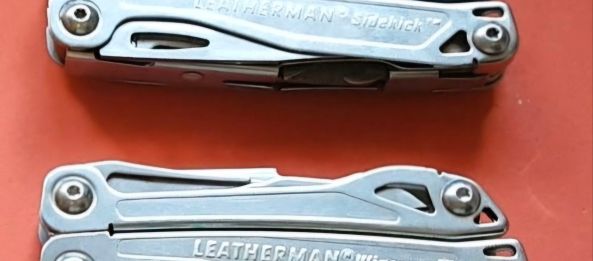
Leatherman multi tool

Are Leatherman Multi-tool any good


Several years ago I wrote a review of the Leatherman multitool I’ve been using for years. This is an update of that review. I’ve owned a few different multi tools varying from the bargain basement ones that come free with a torch at a service station, to the more expensive Leatherman models.

I’ve found them a useful addition to my archery belt and I’ve used them for camping, hiking and even skiing. Pretty much every scout leader I know carries one of these tools on a camp.

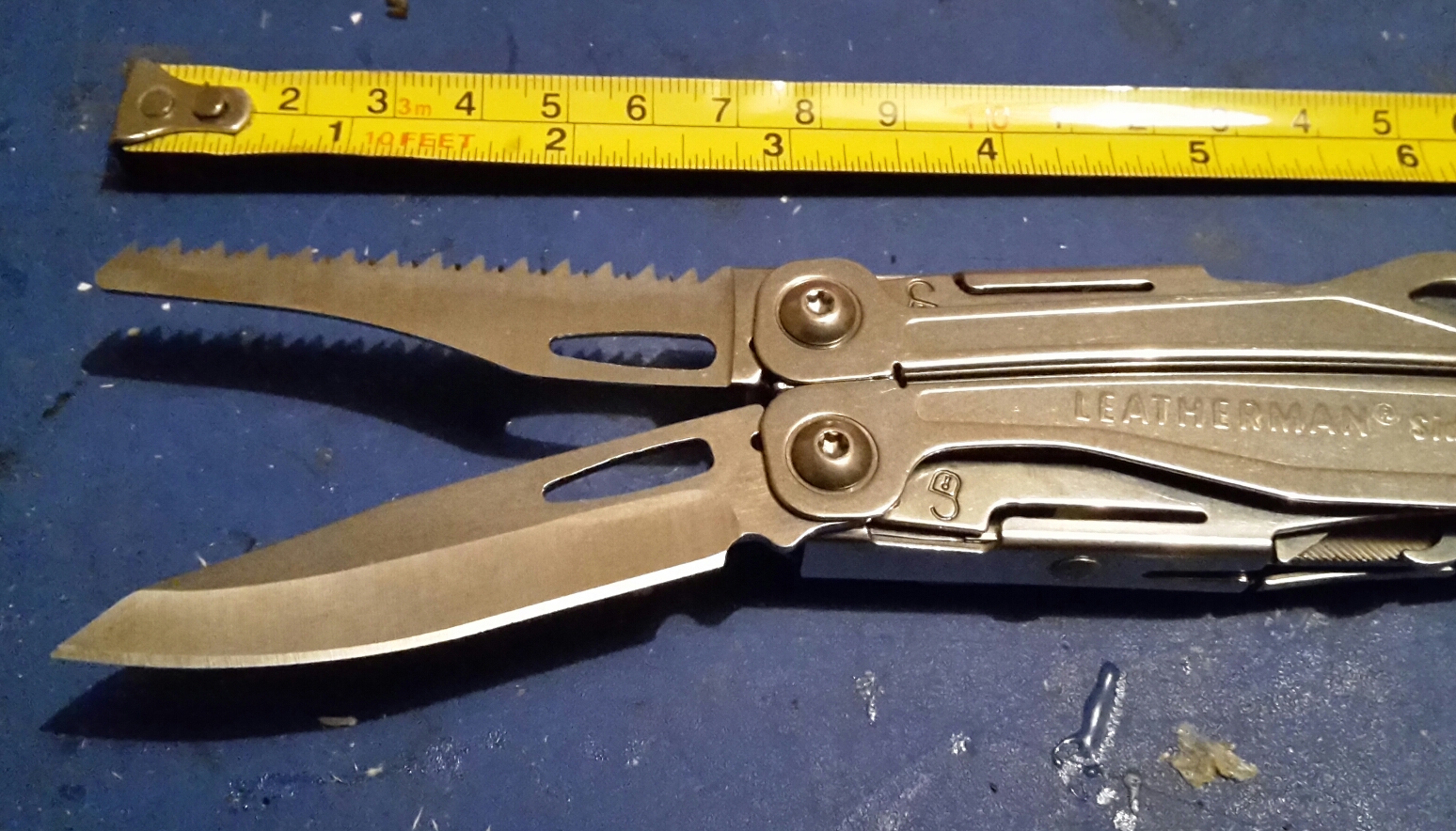
The two I have are the  Wingman and Sidekick. Essentially the two are nearly identical and a full breakdown of the different features are shown below.
The only real difference is the Sidekick has a small saw blade instead of the scissors that can be found on the Wingman.

Uses in the field

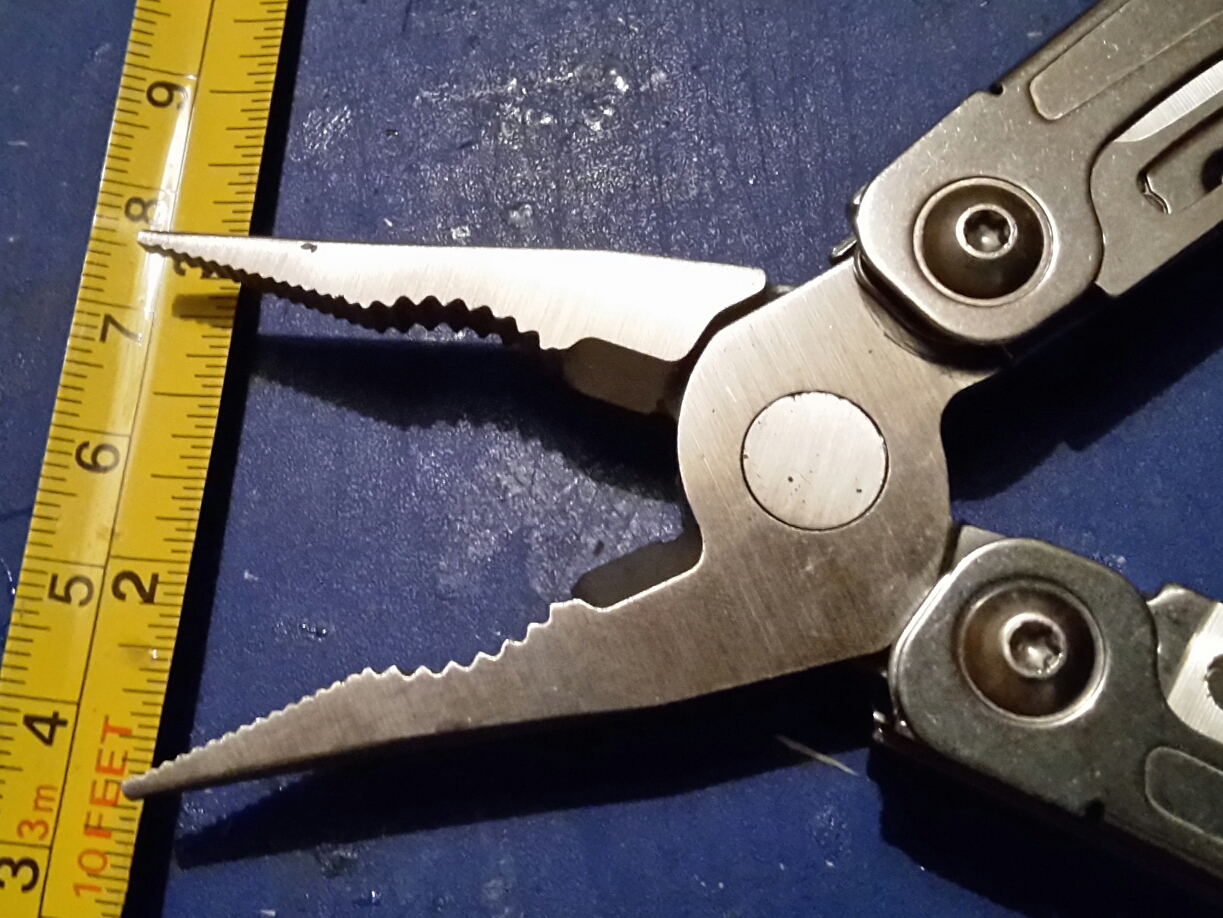
I’ve used the pliers countless times for extracting  arrow points of piles from targets after the shafts have snapped in the boss, 3d targets or more often trees and need removing.
A sharp knife is always useful if you spend any time outdoors whether it be camping, walking or archery.
Quick note here is I wouldn’t use the blade to try and cut a wayward arrow from a tree though, as whilst sharp I would expect the tip to snap under the pressure. For removing of arrows I use an old flat headed screw driver that I have in my quiver.

It’s worth remembering that no matter how good a multitool is, it is by it’s very nature is a compromise, the pliers will never be as good as a true pair of full pliers.

The wingman comes with a small pair of scissors which I’ve found surprisingly useful for archery, when fitting servings etc.

The sidekick  comes with a small saw blade, which isn’t going to chop down any redwoods but I have used to saw through branches of about an inch thickness with ease. For that reason I tend to have the sidekick to hand when camping or working in the woods. I’ve also used it to make impromptu walking sticks.

Tools breakdown

Here is a quick break down of the tools, both are made from stainless steel, are pocket sized and covered by the Leatherman 25-year warranty. The WINGMAN has these tools

  • 420HC Combo Knife
  • Bottle Opener
  • Can Opener
  • Medium Screwdriver
  • Package Opener
  • Phillips Screwdriver
  • Ruler (1 in/2.54 cm)
  • Small Screwdriver
  • Spring-action Needle nose Pliers
  • Spring-action scissors
  • Spring-action Wire Cutters
  • Wire Stripper
    Wood/Metal File Measurements:
    2.6 in | 6.6 cm (blade length)
    3.8 in | 9.7 cm (closed)
    7 oz | 198.4 g

SIDEKICK  has these tools , and mine came with a Carabiner Bottle Opener Accessory.

  • 420HC Serrated Knife
  • Medium Screwdriver
  • 420HC Knife
  • Bottle Opener
  • Can Opener
  • Phillips Screwdriver
  • Ruler (1 in/2.54 cm)
  • Saw
  • Small Screwdriver
  • Spring-action Needle nose Pliers
  • Spring-action Regular Pliers
  • Spring-action Wire Cutters
  • Wood/Metal File

Measurements:
2.6 in | 6.6 cm (blade length)
3.8 in | 9.7 cm (closed)
7 oz | 198.4 g

Workmanship

The workmanship is good and the pivotal joints haven’t slackened off much after 10 years of use, which I have seen on cheaper multi tools. The finish on the back of the Sidekick  serrated blade is a little rough which you notice more when folded up but that is the only criticism I have. The rolled metal handle makes using the pliers more comfortable in the hand, compared to some cheaper models you can find on the market.

I now make a point of always carrying one of mine when out and about.

So if you are looking for a  Christmas present I’d say either would be a good buy and addition to a kit belt or pouch. If you are looking for something a bit more then have a look at what I think they call the expedition range.

If you like this content and would like to see more reviews then please let me know, either here on my YouTube channel. As always thanks for reading, watching and support.


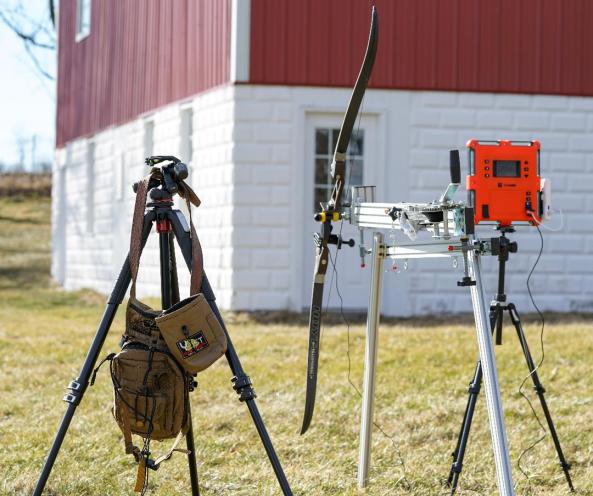
Chat with Cody Greenwood at the TradLab

The TradLab

For those of you who don’t know Cody Greenwood he is the founder of Tradlab (https://www.thetradlab.com/) over in the USA. He has a background the field of analytics and is now focusing this expertise on traditional archery.
He has been working with the guys at The Push on a series of podcasts looking at arrow flight and the elements that effect it such as number, size of fetching, etc.. These are well worth listening to, offering some great advice and suggestions.
For those interested here is a link back to the Push article I wrote a while back.
anyway lets get started.
Rob – For the readers who might not have heard of you Cody, how about introducing yourself and explaining how you first got into archery?
Cody – I have a background in Continuous Improvement.
Rob – that phrase brings back memories of my university studies of engineering. Sorry please carry on.
Cody – I have been shooting archery since I was old enough to draw a bow. I hunted as I grew up and my passion for Archery has consistently increased with every year. I have just begun to get into the competition side of Archery.
I am developing as I now start to tackle the mental side of Trad.
Rob – the mental side is a whole new ball game that is often overlooked with some trad archers.
Listening again to the podcasts which you did with the guys at The Push, you said how you wanted to put something back into the hobby. So why set up the Tradlab, isn’t there enough information out there for people?
Traditional Archery changed for me last year at IBO Worlds. Dewayne Martin turned to me and said 95% of what you learned about Traditional Archery from the internet is false. I spent the afternoon shooting with those guys and during that time I realized he was correct.
A close friend who also competes spent countless hours Coaching me as I had to unlearn so many things.
I was shocked at how much time I had wasted trying to learn from the “Internet Archers”.
Rob – wow that is quite a revelation. Maybe a flip side of this is some of those internet archers believe they are being beneficial. YouTube has been a massive success over the years for people who want to share advice and ideas.
I have to say I do agree in some ways, as with my coaching hat on I’ve spent a few sessions with archers, helping them unlearn bad habits. Some of which they have picked up from YouTube.
Do you think its partly down to not being able to identify easily what is appropriate or right?

What a great quote – from the TradLab pages

I set out to expose this and TradLab was a result. I am using my skillset from my profession to test equipment and theories.
Rob – kind of a like a mythbusters approach in some ways?
My ultimate goal is to get people to go to the large shoots.
Rob – i think you are selling yourself short there Cody. I think you are trying to provide evidence based results to help the community as a whole.
A lot of what you covered in the podcasts are of benefit to hunters, field archers and social shooters.
Rob – Do you find the analytics of archery as interesting as actually shooting?
No absolutely not, I would much rather shoot versus study and test.
As a matter of fact I fear that I may be encouraging some to tinker in excess. We need to develop ourselves as Archers not constantly tinker with equipment.
Rob – My old coach always said, “Learn to shoot before you tinker with anything.”
As a coach myself I have often seen people tinker with there set up believing it would help, when in reality they would be better focusing on their own form or shot sequence.
My goal is to leverage my analytical base to save others from having to test with one factor at a time trial and error. This should enable them to focus on their shot versus testing.
Rob – I have to say the inner nerd in me loves to track and record stuff for improvements in future so hearing that someone else is also doing this makes me happy.
Where do you see yourself going with your archery and the TradLab over the next few years?
The future of TradLab is not clear to me at this time. I know I want to add more value than I take from this community.
My primary goal is to give back. If it turns into a sustainable business that adds value I will apply effort and time. If I find that TradLab becomes anything less than value add for the Community I will stop. I do not have any revenue coming in from TradLab at this point.
I do know there is a lot of bad information and products in our community. I will articulate this through my testing.
On my site I have limbs that sell for $800 that perform worse than $400 limbs. I want people to see this and make good product choices.
Rob – I can appreciate that sentiment. I’ve always tried to be unbiased in my reviews so people can have the facts and make their own minds up.
Rob – How can people get involved if they want to?
People can contact me through my website www.TheTradLab.com, instagram or my facebook page. They can also reach out the folks at Push archery.
I am always interested in theories or new product testing.
Thanks for taking the time to go through this. I’d like to take this opportunity to wish you the best of luck with the TradLab. Looking forward to more reviews and research over the next few months.
For those interested here is a link to The Push (https://thepusharchery.com/)
Thanks for reading

Equipment Review – Hawke 400 rangefinder

Those who follow me on Instagram will know I have recently bought a range finder.
Now many of you might think this a strange thing for someone who has always said they are an instinctive archer at heart. Why purchase one if you don’t gap or use sights? Also why buy one when the NFAS is the home of unmarked distances?
Well this purchase is more to do with course laying than my own shooting.

I have found that when you are setting a course, whether 3D or using bosses it is beneficial to be able to range each shot accurately. This helps to both ensure a good mix of distances but also aids safety, as you can use it to check distances of overshoots etc.

Having done some research or rather that should read lots of research on numerous Google searches and a few postings on different sites asking for advise and guidance I was pretty sure of a couple of things.
The mix of different options was huge.

The prices ranged from £50 to £300 plus

I was fortunate to have a couple of fellow archers who were kind enough to lend me theirs to have a play with and the entry level ones seem to work pretty well. Quite often archers will use a golf range finder as opposed to one designed for shooting, as shooting ones tend to range over hundreds of yards at times.

I also popped down to our local gun shop to ask their advice and to see what options they had. (Shooting Supplies Limited http://shootingsuppliesltd.co.uk/ ) I have to say they incredibly helpful going through the different options and what’s available, along with practical advice, thanks guys.

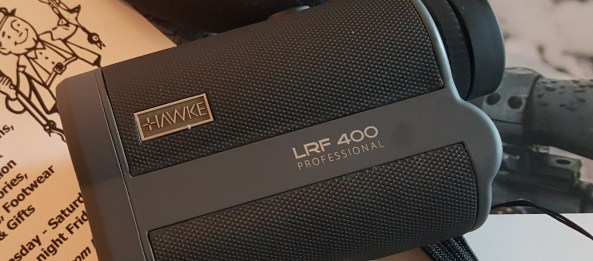
I ended up buying a Hawke 400 from the shop in question and it was a choice between the Hunter and Professional unit. As it was I went for the Professional in the end as it was only slightly more expensive and offered a couple of features I thought might prove useful, more on these later.

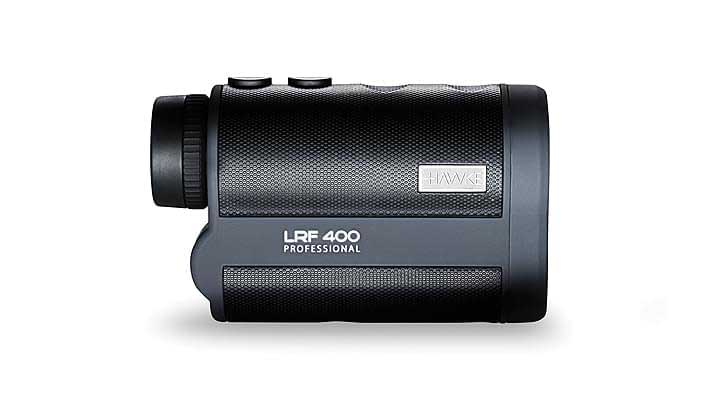
Taken from the Hawke website

First impressions are very positive

The unit is light and easy to carry, though the only criticism I have so far is the carrying pouch which is a little small, making it difficult to stow and retrieve easily. I have managed to get the lanyard caught in the pouch zipper a couple of times. The unit measures approximately 3 inches high x 4.5 inches long and 2 inches thick so small enough to store in my jacket pocket.

The unit can be set for measuring in yards or metres, through the instructions don’t explain how to change between them. I had to Google it.! Where would we be without Google. Maybe including this in the user manual and if it is already then making it more obvious for fools like me.
Clarity through the viewfinder is pretty good making it fairly easy to locate targets. It has a x6 magnification through the unit and ways only 180g / 6.3oz so nothing really. Full manufactures breakdown can be found here https://uk.hawkeoptics.com/laser-range-finder-pro-400.html
Like many range finders the unit displays details through the viewfinder such as yardage. this is shown in black text over the image so it’s a little hard to view with a dark background.
I am yet to check the accuracy against a measured distances. Distances I have used it on so far are from 5 yards to 90, but I need to check the calibration.

Update – I have now tried this on my range finding it very useful and more importantly accurate. Distance wise it matches the long measuring tape I have and the marked distances on my range, which is 40 yards, however if I factor in my garden I can easily got back over 60 yards and I’ve tested it at this distance too.
One thing that this unit has already helped me with is the judgement on height difference. I knew the range was on a slight incline and with the Pro 400 I have bene able to identify the incline over 20 / 40 / 60 yards.
Hawke state there is +/- 1 m and I think that is true as I have found ranging in on the top of the boss and then at the bottom can sometimes give a difference of a yard.

The different modes are described by the manufacturer as

“Beeline mode measures the horizontal distance to a target.

Height mode measures how high the target is in relation to the range finder.
Angle mode measures the angle of projection. It will be measured to the nearest half a degree.”
One feature the unit offers over the Hunter is in giving you the angle to target. This was one of the reasons I went for the Professional over the Hunter. I wanted to know the elevation to or from targets to the shooting peg, something that I felt would be very useful if you are setting shots on hillsides or across dips and valleys.

Having used this now to range in targets on uneven terrain I can confirm it is very helpful when setting shots or for your own shooting. The only thing I have not tried is using it in wet weather so I can’t testify to how water resistant or accurate it is on a rainy day, though knowing the UK I expect this will be tested at sometime in the summer.

Overall I think it is a great bit of kit, useful for all archers who want to improve their distance judgement or like myself want to continue to develop their skills in course laying. I’d give it a 9.5 out of 10. The only reason it’s not a 10 is the pouch and I haven’t tried it in the rain.

Thanks for reading.