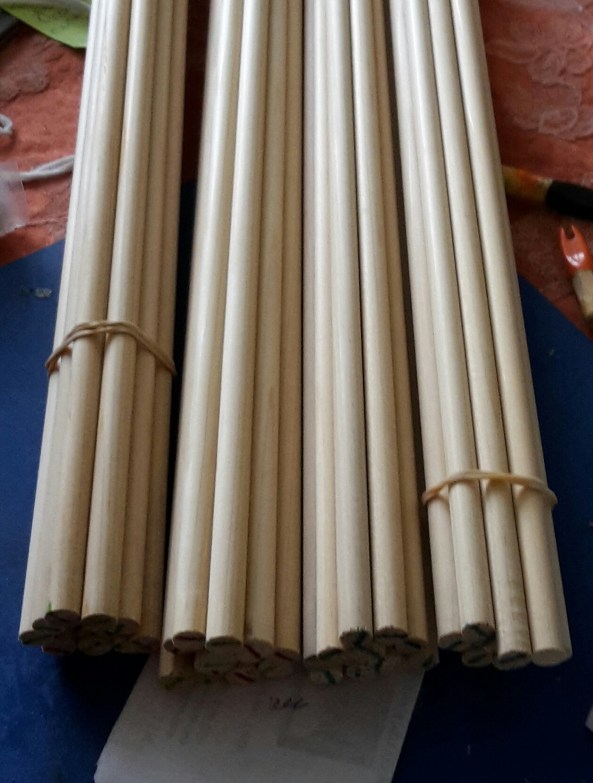
Wooden arrows shafts , a few thoughts before you buy…

Arrow shafts

Arrow shafts

As many of you know Sharon and I make our own arrows and to be truthful, I find it can be quite relaxing after a stressful day at work. One thing we have found to be increasingly difficult over recent years, is to find suppliers of good quality wooden shafts.
There are numerous companies out there that supply shafts or even complete arrows either via retail outlets or mail order and of course there is eBay, but the quality can vary greatly. So I thought it might be worth putting forward a few views, thoughts and suggestions.
Please be aware that I’m not associated with any shop or companies, nor do I have an axe to grind with any retailers.
Retail outlet visit
If we have the time we rather visit a shop to inspect the shafts, spine and weight match them ourselves.
The advantage is you know exactly what you want and are in charge of getting it, the disadvantage with this process is it takes times. Sharon and I have spent a good couple of hours in archery shops before now, sorting through a mountain of shafts to find the ones that meet our requirements.
The other advantage of visiting a shop is you can wander around looking at all the nice bows, quivers etc, window shopping archery style whilst chatting to other archers.

Selecting shafts or how to get what you want?
It is very easy to go to a shop  and grab a dozen 11/32 or 5/16 shafts from the box marked  40/45 spine or order a dozen online. We have found the possible problem here is that the actual shafts spines can vary widely. They might have been 40/45 at time of initial sorting and boxing, but they might not be now post transit from the wood mill to the retailer. Storage affects the shafts too, sometimes drying the shafts out.
The physical weight of the shafts can vary as well and this is important as all bows have a minimum mass weight for arrows. Below this weight you run a risk of damaging the bow as there is insufficient mass in the arrow to absorb the energy being transferred to it by the bow. Think of it as being similar to dry firing a bow and we all know the damage this can cause.
Likewise the shafts may have been put into the wrong box.

Not always the retailers fault
I’d like to make a quick point in defence of the retailers here. In fairness we have all been to shops and supermarkets where stock isn’t always on the right shelf, a tin of beans with the  chilli mix or chopped tomatoes rather than whole ones etc. We spot this because the packaging is different, but with wooden shafts this is a lot harder, after all they all look the same so you can’t easily distinguish a 35/40 from a 55/60. This is why some retailers colour code the tops of the shafts e.g. Red tops are from 40/45 box, brown 45/50 and so on. This is a good idea and helps with initial sorting.
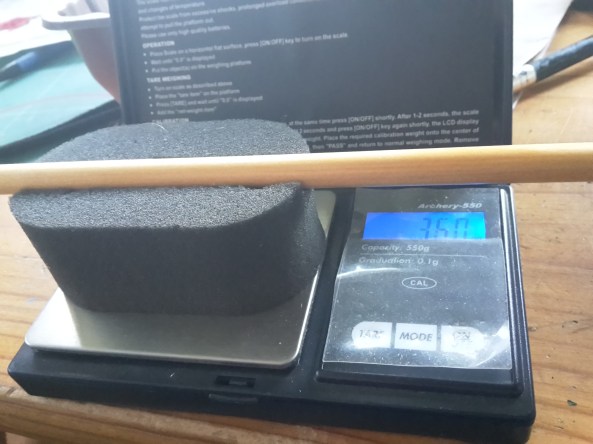
If you do go down the route of checking the  shafts may I suggest you purchase a set of grain scales for weighing the shafts. They are quite inexpensive and prove immensely useful. I can’t remember exactly where I  bought ours from,  but they are easily found online or at archery retailers.
Grain scales with sponge

Grain scales with sponge

When I use them I have a small piece of sponge with a groove cut into it where the shaft rests. This helps  to lift the shafts clear of the plate as I find this prevents the shaft snagging on surrounding items which would result in a false reading.
Remember to take a pencil or pen and paper to note the weights.

The process
We tend to weigh the shafts first and then spine them. This saves some time as weighing them is a quicker process than spining and you aren’t spining ones that prove too light or heavy.
It is worth noting that not all retailers allow you to do this and some don’t have the necessary space or equipment.

If you can spare the time and can travel to a shop here are a couple I’ll mention.

Wales archery (http://walesarchery.com/) situated just over the border in South wales have a huge selection of shafts and have in the past allowed us the use of their digital spining gauge. They are very friendly and helpful and have loads of bows you can look over. There are also some nice country pubs you can pop in for lunch.
Merlin archery (http://www.merlinarchery.co.uk/) in Loughborough too have always been very helpful and allowed us to use their spining gauge although their’s requires a bit of mathematics. I leave that to Sharon as she has the brains (skills and looks). We used to pop up on a Tuesday evening as they are open late.

The great Internet!! 
The other option is buying on-line. Finding good suppliers of wooden arrow shafts by mail order is even harder to find than you realise. You take a risk buying off the net and I would not recommend this unless you know the supplier has a good reputation. Pay for the service – I don’t mind paying a bit more if the quality of the product and service is good and some retailers offer a spining and/or weight matching service.

I’m going to pick out a couple who i have found to be good in recent months. I know there are others out there but these are a couple to start with for now.

For my take down  recurve I found Richard Head Longbows (http://www.english-longbow.co.uk/) for 5/16th was excellent. They are slightly more expensive than others  but are of very good quality. He does spine and weight matching.
As many of you know I’ve swapped back to AFB (American flatbow) and needed some 11/32 shafts and was recommended Longbow Emporium  (http://www.longbowemporium.co.uk/). Marc was really friendly when I spoke to him concerning my requirements.

This is by no means a definitive list or guide as there are many others who supply components via mail order or shops. I’ve just picked out a couple I’ve had experience of. If your favourite shop isn’t on the list or you have something to contribute why not add a comment on your positive experiences below.
I hope it proves useful.
Thanks for reading.

How to measure your draw length?

I’ve had a couple of people ask about how you measure your draw length and what length to make arrows?

There are a couple of ways of measuring draw length, I know Jordan Sequillion has posted a method on her site. The one I feel works best is using a measuring stick or measuring arrow.

You can buy them from most archery suppliers but I made mine. In essence, mine is an unused arrow shaft which I have glued a nock in one end and then marked up in one inch intervals. To make it easier to read I’ve painted the increments in contrasting colours.

Measuring Arrow

Homemade Measuring Arrow

Get the archer to draw up 3-4 times and then coming down obviously without releasing the measuring arrow. (make sure they are in a safe environment so on the range pointing towards the target boss just encased they accidentally release)

Full Draw

Archer at Full Draw

Ensure they are drawing to their normal anchor point each time, this way you can ensure the measurement is correct.

You can then see easily what there draw length is and the technique can be used for all pretty much all styles of bow, though please be careful when trying this with a compound bow, since it is easy to release the measuring arrow when you come down from full draw.

Here is a couple of additional tips.

Camera Phone – Use your camera phone to capture a couple of images of them at full draw. This will make easier to check the measuring later.

Rubber band or Tape – If you don’t have a camera to hand try using a piece of tape or rubber band at what you think is their draw and then have them draw up a couple more times. This way you can see if it is in the right spot.

If they are a beginner add another inch on as shown in this photograph below.

Measuring Arrow

White tape shows potential arrow length

I tend to recommend a slightly longer arrow if shooting woods and field archery. simply as in winter months you might be wearing a glove on bow arm and it gives you a little more clearance. Also should you lose the pile or snap the tip-off you might be able to taper the end back down and still have a usable arrow.

For competition I tend to cut them exact leaving no “spare”, if I lose the tip the arrow is added to the wood pile for the fire 😦

The other useful thing with using this method is spotting archers who either overdraw or overdraw and then collapse slightly. But I’ll cover this in more detail in my next posting.

Thanks for reading, any questions let me know.

Equipment part 4 – Failure and damage – Arrows

Damage can occur

No matter how careful you are equipment will get damaged over time and it is very important that you take the time to check your archery equipment to ensure you can spot issues before they become dangerous.

I’m going to concentrate on arrows in this section and write another one on bows in a week or so.

If you are a coach it is worth showing students and other archers the type of damage that can occur to their equipment.

One piece of valuable advice I’ve seen on a couple of sites is never assume an arrow is safe, even if it is brand new. Likewise expensive arrows can also be damaged in transit or manufacture, so always check them each time you shoot or retrieve them.

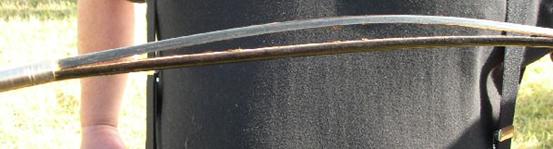
Here is a close up of an unusual style of arrow break.

arrow damage

split shaft close up

Another photo of  the same arrow shaft, you can see how it has split down its length.

split shaft full length

split shaft full length

Below image shows what happens when a wooden arrow impacts a wall  and the pile is flattened. Notice how the wooden shaft has snapped and then been forced into itself.

Arrow Damage

Compression break of wooden arrow

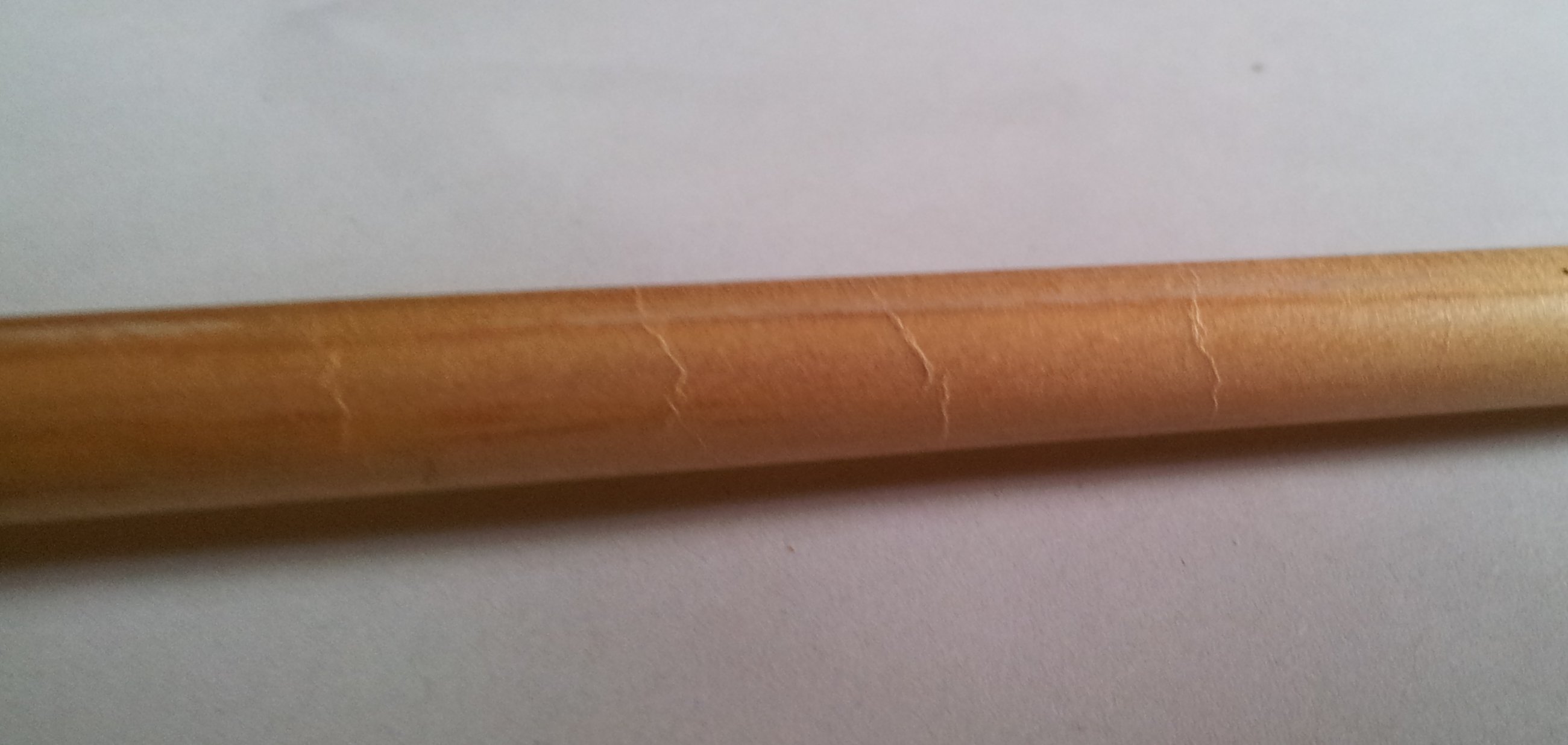
Sometime you can spot damage before it becomes a critical failure, below is a close up shot of a wooden arrow shaft that is showing signs of failure. You can see vertical crack lines across the arrow shaft. This will eventually result in the arrow bending or breaking.

damage to wooden arrow

Damage to wooden arrow

It’s not just wooden arrows that can fail and become damaged.

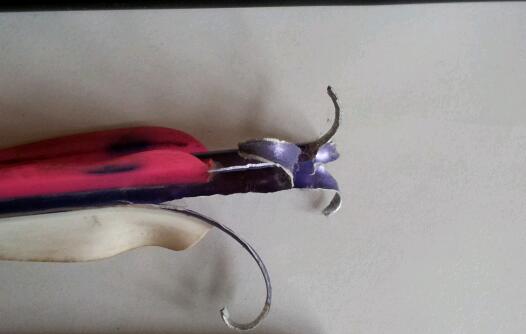
The photograph below shows what can happen to aluminium arrows . The archer had managed to hit their own nock with another arrow (great grouping in the target). The nock has shattered and the metal arrow has peeled back like a banana. This is sometimes called a Robin Hood Shot.

A Robin Hood shot

A Robin Hood shot

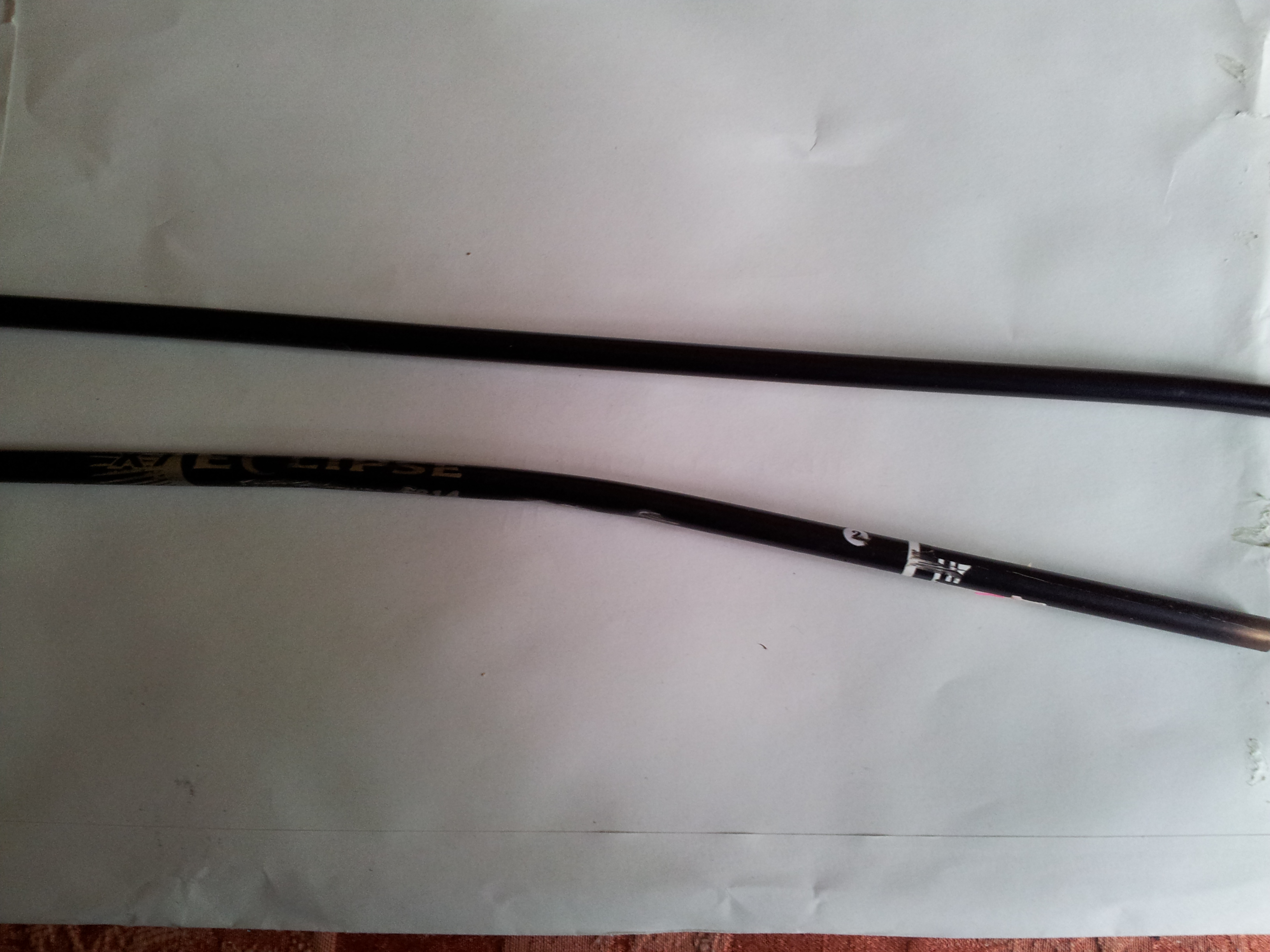
Obviously this arrow is no longer usable, but there are times when you will not have such a critical failure or damage. When your aluminium arrow might be only slightly bent and it can be possible to straighten them but it takes time, a level or expertise and correct straightening jig. Below shows a “slightly” bent arrow, following contact with a tree.

Bent arrows

Bent arrows

Carbon arrows also need checking regularly as they can split or worse still shatter. I’ve seen a compound shooter at a championships, release their arrow and it shatter into a million pieces, showering her and those around with carbon splinters. Fortunately no one was hurt and even more amazingly the bow was undamaged!

I know some archers now wear a Kevlar glove on their bow arm to protect them from any possible arrow failures.

It is not only at the bow end problems can occur, there are times when you are drawing arrows that the arrow may break, so it’s always worth either wearing a glove or using an arrow puller to give a cleaner and stronger grip. I’ve had to patch up a few people over the years who have cut themselves when drawing arrows that have split.

Also be aware of carbon splinters in targets. this often happens when the arrow pile has been forced into the shaft following a hard impact and resulting in the carbon shards breaking off.

A good way to test you carbon arrows is to flex the arrow, if you hear cracking or see splintering then dispose of  them. Also be aware that if you use arrow wraps, cracks can appear under these and are not always noticed.

Here are a couple of good sites and articles on testing arrows, be warned though there are a couple of graphic scenes of what can happen when an arrow fails.

http://www.huntersfriend.com/arrow-safety-warning.htm

http://www.youtube.com/watch?v=k6nIbvrMTbE

Tip – if you have a carbon arrow splinter on a shoot or when practising, don’t drop it into your quiver as it will leave splinters in the quiver. Take some tape and tape over the splintered section, this will stop loose pieces breaking off and fulling your quiver with razor-sharp splinters ( I always carry a roll of micropore tape in my first aid kit that is ideal for this.) You can then drop it into your quiver and dispose of it when you get home.

As always thanks for reading and I hope you’ve found this of use.