Range Set up

I’ve had a few discussions recently about range set up and how I’ve set up our range. I thought I would share how my range is set up to support both marked and unmarked distances practice.

We as a club don’t have any indoor facilities so our range is outdoor and this means we need to consider how it can be used all year round. Currently all the trees are in full leaf, but in winter months it can be quite cold.

Range image

We have only 2 bosses unlike other clubs that have several. These are in static positions, meaning we don’t have to set them up each time we want to use them. There are only 2 due to the space available.

These are arranged in 2 shooting lanes.

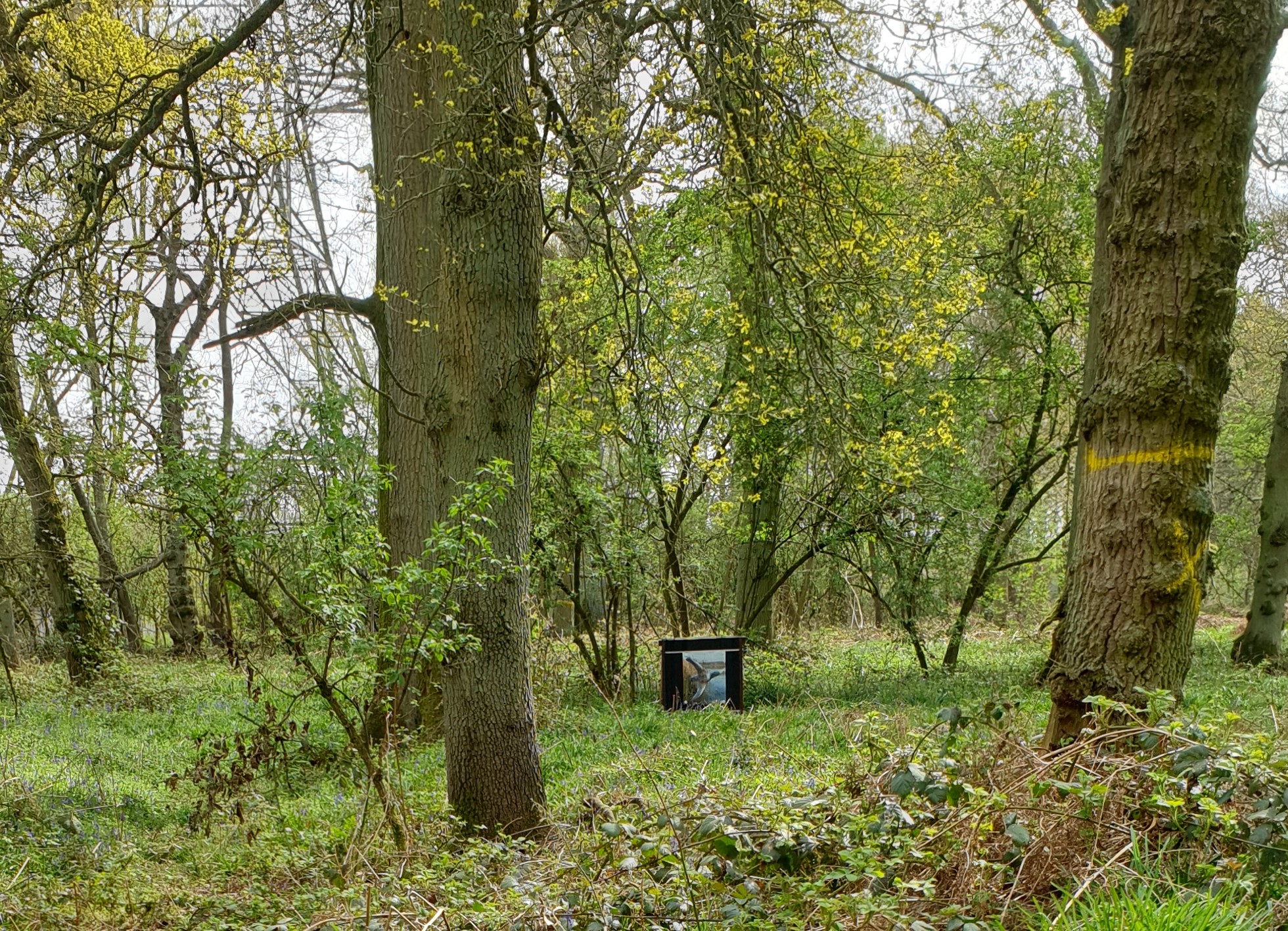
Each has a 60 ft overshoot behind, which enters into a small cop of trees, with catching mats at 30 feet behind each boss in the trees. These catching mats are sections of old carpet hung to act as a simple arrow stop. Beyond the 60 ft overshoot there is a 30ft high earth embankment. Most of the time arrows don’t reach the backstop mat but they are there just in case. If necessary, I can rig a backstop net between the trees, though I’ve found this seldom necessary.

The 2 shooting lanes are set up near parallel to each other with approximately 10 yards apart at boss end and 15 yards approximately at the furthest shooting pegs.

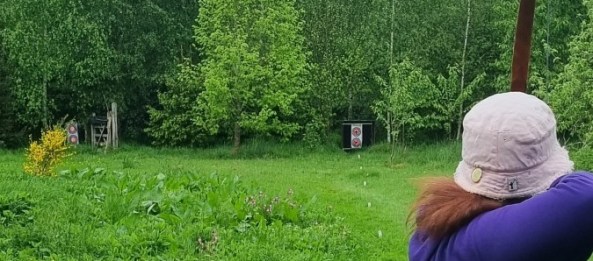
One shooting lane is marked and pegged at 5-yard increments for archers to develop their eye for fixed distance, to calculate their gaps or set up their sights. This is the one shown in the photograph above.

The other is unmarked distances with coloured pegs used by NFAS adults, so red, white and blue. You can just see the target boss beyond the yellow shrub in the above photograph. These are set to use the available ground and vegetation to simulate what you might encounter on a shoot. So, the red is by a tree, which forces the archer to adjust stance to avoid branches as they draw up. The white is on a small mound of earth so the forward foot touching the peg is higher than back foot. This helps archer develop their stance and balance on uneven terrain.

The blue peg is in the open but with trees between the peg and target giving an optical illusion on distance.

Periodically I move these coloured pegs slightly so they are slightly different. So, I might move the white peg forward, resulting in the archers back foot now being higher. This ensures archers don’t get complacent.

The coloured pegs are not set at 5-yard distances so the red is around 33 yards, white 27 and blue 21. This is deliberate again, so not at 20, 25, 30-yard distances that they might have practiced on the marked distance.

This has proved to help archers who want to get these gaps in and then practice unmarked distances with feedback being positive.

I hope this helps, thanks for reading.

Course laying behind the scenes

Archery target in the woods
Course setting

In this and my next few posts, I’m planning on exploring some of the behind-the-scenes activities that go on for a National Field Archery Society (NFAS) shoot. Those activities which attendees may not be aware of unless they have been involved in hosting or running such events. Though this will be focused on NFAS shoots these activities are common to most organisations.

You might wonder why am I doing this, well personally, I feel it is beneficial for all archers to gain some knowledge of some of the activities that go on before the event so they have a clearer understanding of the process which are otherwise hidden on the day. In doing so I hope the attendees can offer constructive feedback.

The concept of feedback will be the focus of this post. This in itself may sound a little strange. Starting with the very thing that is provided after the event, but it is something which has an impact on all parties and can be both positive or negative, constructive or damaging, supportive or hurtful.

Many people love to offer their views and more often or not this used to be via conversations in the clubhouse. Now in the 21st century, countless social media platforms offer people the ability to post their views, thoughts and more. You are currently reading my views.

Reading all this can be difficult especially if it’s not positive pr constructive. Filtering through these reports is not always easy if you are a course layer. I often wonder whether as course layers you have to develop a thick skin. I mention filtering as people will post their feedback based on their point of view or perception of the shot, organisation of the event etc. The style or shooting class will play a part here too, so remember that.

There is an old saying which seems very apt.

“You can please some of the people all the time. All the people some of the time, but not all the people all the time.”

Feedback positive and negative is equally important.

Whilst it’s great to receive positive feedback from archers on your course laying abilities, sometimes the less positive feedback is more important. That may sound a strange thing to say as, after all, you are wanting to experience the feel-good emotion about all the work and effort you’ve put in. So, I will try to explain it and the logic behind this statement.

So here is the Why?

Well, negative feedback if constructive provides you with the opportunity to develop and improve. I firmly believe that learning from your mistakes is vital. Too often in today’s society, people are focused solely on the positive for self-esteem or promotion etc.

Constructive negative feedback should stop you from becoming complacent with your own ability and perspective if you choose to explore the reasoning and facts presented.

The first step is to listen to the feedback, ideally with a clear head and evaluate whether there is justification for what is being said.

Some will present feedback that is, let’s say flawed or not entirely accurate. An example might be a statement that’s a 35-yard stretched shot for the target face. Well, if you know the distance is actually 28 yards and then their justification is possibly flawed.

Admit when you screw up.

Course layers are not perfect, all are human and therefore can and do make mistakes. Sometimes you have to put your hands up and say you got it wrong. In fact, I believe it is very important to do this if you have genuinely made a mistake. To steal a phrase from one of my favourite podcasts, “Don’t be that guy.” Don’t try and cover it up or worse still, blame the archers. It is not fair on them nor is it the right thing to do. If you have to make a mistake accept and learn from it.

For those interested here is a brief shoot report on our clubs website https://briarrosefieldarchers.wordpress.com/2021/08/19/briar-rose-field-archers-shoot-report-15th-august-2021/

Thanks for reading.