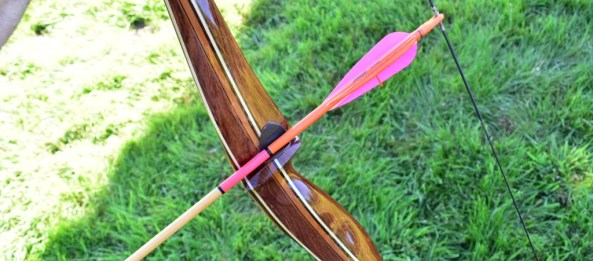
Sharons bow and arrow set up

Quick tip on brace height check

Showing the brace height and cresting

Showing the brace height and cresting

We all know how important it is to have your bow setup right and ensure it is at the correct brace height. I wanted to offer a quick tip to all archers out there for checking your brace height on your bow, which doesn’t involve having a rule.

When I made up the last batch of arrows for Sharon, I crested them in colours to match her fletchings, are pink and orange.

Close up of a couple of finished arrows

Close up of a couple of finished arrows

Before I started I measured the brace height for her bow and made sure that where the two colours met on the arrow, it would be in line with the light coloured strip on her bow, when at the correct brace height.

I then edged the divide between the two colours with a black band.

One of Sharons' finished arrows with black edging

One of Sharons’ finished arrows with black edging

Since this band coincides with the white band on her the bow riser, when the bow is at the correct brace height. It means she has simply to nock an arrows and check the banding on the arrows matches up with the light stripe on her bow and she will know her brace height is correct.
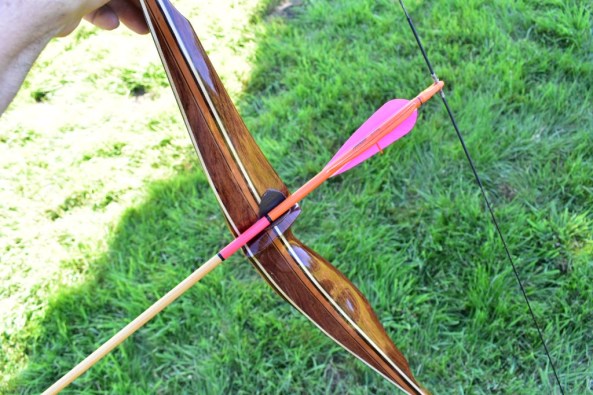
Sharons bow and arrow set up

Sharons bow and arrow set up

It is a simple and quick method that does not need a bracing rule, just a little bit of preparation when making your arrows. You could easily adapt the idea with any arrows, by putting a mark on the arrow to coincide with the correct brace height.

I hope this helps and thanks for reading.

The hardest lessons to learn in archery are…

I’ve had a great response to my question “What they feel is the hardest lesson to learn?” and for that I would like to thank all my followers and readers for their input.
I know that there are many people out there that will have your own opinion on what they feel is the hardest lesson to learn,but based on the responses, there are a few things coming up time and time again.
  • Aiming or rather, how do you aim whether you are a gap shooter or instinctive archer?
  • Stance and footing on a field shoot, where you might not be on level ground.
  • Coupled with aiming is distance judgement, which can be especially tough on a well set field course, where the course layer has used every trick inthe book to fool you.
  • I think the biggest one though has to be drawing down or coming down when you’ve drawn up on a target but feel you have to release, even though you know something is wrong.
  • I’m also working on a post about the importance of arrow weights and importance of not shooting too light an arrow.
  • Over bowing, being to identify when you are shooting too heavy a draw weight bow.
My hope is to create a post on each of these topics in the next few weeks.
I’m planning on covering aiming in a future article but for those interested check out one of the recent coaching podcasts from the guys at The Push, which covers instinctive and gap aiming.
Thanks for reading.