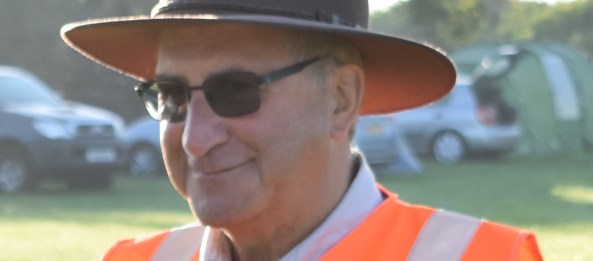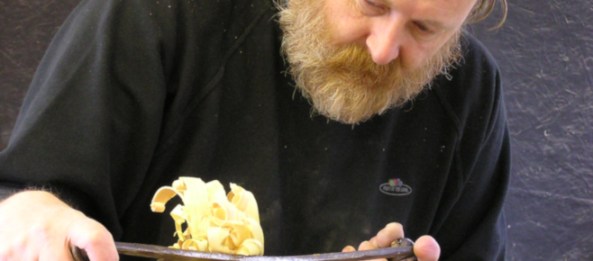
Pip Bickerstaffe Bowyer

A walk with Pip Bickerstaffe

Welcome to another in the walk with series and again we are doing a virtual walk due to the current COVID restrictions in the UK. In this article I will be talking to a well known bowmaker Iain “Pip” Bickerstaffe.
So over to you Iain or rather Pip to introduce himself.

Pip Bickerstaffe Bowyer

In archery I am known as Pip, my parents call me by my middle name, Philip – which is shortened to Pip.  
As I started shooting at 7 I have always been called Pip in the archery world but in “normal” life my first name is Iain and people assume that this is the name to use.
I don’t care what people call me but in archery Pip Bickerstaffe is the name people will associate with best.

Rob – I tend to only be called by Robert by my Mam and then it is usually because she believes I have done something wrong.  Anyway lets get back to the interesting stuff.
Why did you first get into archery, was it solely through family involvement?
I have always been interested in the history of archery, all over the world and the different bow types and designs that different cultures have used.
The bow designs used depend on the climate in that part of the world and the materials available.
So, over the years I have made most bow types and learned a lot about what does and doesn’t work.
I actually started out making fibreglass bows, flatbows and recurve bows. I also made a few compound bows.

Rob – learning what does and doesn’t work is very important part of learning any skill. Sadly, I feel many people just want to know the quick answer these day. Anyway, back to your story of how you got into archery. 
As a family we started in archery after my older brother and I clearly took to it with cheap bows from the Nottingham Goose Fair.  We removed the rubber suckers and used a pencil sharpener to put points on the arrows. We made shields out of cardboard and shot arrows at each other.  
My parents reckoned that this might not end well, it didn’t when I had an arrow in my cheek!
So, my father made us some bows out of garden canes and got us to both shooting in the same direction at a target – under supervision.

Rob – Ouch, but it clearly didn’t put you off. 
My father went and learned how to shoot at Rolls Royce archery club in Derby, but because it was a company club he could not join the club. So, he approached the sports section of the railways in Derby, where he worked in the technical R and R section.
So, he set up a club there where we all learned and got into target archery. This would be late 1960’s.

Rob – I knew you had a been involved in archery for a long time. You must give you a huge understanding of the history of archery and founding of what we now know as the National Field Archery Society or NFAS, and of archery in UK as a whole. Would you mind sharing your memories.
We joined the BFAA British Field Archery Association as well as the GNAS and got into field archery. The BFAA was amalgamated with the EFAA who soon removed the traditional classes.
So, in 1973, along with a group of archers from Lancashire and the East Midlands we formed the NFAS which my father ran as secretary for the first 25 years or so retiring from them in 1997 though we continued to help with championships for a few more years.

Rob – that was a huge commitment on behalf of your father and yourself. Thank you, for all the work it involved. You are well known for producing longbows, so how did this start?
After having used most types of bows over the years I started to take an interest in Longbows and my father was shooting them pretty much all the time.  So, I started making some and learning how to get the best out of them.
I decided to try to make a bow that was smoother and faster than the bows my father was shooting, made by well-known and experienced bowyers.  I tried to make bows of the same draw weight and ended up with a couple of beautiful bows that were around 43 lbs – my father’s bows were 55 lbs.
So, we decided to shoot the same set of arrows from two of his bows and nicer of my 43 lb bows. So, we marked three sets of three arrows that my father shot for maximum distance from the three bows. When we went to collect them we both expected the first arrows to be from my bow. But no, they were from one of the 55 lb bows, the next set were from the other 55 lb bow and the third set were from my bow.
So, 12 lbs lighter bow shot 15 yards further than the first set from the 55 lb bow and 10 yards further than the other one. Clearly my design had some potential.
From there we drifted into doing more roving archery having spent over 25 years running the NFAS and numerous field shoots, working at every National Champs, we headed for a quieter and less stressed style of archery.

In 1994 I started making Longbows to sell.  That was not a choice but I was made redundant when the firm I worked for went bankrupt. I needed to earn money with two young children, a disabled wife and a large mortgage. I have now made over 20,000 wooden bows plus some fibreglass bows and a number of different bow types.

Rob – wow, that is an amazing number of bows even over a 25 year period. Your workshop is based not far from Loughborough, isn’t it? 
The workshop is in Kegworth which is technically in Leicestershire, through the back window we look into Nottinghamshire across the river and a little distance away is the motorway and Derbyshire.  So yes, 3 miles from Loughborough, 1/2 mile from Nottinghamshire and about 2 miles from Derbyshire.

Rob – I’m sure others out there would be interested in knowing what you shoot, when you do get the opportunity to shoot round a course. So, can you talk us through your bow of choice?
When I was shooting a lot of field archery my first love was for a recurve bow with wooden arrows in hunting tackle.  But I was always looking at various options and I was still shooting target from time to time so I did some barebow archery in field and then tried compound bow hunter.
I then got a job doing some stunt shooting at Nottingham Playhouse where they needed a professional archer to put arrows in the target whilst the actors mimed shooting.  Equity could not cover the actors. I reckoned that if they were paying me money I could be professional and we made sure that I had insurance cover.
That earned me half the deposit for our first house!!  
But whilst I had shot most bow types over the years and had an affinity for Hunting Tackle as a shooting class, I found that I was picking up a longbow more and more as the bow of choice.

Pip at full draw with longbow

Rob – I think that happens to everyone. I enjoy shooting hunting tackle too, but for me it was the challenge of shooting Flatbow that always draws me back.
Do you get out to many shoot?
These days I do quite a few shoots in Germany and bow making course all over the continent and in the UK.

Rob – Do you think there is an increased interest in learning to make bows? I know there seems to be more interest in traditional styles in recent years from the people I have spoken to or coached.
There is a rising number of people who want to get into bow making. Many are trying to make self bows from all kinds of woods.  Sadly, nothing that grows in the UK make particularly good bows, never did, all down to climate and how the wood grows.  But you can make a bow out of most woods, it will shoot small game and feed a family, an archery bow good for 100 yards target and 180 yards clout is a different thing.

Rob – I would be curious in knowing how do you find the European archery scene compare to the UK?
In Europe we find a different archery scene where the traditional archery side is more associated with the re-enactment world, but you also find that they are generally very good archers, that like to dress in medieval costumes. Here people like dressing up, but the standard of archery is —  not so good.
Come on lads, don’t let the side down, if you want to be seen as a medieval archer, make the effort to shoot well, does not have to be a heavy bow. 
In my experience a light bow will kill — if you hit what you are shooting at — if you shoot a heavy bow, and I know many who can, but I also know people who struggle to hit the right field.
Some could not hit a barn if they are in it. But I also see re-enactors who give many good archers a challenge — let’s have more of you guys and impress the public.

Rob – This year has been challenging for so many people within the archery community and beyond. How has it affected you?
At the moment business is slow and we are getting very little help from the Government – apparently, I don’t qualify for income support as a self-employed person – but my employee can have furlough.
Hey ho, such is life. We do have orders, not a lot, but hopefully as people can get back to shooting we can hope that there will be a return to demand for our bows.

Rob – If you could reach every newbie archer out there with one single piece of advice what would it be?
For people new to the sport and wanting to get the most out of it the first and best advice would be to look to experienced archers shooting in the traditional manner rather than the modern recurve target archery techniques.
The traditional V draw technique that I was taught in the 1960’s worked then and still works now.

Rob – I was referencing your book “Shooting the English longbow” the other week with a fellow club member. Specifically, the V draw technique you mentioned and describe in the book. That reminds me, he’s still got it, so I need to get it back.
I know you’ve written a couple of books over the years on longbow. What prompted you to do this?
Basically, I have learned an awful lot and a lot of what I learned is not well recorded in the available archery books so I set out to write down what I have learned in a bullshit free way. So, if it is useful and relevant I include it, if it is not necessary or important, why include it? 
So, what I write is tried and tested and explained so that you can see for yourself that it works and you can check it out for yourself, there is enough information to do so.
My father was a physicist so I was taught to think logically and to work everything out from basic principles, in this way I have learned how to understand the important things in my field, how to select and grade wood based on how it grew, how to prepare effective gluing surfaces, what glues to use and how to use them, how to glue up a multi-laminated stave.  Learning the properties of each wood and where it is best suited to be within the bow.
In the end I have developed a range of bows that are consistent and reliable and lase for many years.
My old faithful is 12 years old. It, still shoots like it did day one, if a little smoother, it has not lost any weight and will still shoot 210 meters, not bad for 50 lbs at 28″

In terms of coaching, the old method that I was taught to shoot target archery was the traditional V draw technique which is ideal for wooden bows — but is not taught these days. So, I thought that I had better write it down.
As regards the history of medieval bows all the answers are there if you know what you are looking at and you can fairly quickly assess the likely draw weights of the bows based on the size and materials used to make strings, the nock slots telling you how big they were. The weight of the arrows is another guide to the draw weight of the bows and the size of the bows themselves, when you recognise the wood quality and density that you are looking at.
You can — with an experienced eye — see the likely draw weight of the bows.
It is so easy to see a big lump of a bow and think it must be heavy, not necessarily, the biggest bow on the Mary Rose is big because the wood is not of the best quality and you need more of that wood to make the weight.
So, it is pretty much the same draw weight as the rest of the bows. And that is? Look at all of the evidence and work it out for yourself, after a bit you realise that the medieval bows were made to be as light as possible but capable of achieving what was required. That way it was possible to find enough people capable of shooting them to their full potential. The strings would last a reasonable time and the range and effectiveness of the arrows was as needed.

Huge thank you Pip for your giving me your time and sharing you experiences for this article. For those interested here is a link to Pips website. Bickerstaffe Bows https://bickerstaffebows.co.uk/

Stay safe, stay well and thanks for reading.

photo of Harry Boyce

A virtual walk with Harry Boyce

It’s with great pleasure I get to introduce my next victim, I mean guest to off the arrow shelf. Sadly, due to the ongoing COVID-19 restrictions in the UK we have had to do this remotely but I’m sure you will still enjoy the banter.For the last 12 months it’s been nearly impossible for field archers to meet up in person, with the national society having to cancel it two main tournaments and countless local tournaments it’s been 12 months of challenges for Harry Boyce in his role as the president of the National Field Archery Society, so I’m very grateful for his time.

photo of Harry Boyce
Harry Boyce at the champs

So, let’s get going.  For easy my comments are in bold italics and Harry’s are in italics.

Rob – You are pretty well known to many on the archery circuit, thanks to your past successes in shooting and role as NFAS President, but how would you describe yourself?

Easy going & prepared to give anyone or everyone time to listen to their comments or problems.

Rob – Why did you first get into archery?

45 years ago, I was a youth club leader & along with another local youth club leader we organised an activities weekend for the members, part of which was archery by Friskney Bowmen. Having returned home & informed Terri what we had done over the weekend, she said “I have always wanted to try archery”. I took her along to Castle Bowmen to try it & told her this is your sport, I am not going to get involved with it. As I had always been into shooting rifles & shotguns from around 12 years of age, it didn’t take me long to get interested myself. The rest is history.

Rob – For those that don’t know Terri is Harrys’ other half and a very competent archer in her own right.

Harry and Terri
Harry and Terri

I’m sure others out there would be interested in knowing what you shoot, when you do get the opportunity to shoot round a course. So can you talk us through your kit set up?

As most NFAS members will know I shot barebow for over twenty years. My last barebow set up was a Bernadini riser with Hoyt carbon limbs 49lb at full draw, fastflight string & ACE 520 arrows with 70 grain piles.Fancying a change. I bought a L/H compound, went straight into Unlimited & I have been shooting that for about seven years.

Current set up is a Hoyt Nitrum 34, Fuse long rod with side rod, Hoyt Ultra rest, Black Eagle Challenger 400 arrows with 100 grain piles & Chocolate 3 finger release aid. I’m now going through the motions of thinking about having a go at Barebow again.

Rob – I think you have been shooting compound most of the time I have really known you. I do vaguely remember you shooting Barebow, when I was shooting Hunting Tackle. 

How would you define the appeal of field archery and what makes it such a draw for you, as you have bene shooting for several years?

The appeal of field archery to me is twofold, being out in the countryside & the friendships you make on your journey through archery.Over the years of setting courses & competing at shoots I have seen wildlife that some people only read about or watch on the TV. The most memorable being at a World Champs in Australia when kangaroos came thundering through the course. I didn’t need telling twice to get out of the way. 

What’s better than being out in the woods when everything is in leaf & in bloom with the birds singing. Field archery gives you the opportunity to meet a number of people that become friends for life. In the time we have been shooting, my wife & myself have made friends all over the world.It may have been a long time since you may have seen some of your friends, but when you do meet up again it’s like it was only a month ago & it’s nice to catch up again. 

Rob – Can you explain what your love or passion is that drives your interest in archery?

All my life I have been an outdoor person & shot everything from catapults to rifles & shotguns. The love of it is being out in the countryside with friends. The passion is seeing people enjoying themselves, try to hit what you are aiming at & trying to improve each time you are out.

Harry Shooting
Harry Shooting

It’s hard to describe the feeling of hitting the target that the course builder set so deceivingly to try & make you miss. Introducing a beginner to archery & then watching them to go on to become a top archer in their own right is a very satisfying feeling.  I have been mechanically minded since I was a kid & used to take my toys apart to see how they work. To me a bow & arrow (regardless of if it’s a longbow or compound) is just another mechanical devise, so I still get to tinker with the tools.

Rob – This year’s been challenging for so many people within the archery community and beyond. How has it affected you?

Over the last year I have been fortunate to still be in full time employment. As my work has continued to increase throughout the year it has helped to keep my mind occupied through these times. Like most people I have missed seeing family & friends, being out in the woods & socialising. But in doing that I realise that I have been more fortunate than some people or families & grateful to be able to still enjoy archery once things get back on a normal basis. 

Harry behind the scenes

Rob – The global Pandemic has impacting our lives hugely.  How are you coping with the lack of shooting?

Although there has been no shooting to speak of over the last year, I have still been working with the committee to ensure that once things are back to normal (whenever that may be) we still have a society that’s ready for us to continue shooting & enjoying our hobby.

It’s also helped to keep my mind off the lack of shooting with all the jobs that Terri has found to do around the house & in the garden.

Rob – Yes, I have seen some of the photos of garden projects Terri has shared. If ten years ago I’d told you where you’d be today, how do you think you’d have responded?

Ten years ago, I would have said that you were wrong (and possibly off your head), as having stepped down after serving 6 years in the position as President, I wanted to take a back seat & was not looking at taking up office again.Having said that, I have no regrets about returning to the job.

Rob – What would you say has been your biggest challenge you’ve encountered to date with your archery? How did you overcome this challenge?

The biggest challenge that I encountered was that less than perfect was acceptable. If I made a mistake in executing a shot, I used to get annoyed with myself because I knew I could have done better. It took me a while to realise we are all human (probably Tony Weston is the exception to that rule) & we all make mistakes. You cannot change what has happened, you can only change what is about to happen. Learn from your mistakes & carry on. I found that the more I relaxed, the more I enjoyed it & the more I enjoyed it the better the score. 

Rob – I am always curious what people feel they can pass on to other archers, especially newbies. If you could reach every newbie archer out there with one single piece of advice what would it be?

When you look around at the archers consistently winning their class, remember that they too were just like you, a beginner at one time of day. The only thing that will stop you from doing the same is you. Learn as much as you can from everyone you can. Knowledge of how to shoot and become a top archer can be free. Once gained, knowledge cannot be taken from you.   

Once again, I would like to say a huge thanks for your time Harry. It is very much appreciated.

Thanks for reading, stay safe and well.  

target faces

Target panic techniques – Draw, track, come down

So I’ve covered a couple of techniques so far (drawing down and blank boss shooting) in this series of posts on target panic.
So the third technique I’m going to cover here is one I’ve adopted from Jay Kidwell’s excellent book “Instinctive archery insights“. I’ve written about his book before and would advise anyone who is interested in aspects of coaching or target panic to pick up a copy. It is a very easy read and offers some great insights. The book was recommend to me by another coach and I really should type up a full literature review on it for the site.

cover of Instinctive Archery Insights

Instinctive Archery Insights

There is a little preparation required for this approach and it is not something that I suggest you try with your normal draw weight bow. So one thing you will need is a lighter draw weight bow. I use a 16lb draw weight take down recurve with my students.
In addition to a light poundage bow, you will need a few modified target faces and a 6 sided dice. Okay, so I know this may sound a little strange, some would go as far as to say a bit far fetched, but stay with me. I have found that using a six sided dice can prove very helpful and no, I’m not talking about gambling or playing snakes and ladders. Likewise the simple modification to the target face will help promote focus.

Simple target face with couple of lines added

Simple target face with couple of lines added, one horizontal and the other vertical.

The objective of this technique is to help the archer overcome the urge to release as soon as they have drawn up. Instead they develop the skill, neural pathways or retrain their brains to draw up and track onto and off the target. Overcoming the desire to release immediately the arrow is on the gold or when the archer thinks its on the gold.
Anyway back to how a six sided die can help along your with archery practice.
As many of us spend hours on the range training alone, it is very easy to fall into bad habits or repeating the same pattern again and again. In some ways we want to be able to repeat good form, but in this exercise we need to include a random factor. Hence the six sided die.
In Jays book he describes how a coach or shooting buddy call out a number, to denote the number of times you draw up and track across the target. There are a couple of important facts. The archer track across the target without releasing the arrow. Secondly they do it a number of times specified randomly so don’t form subconscious patterns.
To provide the random factor when alone I used the dice.

six sided dice in a clear box

Dice in a box

I modified the dice so there was no 1,5 or 6. This was easily done by sticking a blank label over the numbers. I wanted the die to show 1 four, 3 two’s and 2 threes. This may sound strange, but you don’t want too many higher numbers when performing the exercise as you would get fatigued, nor do you want a single occurrence.
I then housed the die in a small clear plastic tub large enough to allow the die to roll and clear enough to see the result.
So the second thing I done is modified a couple of targets by drawing lines on them through the centre, one vertically and one horizontally. When on the boss it gives the archer something to focus closely on when moving on and off the centre spot.

Remember, since you undertake these exercises multiple times, it is advisable for you to use a lighter draw weight bow.

In Jays book there are 3 exercises and rather than going into detail of how each of them work I’m going to explain how I use them and adapted them for my coaching style and students.

Step one

Me trying to remember to shoot

Me trying to remember to shoot

I’ll got through these step by step

  • First, fit one of the modified target faces to the boss so you have one line horizontal and another vertical.
  • Pick up you light draw weight bow and set yourself up at about 10 to 15 yards from the target boss.
  • Roll the die to get your random number, lets say 3.
  • Draw up and when they get to full draw and aimed / focused on the gold or in this case centre of the target, you move to the right to the edge of target and then  back to the centre. Once at the centre track left, again to the edge of the target. All the time maintaining full draw whilst not releasing. That is the crucial part, not releasing.
  • In this example  you would pass over the centre 3 times before coming down. Right, left, right and down.

The lines on the target provide a guide for movement. The theory is you are retraining your brain to be able to draw up,  centre on the target and then move off and back on without releasing. The movement to the left and right doesn’t have to be huge, ideally 3 to 4 inches at most.
The advantage of using the pizza base targets are they aren’t that large so you are tracking left and right only a little.
An alternative to this method is rather than tracking left to right, you track up and down, moving vertically through the centre. This is why there are both horizontal and vertical lines drawn on the face.
Try practising this technique for a few weeks and slowly it will help you build confidence and control.

The next step

So by this stage you have hopefully learnt to be able to draw up onto the target and move off it. A subtle development of this technique is when pass over the centre, you actually stop and hold on the centre for a moment.

From my experience these exercises work well, with the die providing a random number of reps you have  to perform.

Development

When you have mastered either or both of theses techniques you can progress to a slightly different version. In this version you combine the above exercise of moving over the centre spot of the target but on the final pass you lock onto the centre and you actually release the arrow.
When I am coaching these technique with students I recommend, they don’t perform them for long periods of time. Even with using a light draw weight bow there is quite a lot of strain on muscles, not to mention the concentration required. Ideally 15- 20 minutes seems to be optimum. Any longer and it can become tedious and the students tend to lose concentration.
The other thing is to practise these techniques over a few sessions, as it will take time for you to retrain your brain into being able to draw up, move on and off target spot etc. It is not something you can do once or twice for a couple weeks and then stop. Overcoming potentially years of subconscious neurological programming takes time and effort. So give yourself time to learn these skills. It does help if you practise them.

Thanks for reading.