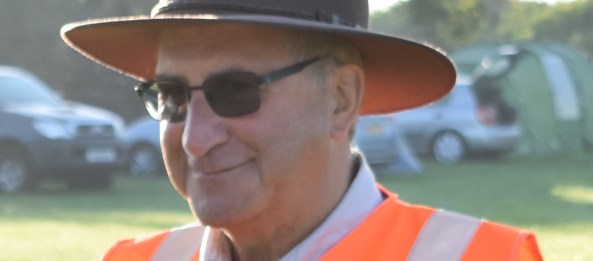
It’s with great pleasure I get to introduce my next victim, I mean guest to off the arrow shelf. Sadly, due to the ongoing COVID-19 restrictions in the UK we have had to do this remotely but I’m sure you will still enjoy the banter.For the last 12 months it’s been nearly impossible for field archers to meet up in person, with the national society having to cancel it two main tournaments and countless local tournaments it’s been 12 months of challenges for Harry Boyce in his role as the president of the National Field Archery Society, so I’m very grateful for his time.

So, let’s get going. For easy my comments are in bold italics and Harry’s are in italics.
Rob – You are pretty well known to many on the archery circuit, thanks to your past successes in shooting and role as NFAS President, but how would you describe yourself?
Easy going & prepared to give anyone or everyone time to listen to their comments or problems.
Rob – Why did you first get into archery?
45 years ago, I was a youth club leader & along with another local youth club leader we organised an activities weekend for the members, part of which was archery by Friskney Bowmen. Having returned home & informed Terri what we had done over the weekend, she said “I have always wanted to try archery”. I took her along to Castle Bowmen to try it & told her this is your sport, I am not going to get involved with it. As I had always been into shooting rifles & shotguns from around 12 years of age, it didn’t take me long to get interested myself. The rest is history.
Rob – For those that don’t know Terri is Harrys’ other half and a very competent archer in her own right.

I’m sure others out there would be interested in knowing what you shoot, when you do get the opportunity to shoot round a course. So can you talk us through your kit set up?
As most NFAS members will know I shot barebow for over twenty years. My last barebow set up was a Bernadini riser with Hoyt carbon limbs 49lb at full draw, fastflight string & ACE 520 arrows with 70 grain piles.Fancying a change. I bought a L/H compound, went straight into Unlimited & I have been shooting that for about seven years.
Current set up is a Hoyt Nitrum 34, Fuse long rod with side rod, Hoyt Ultra rest, Black Eagle Challenger 400 arrows with 100 grain piles & Chocolate 3 finger release aid. I’m now going through the motions of thinking about having a go at Barebow again.
Rob – I think you have been shooting compound most of the time I have really known you. I do vaguely remember you shooting Barebow, when I was shooting Hunting Tackle.
How would you define the appeal of field archery and what makes it such a draw for you, as you have bene shooting for several years?
The appeal of field archery to me is twofold, being out in the countryside & the friendships you make on your journey through archery.Over the years of setting courses & competing at shoots I have seen wildlife that some people only read about or watch on the TV. The most memorable being at a World Champs in Australia when kangaroos came thundering through the course. I didn’t need telling twice to get out of the way.
What’s better than being out in the woods when everything is in leaf & in bloom with the birds singing. Field archery gives you the opportunity to meet a number of people that become friends for life. In the time we have been shooting, my wife & myself have made friends all over the world.It may have been a long time since you may have seen some of your friends, but when you do meet up again it’s like it was only a month ago & it’s nice to catch up again.
Rob – Can you explain what your love or passion is that drives your interest in archery?
All my life I have been an outdoor person & shot everything from catapults to rifles & shotguns. The love of it is being out in the countryside with friends. The passion is seeing people enjoying themselves, try to hit what you are aiming at & trying to improve each time you are out.

It’s hard to describe the feeling of hitting the target that the course builder set so deceivingly to try & make you miss. Introducing a beginner to archery & then watching them to go on to become a top archer in their own right is a very satisfying feeling. I have been mechanically minded since I was a kid & used to take my toys apart to see how they work. To me a bow & arrow (regardless of if it’s a longbow or compound) is just another mechanical devise, so I still get to tinker with the tools.
Rob – This year’s been challenging for so many people within the archery community and beyond. How has it affected you?
Over the last year I have been fortunate to still be in full time employment. As my work has continued to increase throughout the year it has helped to keep my mind occupied through these times. Like most people I have missed seeing family & friends, being out in the woods & socialising. But in doing that I realise that I have been more fortunate than some people or families & grateful to be able to still enjoy archery once things get back on a normal basis.

Rob – The global Pandemic has impacting our lives hugely. How are you coping with the lack of shooting?
Although there has been no shooting to speak of over the last year, I have still been working with the committee to ensure that once things are back to normal (whenever that may be) we still have a society that’s ready for us to continue shooting & enjoying our hobby.
It’s also helped to keep my mind off the lack of shooting with all the jobs that Terri has found to do around the house & in the garden.
Rob – Yes, I have seen some of the photos of garden projects Terri has shared. If ten years ago I’d told you where you’d be today, how do you think you’d have responded?
Ten years ago, I would have said that you were wrong (and possibly off your head), as having stepped down after serving 6 years in the position as President, I wanted to take a back seat & was not looking at taking up office again.Having said that, I have no regrets about returning to the job.
Rob – What would you say has been your biggest challenge you’ve encountered to date with your archery? How did you overcome this challenge?
The biggest challenge that I encountered was that less than perfect was acceptable. If I made a mistake in executing a shot, I used to get annoyed with myself because I knew I could have done better. It took me a while to realise we are all human (probably Tony Weston is the exception to that rule) & we all make mistakes. You cannot change what has happened, you can only change what is about to happen. Learn from your mistakes & carry on. I found that the more I relaxed, the more I enjoyed it & the more I enjoyed it the better the score.
Rob – I am always curious what people feel they can pass on to other archers, especially newbies. If you could reach every newbie archer out there with one single piece of advice what would it be?
When you look around at the archers consistently winning their class, remember that they too were just like you, a beginner at one time of day. The only thing that will stop you from doing the same is you. Learn as much as you can from everyone you can. Knowledge of how to shoot and become a top archer can be free. Once gained, knowledge cannot be taken from you.
Once again, I would like to say a huge thanks for your time Harry. It is very much appreciated.
Thanks for reading, stay safe and well.


