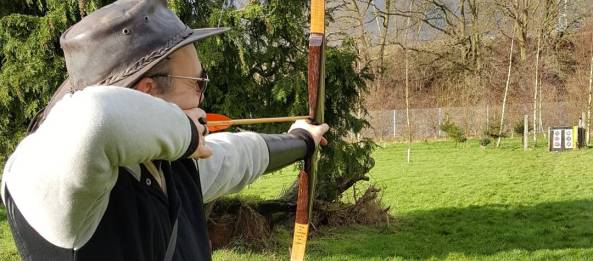
Me trying to remember to shoot

Target Panic techniques – drawing down

As promised we are going to start on the shooting techniques that can help with you overcoming target panic or anxiety when shooting.
So let’s look at one technique, which I feel is the best to start with and is a good one for any archer to develop whether suffering from target panic or not. Ironically it is something you probably did lots when you started but have maybe forgotten and thought is no longer needed. What am I talking about? The ability to draw down from a shot.
A while back I wrote a series of articles on what I thought were the “Hardest lessons to learn in Archery“. In those articles, I shared some coaching tips and ideas. One of these was on the skill of drawing down, sometimes called coming down from a shot. I’m going to revisit it here as it is a good technique to master when on the road to overcoming target panic. If you take nothing from this post, other than the thought of the importance of drawing down from a shot, fine believe me it’s going to help you.
First a quick definition -So drawing down is when you have drawn up your bow on your target, ready to release, and then lower it back down, without releasing the arrow and taking the shot.
Chances are you do it as a beginner when you first start, as it’s not uncommon for us to flick the arrow off the rest, normally because we are twisting the string, but as time progresses chances are you do it less and less often.
I would go as far as saying that learning to draw down your bow is probably my top tip for all archers, whether they suffer from anxiety, target panic or not. I firmly believe it is as equally important whether you shoot a trad bow or a compound. You have to be able to stop and come down from your shot safely.
I would like to share an example, which I feel ideal demonstrates the importance of practising this technique and how vital it can be.
When I was at a national tournament in a country park. This was a little over 4 years ago and I was about to shoot a 3D target about 15 yards away when a dog ran out in front of me!
I was at full draw, focusing on the target and about to release. In that split second, I reacted and followed my training and came down but it could have ended very differently.
The dog had been let off its lead by its owner on a public footpath running through the wood, after ignoring the warning signs to keep dogs on the lead due to the tournament. It was a close call and I was pretty shaken up and yes I did report the incident to the marshalling team.
It is quite common for those suffering from target panic to be unable to reach or hold at full draw, with many being unable to draw down. So building a training program that encourages it, developing it in such a way as it becomes a natural process is a good plan.
Think of it from this perspective, taking a shot is part physical, part mental. Over time your muscles develop in strength and flexibility, but your head is different. You think you may have learnt what to do. You’ve got yourself psyched up to take that shot and then at the last stage, you have to admit something is wrong or doesn’t feel right. That can feel like a big hit to your confidence, especially if people are watching. So the anxiety hits and you either release the string too early, as you can’t get to anchor or maybe do something else. If this behaviour persists then it becomes a habit and part of your shot sequence.

Train the brain

Okay now think of your brain as a computer and we train our brain through actions we undertake. If your brain believes every time you draw up on a target you have to shoot then it becomes very hard to stop this chain of events, even when you want or have to. If I hadn’t been able to stop when that dog ran out in front of me, well things could have been much worse.
Developing the ability of drawing down helps to program our brain, training it to know that just because we draw up onto a target doesn’t mean we have to shoot.
When drawing up to take your shot, there is the programming in your head or maybe I should say the expectation to release the arrow. In the back of your mind, you don’t want to admit that something is wrong or that you may have done something wrong.
One way you can overcome this problem is to condition yourself to draw down, or rather condition your head to accept that each time you draw up you don’t have to shoot.
An analogy – When you are driving a car and approaching a roundabout or junction, we might be able to arrive at said junction, observe no traffic and go. This is similar to us drawing up and encountering no problems, so we shoot. However, those of us who drive know we often have to stop at junctions due to the traffic we observe. Those observations provide information to us and are similar to drawing up and it feels wrong or uncomfortable.
Through repeated practise and experience of driving, we know we have to stop to avoid a collision. If we can do this when driving a car, which is far more complicated than shooting a bow, then we should be able to come down from a shot. Well, that’s the theory.

So what can you do?

One way of trying to overcome this mental block is to start programming your brain that
  1. The action of drawing up does not mean you have to shoot.
  2. The action of drawing down is normal.
There are a couple of effective ways of doing this. One method sees you using your normal bow, the other has you using a lighter draw weight. The techniques goal is to train yourself i.e. your brain during practising learns to not take each shot, i.e. removing the expectation that every time you draw up you have to shoot.

Step 1

So when you are shooting your normal bow and on the practise bosses, try this addition to your normal program. It’s really simple. Don’t shot your 3rd arrow immediately.
When you get to your 3rd arrow draw up as normal, anchor, settle aim and at the point, you would normally release the string, stop.
Instead of releasing, drawdown, go back to your ready position. Take you hand off the string, leave the arrow on the string and relax. Take a couple of breaths and then draw up and if it feels right take the shot.
So why do this?
Well it starts to condition your mind into that mindset we are wanting i.e when you draw up it does not mean you will have to always take the shot. Effectively you are retraining your brain to be more flexible.
This may sound strange but it helps build your muscle memory and gives you confidence, it helps to make you realise that you don’t always have to take the shot. This, in turn, goes a long way to improve your shot control. Don’t get me wrong, it won’t be easy. There are times you draw up and feel perfect, but if it is your third arrow come down and do it again. You might draw up and down 3 or 4 times but over time you will get used to the feel and not let it affect you.

Step 2

The other technique has you doing a similar exercise using a lighter weight bow, I have an 18lb recurve I use. With this method, you draw up, anchor and come down, then draw up anchor and shoot. Because you are effectively drawing up twice for each shot you need to use a lower draw weight bow, otherwise, you are going to get tired and fatigued very quickly. I find doing this for a couple of sets of 4 arrows works best.
The key point of this technique is for you to learn that just because you draw back your nocked arrow, it doesn’t mean you have to take the shot. It can be a hard lesson to learn, but when it works and it will with practise, it feels great. It feels like you have retaken control of the shot and your archery.
Try the technique and let me know if it works for you or if you have something else that works. I sincerely hope this has helped, please let me know what you think.
Thanks for reading and as I have said previously feel free to drop me a line with any questions or thoughts you might have.
Selection of bows

Target panic and how knowing our bows can help

In the previous post on overcoming target panic I talked about building confidence and how knowing your arrows can help give you confidence. In this post lets look at the second side of the archers triangle the launcher of those projectiles, our bows.
archers triangle graphic

The archers triangle

Our bows come in all shapes and sizes. They can be a hand crafted traditional English longbows or the latest high tech compound from Bowtech. Yet they all share one or two key facts. They are all designed to perform one function, to launch a projectile effectively and hopefully deliver said projectile to the target. They all require correct setting up and maintenance at varying levels of complexity to ensure they perform this task. Just to be clear though I’m not going to go into detail about tuning bows in this post, that’s for another time. What I am will do is give you some points to consider,
So I want to start by pondering a couple of questions.
Does your bow perform exactly the same each time you use it? I’m not talking about how well you shoot it but how well it performs. Hopefully it does, but what if it doesn’t. If we take this question further and look at one element of set up as an example, the brace height.
How often do you check your bows brace height? Each shooting session, once in a while?
For traditional bows or take down recurves the question can be Is the brace height the same each time you string it? Its very easy to drop the string and loses a few twists. Alternatively if it is a new string it could stretch slightly as it beds in.
Without knowing the bow is performing consistently how can you have confidence in its behaviour and its delivery of the arrow to the target.
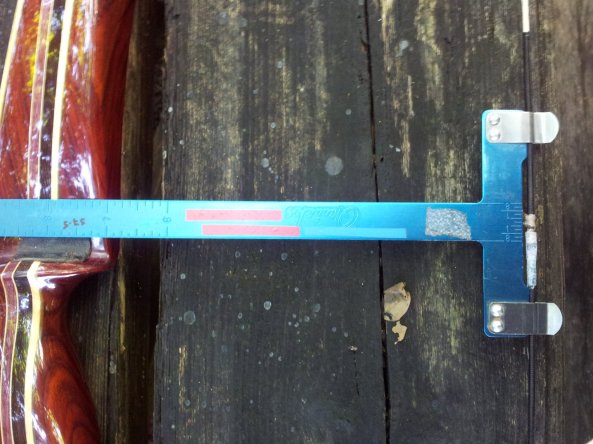
Definition of brace height the brace height of a bow is the gap from the string (nocking point) to the riser. The actual brace height of different bows vary, but all manufacturers will provide an upper and lower limit. Normally for a recurve this will range from about 7 1/2 inches to 8 3/4 inches.

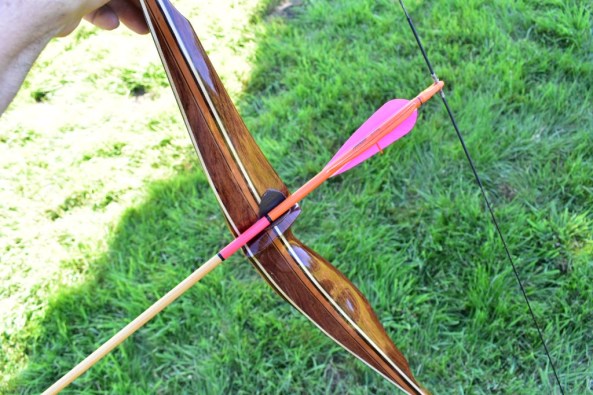
One tip I will share is using your arrows cresting to help you check the brace height of your bow, as shown in this photo. The black banding is set at the ideal brace height for the bow as it lines up with the white band you can see.

Sharons bow and arrow set up

Sharon’s bow and arrow set up

Tune don’t Twiddle

I would always suggest you spend some time and ensure the bow is set and working at its best, tweaking brace height, nocking point etc. until you reached the optimum. Once it’s tuned and working well stop. Yes, stop. Focus on learning to shoot that bow. If you are constantly altering elements of your bows set up, say the brace height or nocking point, then you will have an ever changing platform on which to try and learn to shoot. This twiddling or constant changing will not help you develop confidence in being able to shot the bow.
Top tip – If you have something that works please don’t be tempted to twiddle or tweak it, especially in the run up to a champs or competition. You might think it will help and get you those extra few points, but the flip side is it could cause all your training to be for nought if it has a negative effect on your setup.
I’ve seen lots of archers spending a fortune on kit, along with hours of time chasing the idea that a slightly different spinning of arrow shafts or couple of extra twists in the string will make the difference. When in reality they already have something that works really well and changing means quite often they lose confidence in their kit. As well as points on the score card.
“Learn to shoot with the bow you have” was something my old coach always said. Know that it works and your arrows work and this will give you confidence.
I tend to record what works well for each of my bows. This means I have a record of string length, brace height, plunger set up, etc. for all my bows and over the years I have found photographing the brace height and nocking point particularly useful. I have found this makes it much easier when setting up a new string. It provides visual guidance something that makes your life much easier. I tend to bring the image up on my tablet screen so it’s large enough to see easily.
Bracing on bow

Bracing on bow

Using your phone camera is one piece of advice I will offer as it can not only help with set up, but also monitoring any possible problems i.e. how much has the string stretched or worn over the space of a few sessions.
Bows like arrows are susceptible to damage, this can be via accident such as dropping it or through ignorance in improper usage.
dmaged riser

Damaged riser

Again your camera phone can help here for documenting wear and tear on your bow. I’ve know archers to use their phone cameras to photograph the limb bolts after marking them to see if they undo over time. Other forms of damage can occur from incorrect usage such as dry firing.

Dangers of dry firing

What is a dry fire? It’s when you draw back a bow without an arrow loaded on the string and release the string.
Why is this a problem?
All the energy that would normally be transferred to the arrow from the bow has nowhere to go other than back into the bow. This is never good and has seen bow risers break, limbs delaminate or even snap. There are a few YouTube videos on what happens and archery360 has produced a good one.
In short NEVER ever dry fire a bow.

Arrow weights V bow damage

While talking about bow dry fires I want to mention arrow weights. Be mindful of how light your arrows are. Some manufacturers recommend a minimum arrow weight for their bows as a safe guard against potential damage or failure. Shooting an arrow that is too light can be akin to a series of mini dry fires and over time can lead to damage to the bow. So check if the manufacturer’s have a minimum arrow weight.
String maintenance – It sounds like a simple thing to remember but I am always amazed at how few people actually maintain their bow strings. Whether this be waxing it on a regular basis or just checking for any fraying or damage to the serving. If you shoot a compound bow with a d-loop, please keep an eye on these. I’ve seen an archer at full draw have their D-loop snap. The arrow went flying off some 50 yards. Our coaching equipment is regularly checked as we’ve noticed wear and tear on the serving loops from them being fitted and removed constantly.
Please don’t over bow yourselves. I know I have said this so many times before but it’s really important. A well set up bow with well matched arrows often negates the need for heavier draw weights. One final point for you to ponder I’ve written previously about the benefits of having and using a light poundage bow when working on form or recovering from injury etc. So much as it might be tempting to exchange or sell the lighter poundage limbs you might want to hang onto them just in case.
Personal insight
This process of arrow and bow set up certainly gave me confidence when I started. Knowing the quality of the arrows and the bow I was shooting, and they were working correctly together meant there were less things for me to worry about.
Both of these elements are pretty easy to tune given time. The fare harder part is the archer, as unlike the bow and arrow, the archer has a mind of their own. The thing is once you know your kits right, you will inevitability grow in confidence as your bow delivers your arrows with more consistently at short, medium or long distance.
So lets start looking at building confidence in the third and final element, the archer.
Thanks for reading.
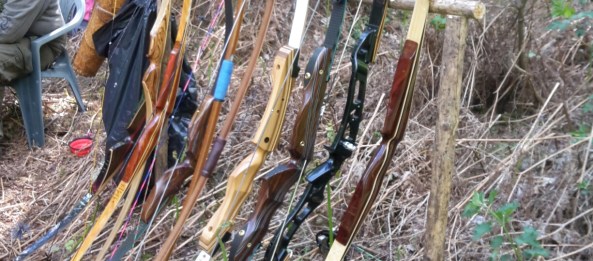
Bows resting on tree

Target Panic and the archer part 1

When accuracy turns to anxiety, fun turns to fear, maybe it’s time to get some help?

So here goes. I am going to try and offer some thoughts on the very sensitive topic of target panic, something I know countless people, along with several friends struggle with at varying levels. I realise it is a very sensitive topic and I will freely admit I am no expert on the subject.
All I am going to do or I should say trying to do, is offer some ideas, possible guidance and help. So here goes, wish me luck.
Based on my own experience I believe target panic of some form will affect every archer at some point in their archery life. That is a pretty big statement to make in the outset but it is something I believe to be very true.  It may manifest as a slight uneasiness when about to take a shot, to being so severe archers will want to quit shooting altogether. I’ve lost count of the number of archers I have spoken to over the years about varying levels of target panic and how it impacts them individually. For this reason I am going to be writing a couple of posts with some personal insights, suggestions and experiences.
So what is Target Panic exactly?
Well Wikipedia defines it as follows
“Target panic is a psychological—and perhaps neurological—condition experienced by many archers, both competitive and recreational.” (https://en.wikipedia.org/wiki/Target_panic)
This definition has quite an important factor to remember,  as target panic can affects the competitive archer and the hobbyist. Even if  you never go to a competition and shoot purely for fun target panic can impact you.
It can also manifests in many forms and this is why I personally prefer describing it as target or shot anxiety.
The rational for my description is simple, as the anxiety felt by the individual can occur long before ever getting to the shooting peg. I know I’ve spoken with some archers who can’t go to the warm up or practice area. Others feel it when they are preparing to set off or in the car on route to the location.
For this reason I’m going to offer my own definition.
“It is a level of anxiety felt by the archer, which can either result in manifesting in physical feelings of unease, loss of muscle control or manifest in the lack of mental skills such as concentration or focus.
The level of anxiety varies widely and can present itself on the field or at stages before. “
Okay so that is a pretty lengthy definition but I believe it covers the key elements.
So lets explore how target anxiety can manifest with a few common examples.
  • As the archer approaches the peg they feel they have forgotten how to shoot, their brain goes blank and they can’t seem to remember the order of the stages in their shot sequence.
  • An archer may find it difficult to draw up on a target, with their bow feeling too heavy, they can feel like their muscles and brain aren’t communicating. Yet they can draw up perfectly well when not aiming on the target.
  • Archers may feel their kit is letting them down and be constantly altering the pressure on their button or adding / removing twists in their string.
  • Some may be able to draw their bow, but release the string as soon as they have drawn up towards the target. Releasing the arrow long before they intend to or are on the target. They are effectively missing the aiming part entirely as they feel unable to hold on a target believing they must immediately release at full draw.
  • Archers may feel unable to release the string when at anchor, as they hold and hold for what they believe is a more controlled shot. Eventually releasing the string when they become to shake or can’t hold it any longer.
  • These are just a few examples, there are countless others which goes to demonstrate how target anxiety can impact on an archer in different ways and at different times. The good news is there are techniques that can be employed to help you.
So what can trigger the onset of such anxiety? Here are a few possible scenarios
  • You might find it builds gradually over time. A common example I have seen is for the archer to start shooting very quickly, releasing as soon as they think they have reached full draw.  Please note this is not the same as snap shooting where an archer has trained to draw and release in a fast single motion. With target anxiety they are not giving themselves times to settle and aim. Over time they begin to lose control of the final stages of the shot process.  Eventually resulting in them prematurely releasing the string and having the arrow impact in the ground in front of the target.
  • Another example comes when you apply pressure on yourself to perform, to reach the next level or perceive that you should be improving faster.  I have seen archers spend hundred and hundreds of pounds on new arrows, limbs, release aids etc. All in the belief that this is what is they need for them to succeed. I have little doubt you have heard the phrase all the gear and no idea to describe them. The reality being that what they need is the support and instruction on improvements to their form or mental outlook to the hobby.
  • When you have achieved a level of success and feel others watching you. On a personal note I can admit to this being how it manifested for me. I am a reasonable shot with my flatbow and been fortunate to win a few medals at local and national level.  Over time I’d gone from a beginner, or rather an also ran, to  a top 20 place, to top 10 and then a medal winner. Problem with this is the level of expectation that comes with shooting well. I would get to a competition and feel people watching me, whether they were or not, it was how I felt. I would feel they would expect me to place. This is one of the reasons I hate being picked for memberships of teams at competitions. I’ve had to work very hard to overcome these demons and I’m still struggling at times. The key thing it is possible.
  • Want to match own expected performance – again this is personal to me. I will admit I am competitive, but very much against myself. If I take a shot and don’t score as well as  i’d expect, I could start a downward spiral. If it was down to good course laying I wouldn’t feel so bad as they tricked me, but if it was down to me then I can get pretty low. I let that poor shot effect the next  shot and so on.
I’m sure you can think of other examples, maybe personal ones based on your own experiences.
As coaches, we may well be the last people archers come to for help. Sadly this is often quite late in the development, being more often the last call behind Google searches and YouTube. This is part of the problem with Target Anxiety as archers don’t want to admit they may have a problem. We live in world where admitting problems or we may not be perfect is seen as wrong or a weakness. This is something that has to change and in my view is simply wrong.
In the next article I will go I to more details on what  can help and identify in more detail how it has impacted me and what I have tried to overcome it. In the meantime if you have any comments or thoughts let me know.
Thanks for reading.