Old wolf

Original rule of 6 had nothing to do with COVID-19

Old wolf

old wolf – just because I like the photo

It was a concept I think I heard of years ago and think it was north American Indian culture from memory. though I may well be wrong. It was concerning looking at something, a problem or concept and identifying 6 possible reasons, outcomes or possible rationales for actions. Effectively expanding your understanding and perception of the activities

So, if you take this onboard I have found it very useful when looking at computer systems, working processes and from coaching. Some of the ideas might be pretty straight forward or sensible others might be more out of the box, but it is a good exercise to broaden your perspective.

To give you an example of what I mean let’s look at why someone might post something on Facebook or a blog

  1. To share their thoughts / experiences – we are social creatures and some like to share ideas, concerns and thoughts.
  2. To be seen as knowledgeable in an area – possibly when talking about specific topics or theories, often something seen in work places.
  3. To building their fan base – you see this with internet social influencers, they wish to boost their own presence or perceived standing online or in the specific area, whether they have knowledge in the area or not.
  4. They might be trying to build self-confidence – COVID-19 has seen an impact on the mental health of many and some might find posting on social media or other sites help boost confidence.
  5. Doom bringers – some come across as always wanting to be negative and pull everyone down, destroy ideas.
  6. Like to hear own voice – possible gregarious and like talking and expressing views on everything.

As I have said I have a tendency of doing this, I would say almost naturally in that I do try and look at things from multiple angles, I think partly due to my struggles with health and education over the years, from childhood and onward. I have found this approach useful when coaching archery and in my working life.

So why am I talking about this?

The last few months have not been easy for many people and the new restrictions of group sizes due to arrive on the 14th of September in the UK, local lockdowns, return to office work after working from home, and more  is affecting lots of people so my example 4 of self-confidence is possibly even more important.

Lots of people are struggling with their stress levels, physical and more importantly mental health. I know personally I have been and am struggling a bit, probably more than a bit, if I am truly honest. I miss being out and about in woods. I really miss the coaching and social interactions that come with helping people. I think that was one of the instigators of me starting the podcasts in an attempt to reach out and support people.

I started this site and more recently podcasts to share thoughts and experiences, not to be seen as knowledgeable or expert,  as the one thing I have learnt is the more you learn, the more there is to know. I have no interest in being a social influencer and despite what some think I don’t want to be negative or enjoy hearing my own voice. Yes, I often see the possible problems but this is because I want to be aware of them and have counter measures, plans or ideas to overcome them. A problem shared is sometimes a problem halved as others contribute to the solution or offer support.

So, next time when you read something, hear something or have a problem to solve, take a moment and try to note down 6 options. You might not be able to come up with 6 initially, but over time you will find you broaden your perspective. You never know it might help.

Stay safe, stay well and thanks for reading.


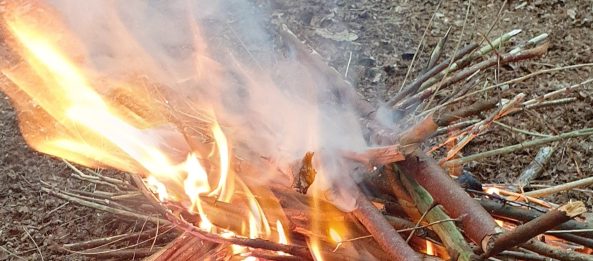
6 bundle Fire

I made fire

Listening to instruction

Listening to instruction in our small group

Okay so this is not strictly an archery related, actually it has very little to do with field archery at all, other than it takes place in woodland. This post is part review and part my thoughts following a bushcraft experience day I spent in sunny Wales. Yes, I did say sunny Wales before you wonder if your eyes are deceiving you. It was a warm, dry day spent in the woods with the experts from Original Outdoors (https://originaloutdoors.co.uk/ )
Some of you may know that I have for many years had an interest in bushcraft and associated skills. So, for a birthday gift Sharon bought me a bushcraft experience day. Now due to the COVID-19 pandemic, the initial date and plans were put on hold for a few months. This meant it would be early August before I was able to journey up to Wales to attend the session.
The course was based in North Wales, not far from Ruthin, with the first challenge being finding the secluded spot where the instructors would meet you. We would then take off into the wooded hillside for a mile walk to what would be our base camp for the day. The woodland they have access to is a huge private wood, ideal for covering the variety of bushcraft topics they run courses on.

Fire in the woods

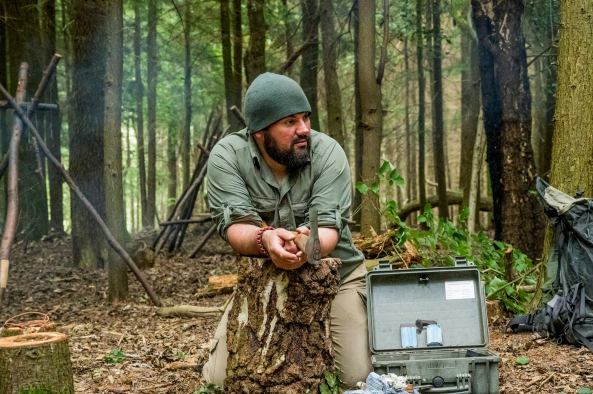
Me doing my best to prop up a tree while listening to Richard

So, what does bushcraft mean to you?

This was one of the interesting questions we discussed with Richard our main instructor for the day, as we walked to base camp. Though along the way there were multiple stops to examine local edible flora or fauna, along identifying which trees make the best tinder, how tree sap can be used in fire lighting and more. Before I go any further though, I’d like to apologies to the lady who was the other instructor now, as though I spoke with you my memory for names is truly awful. I think her name was Amy but not 100% sure. Sorry I could blame my age but I’ve always been terrible with names.
Anyway, back to the question of what is bushcraft? We discussed how it varies depending on what you have read or where you might be in the world. What we in the UK think of as bushcraft skills might be considered basic skills in other areas of Europe. The thing is the subject is one that generates different views from people. Some see it as core survival skills, others see it as simply being resourceful in the countryside. Whatever your viewpoint I think the instructors on the course would be able to tailor something suitable for your needs.
From my perspective it is simply having some skills that make being out and about in woodland more enjoyable. I guess less survival skills and more outdoor skills in my view. I’ve also been interested in learning near forgotten skills whether those be bushcraft or others.
So back to the course. The first topic was that of fire lighting. Our instructor Richard took us through different fuels and ignition methods, along with the importance of preparation of the materials and surrounding area.

Richard explaining axe sharpening

Richard explaining axe sharpening

These are key principle of fire starting and important factors to consider, along with other less immediately obvious ones, such as location of fire with respect to tree roots if in woodland, what rocks might be in the surrounding area as some will explode when heated. There are a few YouTube videos I’ve seen of this happening. Along with the time spent in sourcing dry tinder and preparation of the materials you are going to use.

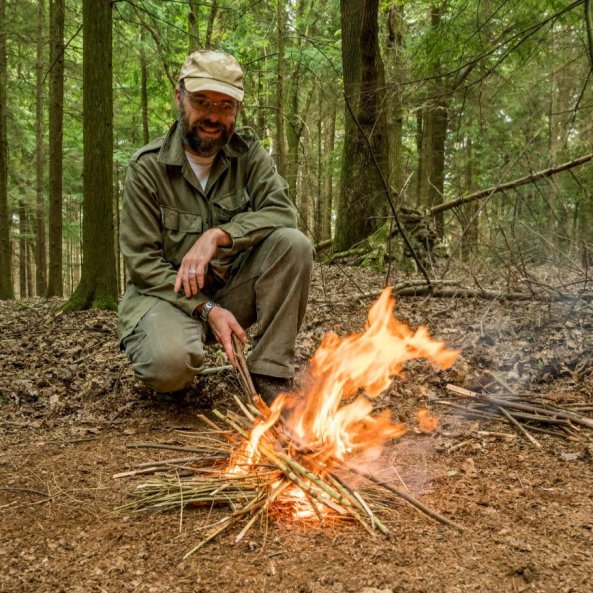
I made fire and yes, it’s harder than it looks.

There is something very satisfying about being able to make a fire with limited resources. Whether this be using a single match to start your log burner on a cold winters day or getting a campfire going, to while away the hours when camping with friends.
After the course I was thinking about what was covered and it brought back memories of childhood.

So I made fire

So I made fire you can see I’m happy

I think I can count on one hand the number of times I have used fire lighters to start a fire, whether this be in ours or my Mams wood burner, in one of our garden fire baskets or a campfire. It’s not meant to sound like me boasting, it’s just the way I way taught to start fires. I can still remember being about 4 or 5 years old and my Nan showing me how to use scrunched up newspaper and sticks to start the coal fire in our living room each morning for heating and hot water. Yes, I am that old thank you. Having said this lighting a fire without a match and in the middle of a wood is a whole different ball game to trying to light one in your own home.
I had lit fires using a ferrous rod and striker before but by striking it into cotton wood or mixed tinder bundles. I had never used birch bark as the fuel before and it took some perseverance and expert guidance, but after a few attempts I managed to ignite the bark and start the fire. If you check out their YouTube channel they have it listed as the six-bundle fire lay method. ( https://www.youtube.com/watch?v=aQLeFTp6x9Y&feature=emb_title)

I was smiling to myself when doing this as the effort it initially took, is not always reflected accurately on different TV programs.
In addition to starting a fire you were instructed in how to safely extinguish the remains of the fire to ensure it was completely out and remove signs of the campfire.
Other topics we covered were the creation of simple string. Cordage is something all civilisations have always needed and we were able to try our hand at making string from stinging nettle stalks. This was something I was very curious about as I can recall my grandfather mentioning how they used to use nettle stems as string in the garden to tie up plants.
Unfortunately, we didn’t have time to cover friction fire lighting which was a shame, but there are only so many hours in a day. To be fair to the organisers, we were given the choice of whether to cover that or tips on axe / knife sharpening. As a group we opted to go for knife and axe sharpening.

Simple wood carving

fires out so time for some simple wood carving

We also did some simple wood carving for a pot hook. I have to say that brought back memories of my early teens when I would find a decent size stick and spend hours, removing the bark, smoothing the surface and use it as a walking stick. Even made a short one for my Nan who was too short to reach curtain and draw them easily. So, I made up a small stick long enough for her to reach the curtain and light enough so she didn’t struggle holding it.

Pot hook

Okay so not the most exciting thing but a pot hook

Like most organisations these days they also have an Instagram @originaloutdoor They also have a podcast the Angry Badger which is quite entertaining to listen to, being available on Spotify and other platforms. As I said they have their own YouTube channel too (https://www.youtube.com/user/originaloutdoorvideo) .
I felt the small group size really helped with interaction, I know they were operating on reduced numbers due to COVID-19 restrictions limiting the number of attendees.

Personally, I felt part of the enjoyment was confirming things I thought I knew, with the opportunity to just experiment and learn some new skills in an incredibly friendly and welcoming environment.
All in all, it proved to be a really good day. Thank you for a great birthday present, even if it was a few months late.
The best thing of the whole weekend though, wasn’t the course, but the opportunity to see my Mam for the first time in months due to the COVID-19 restrictions on travel in Wales.
Thanks for reading, stay safe.

Coaching and Covid19

Challenges of coaching with social distancing

Coaching from a “safe” distance is something many of us are trying to figure out given current circumstances. Many archery clubs or organisations have put a stop on all coaching until further notice due to the risks of COVID-19 and the difficultly of coaching and remaining within government guidelines for social distancing are considerable.
So what are the alternatives available for coaches and archers? From my perspective, I see three options
  • Face-to-face
  • Virtual face-to-face
  • Filming
I don’t think any coach or archery student would argue that face-to-face coaching is in many ways the ideal option when helping archers develop their skills. But, this option is not necessarily practical at present, when you factor in elements such as, social distancing guidance, limitations on numbers who can attend, locations capacity and how many can meet up. Some coaches may feel they can coach effectively in the current climate and that is there call. I will admit I have struggled to coach effectively or as fluidly given these restrictions.
What I want to suggest here are other options, such as remote coaching?

Virtual face-to-face

Coaching live via conferencing tools such as Zoom, WhatsApp, Microsoft Teams etc is practical in some ways or rather circumstances. It is an option if the coach or student is presenting information, though harder if trying to demonstrate shooting or some practical skills. The advantage of these modes of communication is the ability to have a live discussion with students about ideas and allows a virtual face to face chat. So if either has questions they can ask there and then and not have to wait for email responses etc. I know we have been using these technologies for the past few months extensively in a work context. The one technical downside is the quality of connection speeds of your internet provider.
Whilst talking about communication technology you could also consider social media for sharing recordings of shooting, from short snippets in Instagram to uploading longer recordings to YouTube. The downside of sharing the content on these platforms is that you are likely to get a lot of comments, some of which may not be that constructive or accurate as you would like. Everyone likes to offer comments, some for genuine reason in the hope to help, others simply because they believe they know best. So remember some people prefer to criticise rather than offer constructive comments. It’s their way or the highway so to speak. So whichever option you choose, be aware of the possible negative reactions you may get.

Filming

There is no doubt that cameras and recordings can be very powerful tools for coaches to use, as they offer the ability to capture, rewind, review and replay in slow motion actions that might be too fast for the naked eye to accurately see. I can’t speak for other coaches but I often use my tablet or phone to capture footage of archers as they are shooting.
From a safeguarding perspective, you need to be very careful when filming children and young people. Before you record anyone you really should always ask permission of the individual and or parents/guardians.
Because of this, I would like to offer one word of caution when it comes to filming. If you have someone recording your shooting then consider their safety.
Where will they be standing when you are shooting? 
How close will they be? 
There has been more than one occasion where I have had to stop an enthusiastic parent wandering into a danger zone as they search for the ideal angle.
Coaching at a distance, what angle to go for?

Coaching at a distance, what angle to go for?

It is very easy to get carried away when behind a camera, wanting to get the best angle for the photo. Slowly moving around, whilst focused on the small screen you can quickly lose track of your physical surroundings.
The cameraman or women should never be in front of the archer or in any location where they make the archer uncomfortable or offer a distraction to them shooting, as this can lead to problems or dangers.
It is also worth remembering that some people become quite nervous when they think they are being filmed, changing their natural shooting process, so you might need to take a few recordings for them to settle down.
Provides easy playback

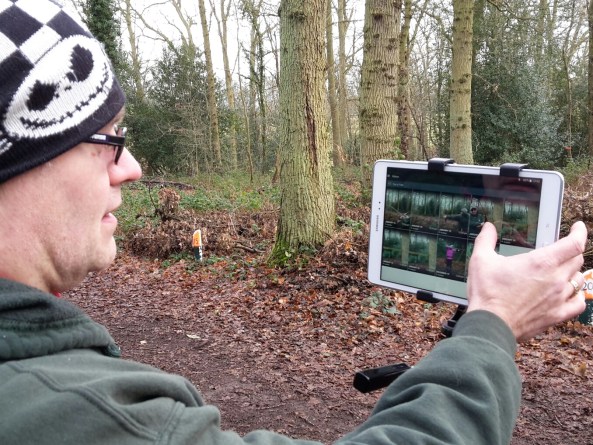
Fellow coach showing ease of playback

There are a couple of Apps available which coaches or any archers may find useful, these being Coaches Eye and Technique. I use Technique quite a bit to record archers shooting and playing it back to them in sessions on the tablet.
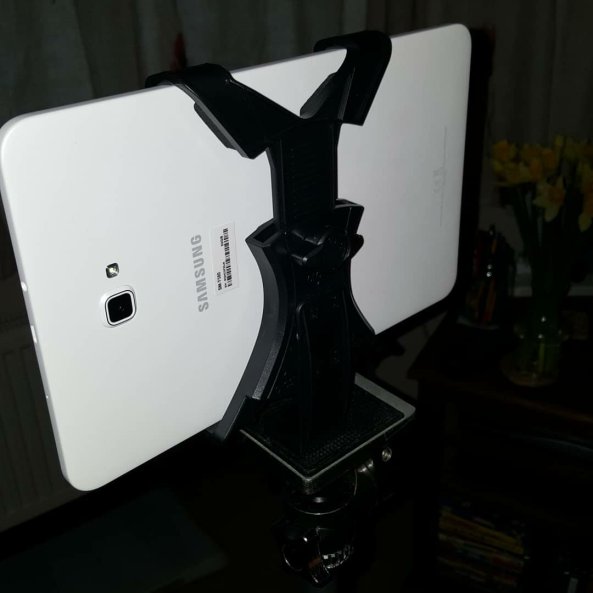
I have a tablet mounting on my tripod that allows me to position the camera in a location where a camera person could be.
Tablet mounting

Tablet mounted on tripod

The advantage I find with using Technique over just recording video on the native mobile phone are numerous
  1. It is very easy to use as I can record within the app or import video shot on another device into it.
  2. I can slow the footage down to 1/8th speed if I want to, which allows me to analyse the smallest movements in release or bow arm.
  3. I can zoom in on areas of the screen and show exactly how an archer is gripping the bow or releasing the string. Especially useful on the larger screen of my tablet.
  4. The top thing with the app is I can annotate it. So I can have the archer shoot three arrows at the same point on the target. Then overlay each arrow on the screen with a coloured line showing exactly the arrow or bow alignment. (the stable platform offered by the tripod helps hugely when doing this).
another view of tablet on tripod

another view of tablet on tripod

Once you have the footage, you will want to share it with your coach there are a few options. You could use something like Google Drive or Dropbox to share it. YouTube offers users the ability to upload content and to have it unlisted so you access it via a link the author sends out. I’ve used YouTube in the past to share content in this way.
I hope this has given you all some ideas. If anyone has other suggestions feel free to share them here by adding a comment.
Thanks for reading, stay safe.