Leatherman multi tool

Are Leatherman Multi-tool any good


Several years ago I wrote a review of the Leatherman multitool I’ve been using for years. This is an update of that review. I’ve owned a few different multi tools varying from the bargain basement ones that come free with a torch at a service station, to the more expensive Leatherman models.

I’ve found them a useful addition to my archery belt and I’ve used them for camping, hiking and even skiing. Pretty much every scout leader I know carries one of these tools on a camp.

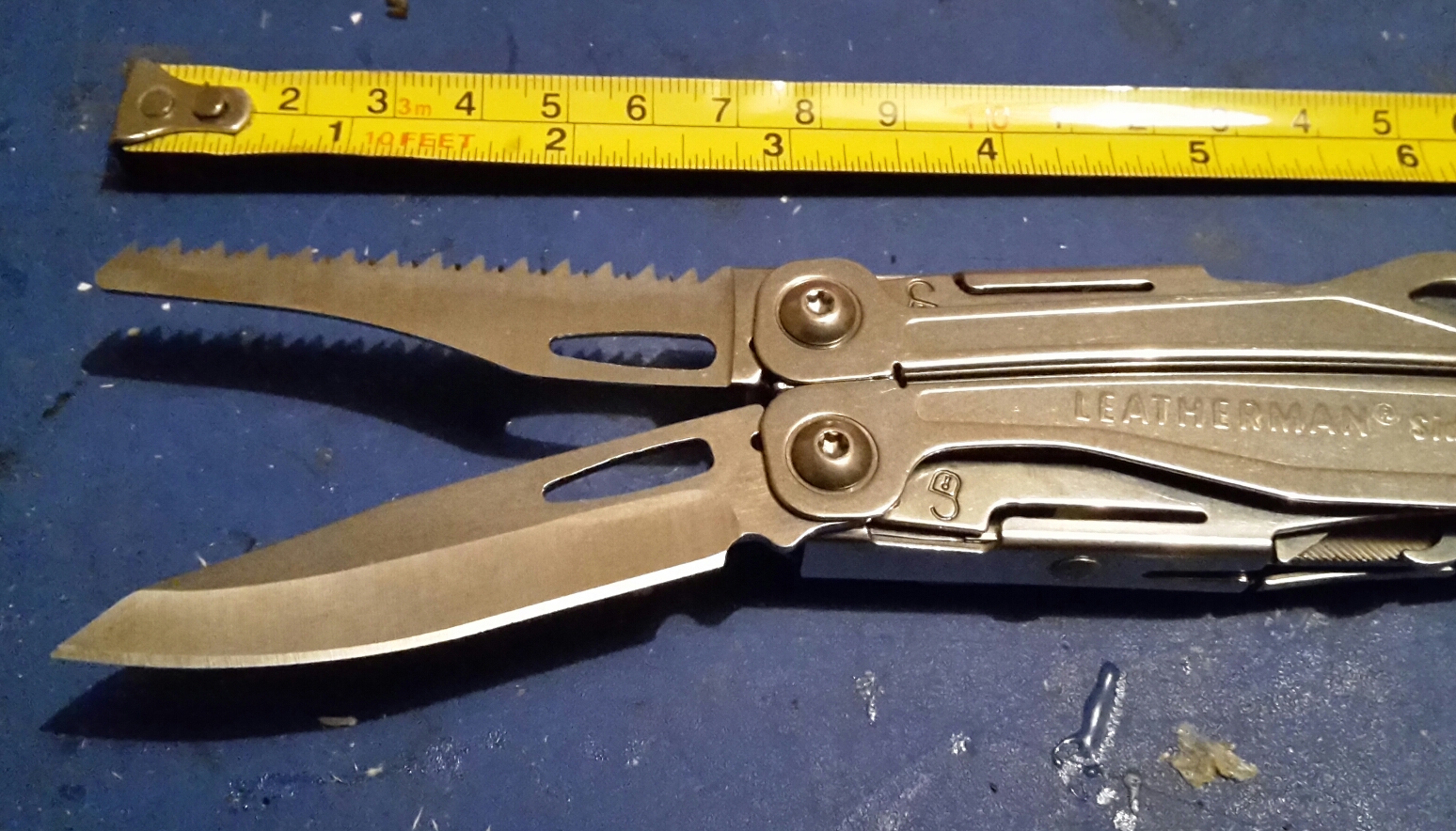
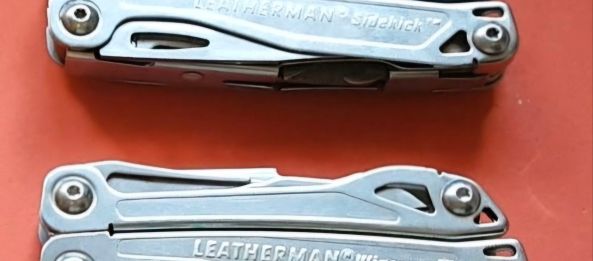
The two I have are the  Wingman and Sidekick. Essentially the two are nearly identical and a full breakdown of the different features are shown below.
The only real difference is the Sidekick has a small saw blade instead of the scissors that can be found on the Wingman.

Uses in the field

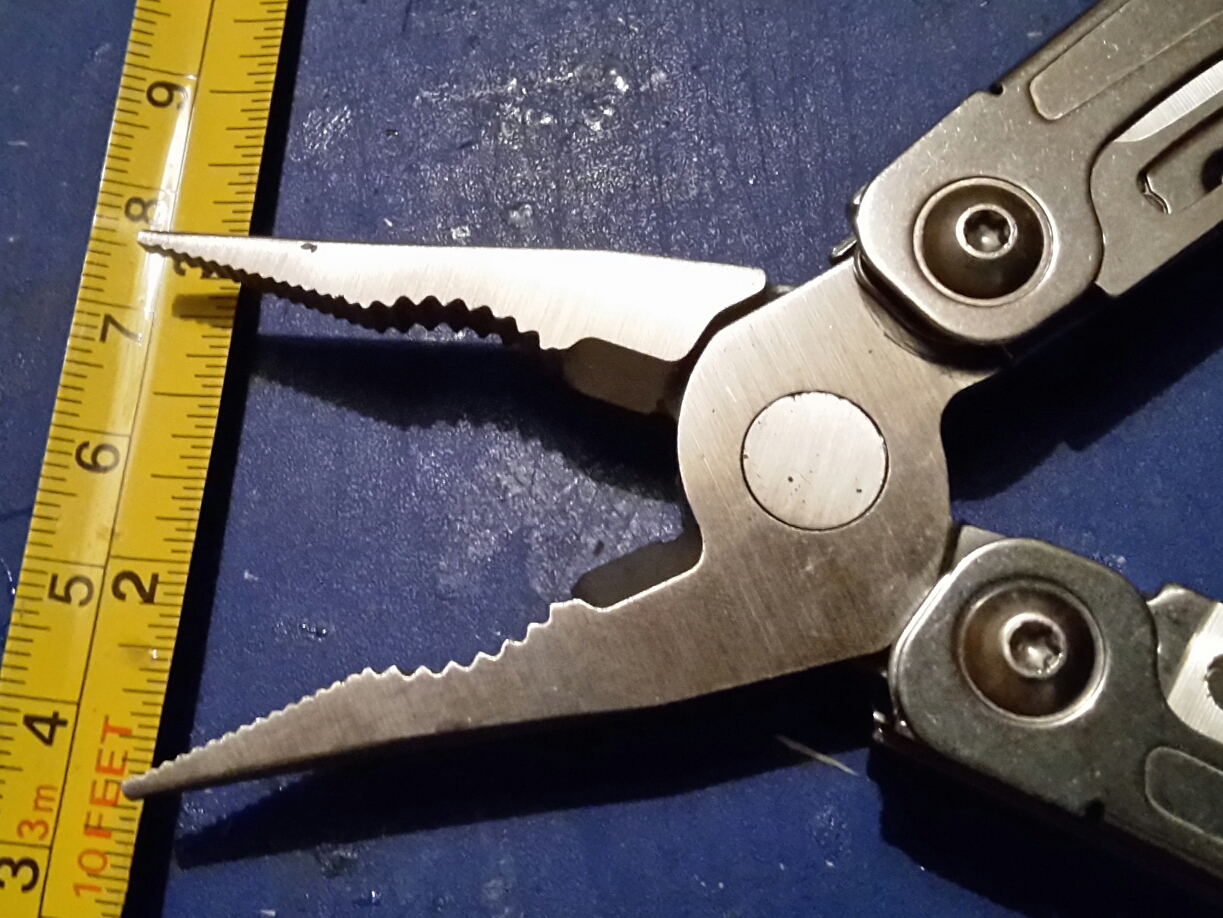
I’ve used the pliers countless times for extracting  arrow points of piles from targets after the shafts have snapped in the boss, 3d targets or more often trees and need removing.
A sharp knife is always useful if you spend any time outdoors whether it be camping, walking or archery.
Quick note here is I wouldn’t use the blade to try and cut a wayward arrow from a tree though, as whilst sharp I would expect the tip to snap under the pressure. For removing of arrows I use an old flat headed screw driver that I have in my quiver.

It’s worth remembering that no matter how good a multitool is, it is by it’s very nature is a compromise, the pliers will never be as good as a true pair of full pliers.

The wingman comes with a small pair of scissors which I’ve found surprisingly useful for archery, when fitting servings etc.

The sidekick  comes with a small saw blade, which isn’t going to chop down any redwoods but I have used to saw through branches of about an inch thickness with ease. For that reason I tend to have the sidekick to hand when camping or working in the woods. I’ve also used it to make impromptu walking sticks.

Tools breakdown

Here is a quick break down of the tools, both are made from stainless steel, are pocket sized and covered by the Leatherman 25-year warranty. The WINGMAN has these tools

  • 420HC Combo Knife
  • Bottle Opener
  • Can Opener
  • Medium Screwdriver
  • Package Opener
  • Phillips Screwdriver
  • Ruler (1 in/2.54 cm)
  • Small Screwdriver
  • Spring-action Needle nose Pliers
  • Spring-action scissors
  • Spring-action Wire Cutters
  • Wire Stripper
    Wood/Metal File Measurements:
    2.6 in | 6.6 cm (blade length)
    3.8 in | 9.7 cm (closed)
    7 oz | 198.4 g

SIDEKICK  has these tools , and mine came with a Carabiner Bottle Opener Accessory.

  • 420HC Serrated Knife
  • Medium Screwdriver
  • 420HC Knife
  • Bottle Opener
  • Can Opener
  • Phillips Screwdriver
  • Ruler (1 in/2.54 cm)
  • Saw
  • Small Screwdriver
  • Spring-action Needle nose Pliers
  • Spring-action Regular Pliers
  • Spring-action Wire Cutters
  • Wood/Metal File

Measurements:
2.6 in | 6.6 cm (blade length)
3.8 in | 9.7 cm (closed)
7 oz | 198.4 g

Workmanship

The workmanship is good and the pivotal joints haven’t slackened off much after 10 years of use, which I have seen on cheaper multi tools. The finish on the back of the Sidekick  serrated blade is a little rough which you notice more when folded up but that is the only criticism I have. The rolled metal handle makes using the pliers more comfortable in the hand, compared to some cheaper models you can find on the market.

I now make a point of always carrying one of mine when out and about.

So if you are looking for a  Christmas present I’d say either would be a good buy and addition to a kit belt or pouch. If you are looking for something a bit more then have a look at what I think they call the expedition range.

If you like this content and would like to see more reviews then please let me know, either here on my YouTube channel. As always thanks for reading, watching and support.

3d printed archery boxes

Back in episode 128 of the podcast,  I wrote a review of the Push Alpha pack quiver and in that episode, I mentioned some 3D printed boxes that Sam a fellow club member has been producing for members.

I promised then I would be doing a full review of the boxes and explain how I’ve been using them, so here it is.

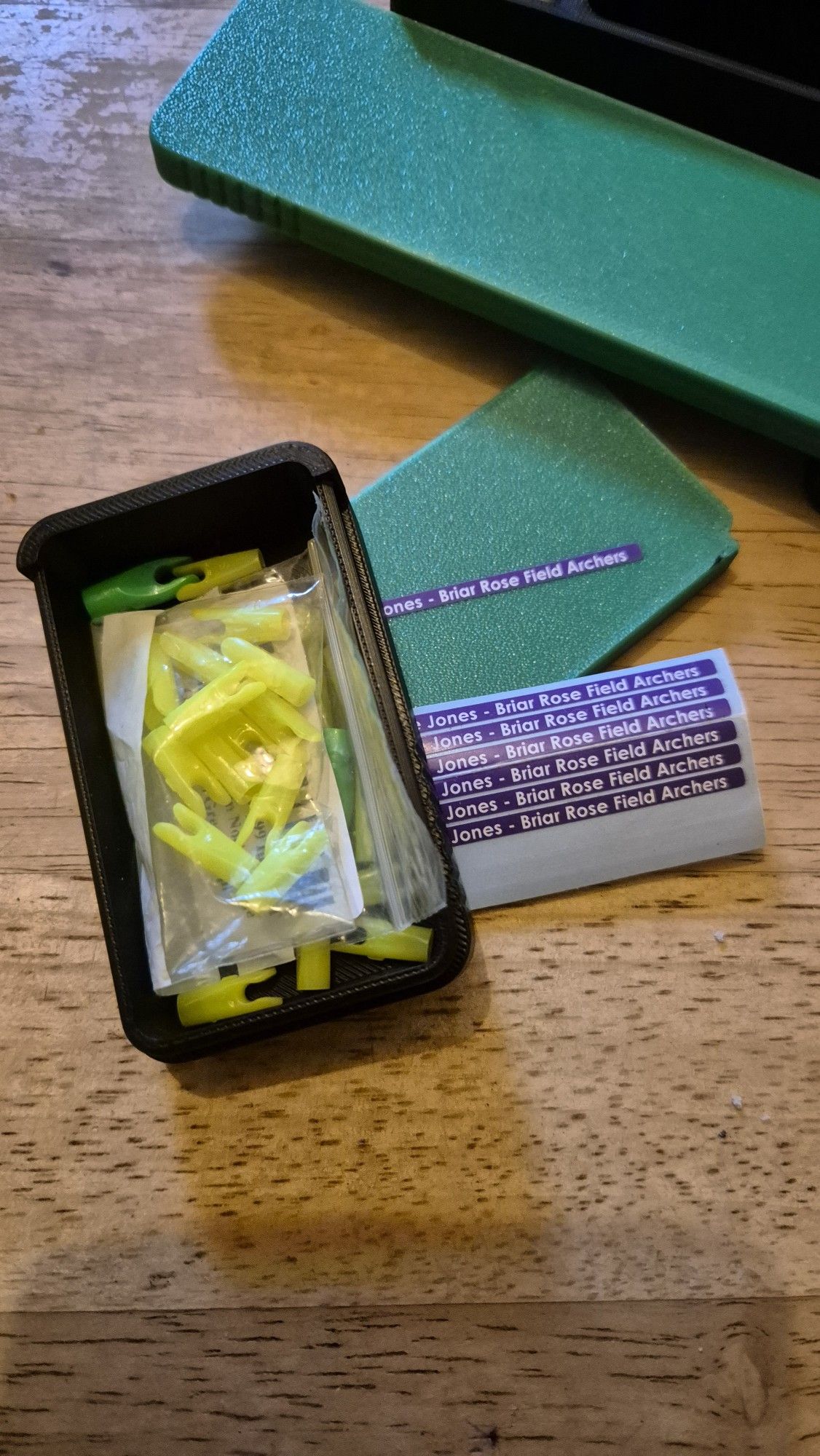
The cases come in 3 sizes, with the smallest and medium ones having sliding tops, the largest having a hinged lid. First lets look at the small box. This works really well for a few spare nocks, points and labels. I’ve given this one to my son as it fits perfectly in his little quiver pouch.

This size is ideal to fit into a pocket and would be really useful on camping or hiking trips to hold a few matches, etc.

The next is the medium pouch which has 3 sections, one long enough to accommodate a bow string.

The medium size box fits really well in the smaller mesh pouches of the Alpha pack and is large enough to house a spare string a few points, name labels, allen keys and spare plunger button.

Here you can see the medium and large box to give a comparison of sizes.

The largest box is ideal for your bow case and is large enough to accommodate bow string, plunger button, points, string wax and more. There is a small pull out draw (in green) that I use to hold my spare plunger.

Overall these work really well. I’m not sure how waterproof they are but so far there’s no complaints.

Thanks for reading and enjoy your archery.

How do you track your progress

In this episode (episode 130) of the podcast, I do my best to answer a question from a follower. The question is about how you go about tracking your progress and monitoring your improvement in archery over time.

I break the process down into tracking progress when shooting at your home club grounds and when you venture out onto competitions. It’s a tactic I have used for several years and the process works well.

I’m not going to be giving advice on how you improve your archery in this episode, it’s solely about tracking your progress.

Home club

The difficulty with shooting the same course is you don’t always focus in the same way, you can become a little complacent resulting in a lack of focus in the same way. I’ve used this phrase in the past ” You learn to shoot the coach and targets, you don’t learn to read the shot.”

In NFAS the goal is to shoot as few arrows as possible when at a competition, as your first arrow will score the highest being 24 pts / 20 pts / 16 pts. If you take a second arrow this will score 14 pts / 10 pts, with a third arrow scoring 8 pts or 4 pts. Remember in the most commonly used course round in NFAS, the Big game round you only get to shoot a max of 3 arrows. If you miss with the third and final arrow you blank the target i.e. score 0 points.

There are other rounds but the Big Game round is by far the most commonly used.

The first thing you will be wanting to track are the number of blanks you have when you are shooting. Chances are when you are starting out you will be getting quite a few of these. As I explained earlier a blank is when you shoot all 3 arrows but fail to score. You obviously want to try to reduce the number of blanks and over time as your skill improves you will, replacing them with a successful hit.

The next this you will want to track are the number of 3rd arrows which are scoring. Note down what you scored, was it a 4 or an 8. Ideally an 8 means you have learnt from the 2 previous misses, compensated and produced a good shot.

You also want to track the number of 2nd arrows and what you scored, was it a 10 pts or 14pts . A 14 normally means you have been able to correct you mistake or misjudgement, nailing it the second time.

The final step is to track the number of 1st arrows and what you scored, was it a 16, 20 or a 24. You goal is to increase the number of first shots that hit.

Over time you will see your arrow count reduce and scores gradually improve, but it may take time. So please be patient with yourself and kind to yourself. Its also worth noting any other variables, like different arrows, or if the weather such as strong winds or rain impacted your shooting.

At open competition

When you start going out to competitions you still want to continue to track your blanks, 1st, 2nd and 3rd arrows as a point of reference as this can indicate how things are progressing over time.

The other method of tracking progress is to identify a base line as a comparison. The thing to remember is that NFAS courses can vary greatly, this means no 36 or 40 target course can be identical to another. Even if you shoot the same clubs course on multiple occasions chances are there will be differences, whether that be 3d targets used, peg positions or even the weather.

Therefore, it’s a good tactic to identify someone act as a baseline. Ideally the person chosen should be someone who shoots consistently. Not like me who have good or bad days. If you can track their scores and compare it to yours you will be able to judge how challenging the course would have been.

Lets say the you scored 400 and your baseline person Mr Smith scored 600, a difference of 200. Next time you shoot you get 350 and Mr Smith gets 550, still a difference of 200 you know it was probably a more challenging course.

Then on the following course you score 500 and Mr Smith scored 600, you know you’ve probably improved.

I hope this helps and enjoy your archery.