target faces

Target panic techniques – Draw, track, come down

So I’ve covered a couple of techniques so far (drawing down and blank boss shooting) in this series of posts on target panic.
So the third technique I’m going to cover here is one I’ve adopted from Jay Kidwell’s excellent book “Instinctive archery insights“. I’ve written about his book before and would advise anyone who is interested in aspects of coaching or target panic to pick up a copy. It is a very easy read and offers some great insights. The book was recommend to me by another coach and I really should type up a full literature review on it for the site.

cover of Instinctive Archery Insights

Instinctive Archery Insights

There is a little preparation required for this approach and it is not something that I suggest you try with your normal draw weight bow. So one thing you will need is a lighter draw weight bow. I use a 16lb draw weight take down recurve with my students.
In addition to a light poundage bow, you will need a few modified target faces and a 6 sided dice. Okay, so I know this may sound a little strange, some would go as far as to say a bit far fetched, but stay with me. I have found that using a six sided dice can prove very helpful and no, I’m not talking about gambling or playing snakes and ladders. Likewise the simple modification to the target face will help promote focus.
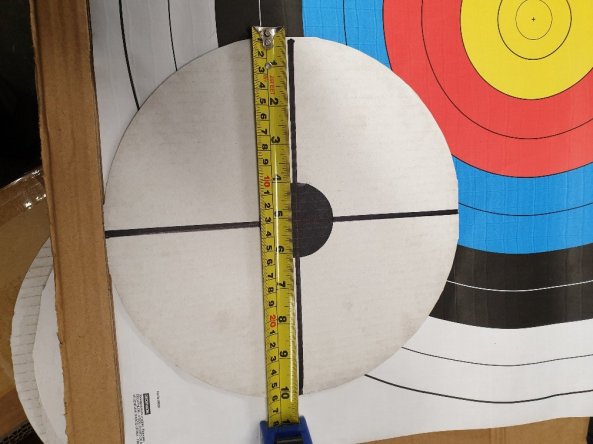
Simple target face with couple of lines added

Simple target face with couple of lines added, one horizontal and the other vertical.

The objective of this technique is to help the archer overcome the urge to release as soon as they have drawn up. Instead they develop the skill, neural pathways or retrain their brains to draw up and track onto and off the target. Overcoming the desire to release immediately the arrow is on the gold or when the archer thinks its on the gold.
Anyway back to how a six sided die can help along your with archery practice.
As many of us spend hours on the range training alone, it is very easy to fall into bad habits or repeating the same pattern again and again. In some ways we want to be able to repeat good form, but in this exercise we need to include a random factor. Hence the six sided die.
In Jays book he describes how a coach or shooting buddy call out a number, to denote the number of times you draw up and track across the target. There are a couple of important facts. The archer track across the target without releasing the arrow. Secondly they do it a number of times specified randomly so don’t form subconscious patterns.
To provide the random factor when alone I used the dice.

six sided dice in a clear box

Dice in a box

I modified the dice so there was no 1,5 or 6. This was easily done by sticking a blank label over the numbers. I wanted the die to show 1 four, 3 two’s and 2 threes. This may sound strange, but you don’t want too many higher numbers when performing the exercise as you would get fatigued, nor do you want a single occurrence.
I then housed the die in a small clear plastic tub large enough to allow the die to roll and clear enough to see the result.
So the second thing I done is modified a couple of targets by drawing lines on them through the centre, one vertically and one horizontally. When on the boss it gives the archer something to focus closely on when moving on and off the centre spot.

Remember, since you undertake these exercises multiple times, it is advisable for you to use a lighter draw weight bow.

In Jays book there are 3 exercises and rather than going into detail of how each of them work I’m going to explain how I use them and adapted them for my coaching style and students.

Step one

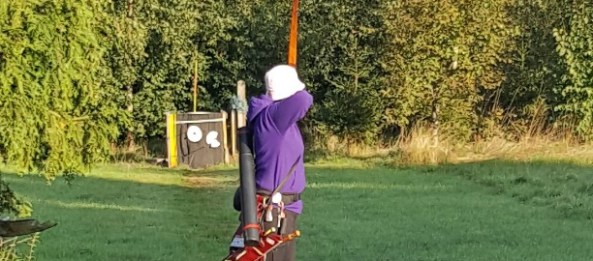
Me trying to remember to shoot

Me trying to remember to shoot

I’ll got through these step by step

  • First, fit one of the modified target faces to the boss so you have one line horizontal and another vertical.
  • Pick up you light draw weight bow and set yourself up at about 10 to 15 yards from the target boss.
  • Roll the die to get your random number, lets say 3.
  • Draw up and when they get to full draw and aimed / focused on the gold or in this case centre of the target, you move to the right to the edge of target and then  back to the centre. Once at the centre track left, again to the edge of the target. All the time maintaining full draw whilst not releasing. That is the crucial part, not releasing.
  • In this example  you would pass over the centre 3 times before coming down. Right, left, right and down.

The lines on the target provide a guide for movement. The theory is you are retraining your brain to be able to draw up,  centre on the target and then move off and back on without releasing. The movement to the left and right doesn’t have to be huge, ideally 3 to 4 inches at most.
The advantage of using the pizza base targets are they aren’t that large so you are tracking left and right only a little.
An alternative to this method is rather than tracking left to right, you track up and down, moving vertically through the centre. This is why there are both horizontal and vertical lines drawn on the face.
Try practising this technique for a few weeks and slowly it will help you build confidence and control.

The next step

So by this stage you have hopefully learnt to be able to draw up onto the target and move off it. A subtle development of this technique is when pass over the centre, you actually stop and hold on the centre for a moment.

From my experience these exercises work well, with the die providing a random number of reps you have  to perform.

Development

When you have mastered either or both of theses techniques you can progress to a slightly different version. In this version you combine the above exercise of moving over the centre spot of the target but on the final pass you lock onto the centre and you actually release the arrow.
When I am coaching these technique with students I recommend, they don’t perform them for long periods of time. Even with using a light draw weight bow there is quite a lot of strain on muscles, not to mention the concentration required. Ideally 15- 20 minutes seems to be optimum. Any longer and it can become tedious and the students tend to lose concentration.
The other thing is to practise these techniques over a few sessions, as it will take time for you to retrain your brain into being able to draw up, move on and off target spot etc. It is not something you can do once or twice for a couple weeks and then stop. Overcoming potentially years of subconscious neurological programming takes time and effort. So give yourself time to learn these skills. It does help if you practise them.

Thanks for reading.

Sharon on the range

Before we start a quick reminder

So we have looked at two sides of the archers triangle, that of the arrow and bow. Now let’s look at what many see as the hardest element to gain control of, the archer.

archers triangle graphic

The archers triangle

Before we dive into this I want you to think for a moment about your mindset and how you approach these ideas.
It’s good to be optimistic when it comes to combating target panic but you have to temper this with a level of realism. So please be realistic in what you can achieve with the time you have available. Try and plan your activities so your time is used effectively and efficiently. Just like you need to allocate time for tuning your bow or making arrows you need to give yourself time to practice these techniques.
You will need to consider planning your time effectively. Don’t just go out and shoot lots of arrows believing it will cure your anxiety. It might build your muscle strength but I doubt it will solve the anxiety you feel.  Consider the fact that shooting 100 poor shots does not work as well as 30 well executed shots.

So think about practice regime and exercises you can do to help build confidence and resolve. Working on your chosen techniques whether these be focusing on your own form, shot sequence steps or exercises like drawing down off a shot have to be factored into your training regime.

view of the range

view of the range

Consider carefully how much time you can allocate to the techniques I will suggest. It may well require you to allocate 20 to 30 minutes a session in the early stages to get used to the drills. This is the sort of commitment required in the early stages.
Once you have regained control its still worth practicing the techniques every few sessions partly so they remain fresh in your mind and partly because they can help you remain in control.
Your objective is not to hit the target but to gain control over your target panic / shot anxiety – remember this. Don’t let your focus move to hitting the gold, it has to be on control.
Too often we focus and perceive success as making the shot score highly. That is an outcome from solving the anxiety, your true goal is to take back control of the shot.

Physical Practise is one way but remember we are training your brain too. I mentioned in the previous article about mindset and changing the way you think about things. This includes how we consider things such as how we recall what we consider to be good or bad shots, productive or unproductive practice. Often when we start experiencing target panic we tend to recall the poor shots, what we consider bad ones. These prey on your mind, possibly because you missed a shot or scored less than you wanted. In reality the shot has gone, its in the past. remember to learn from it and move on.
You may have heard of the phrase “Making mistakes is not failure unless you let it be.” or something similar.
I firmly believe that making mistakes should not be viewed as a failure as it can provide a great learning experience. The reality is if we don’t learn from our mistakes we are likely to repeat them. Think of this for a moment. Shooting the wrong spine of arrow and identifying this only comes about from the mistake of shooting the wrong arrows in the first place.
Where archery is concerned this is very important to remember as you might try a technique and it doesn’t gell with you for whatever reason. The crucial thing to remember is you’ve tried something and made a step in gaining back control.
One way you can think of it is as if you are going to a new restaurant. You decide to try something new on the menu that sounds interesting. You might like it or you might hate it, without trying you’ll never know.

Getting good at something takes practice.
Getting better at doing the same thing takes more good practice.
Getting to a level where you are a master, can take a lifetime.

This is true if you are field archer, target shooter, fisherman, golfer or even a surgeon.
It is equally true of physical and mental practices. They take time to learn and for you to develop.

Natural Aptitude and learnt skill

Basic talent or natural aptitude only goes so far, after that its perseverance and good practice. Someone with natural talent will often start off well or ahead of another who has to work on shooting a bow. The thing is the person who is a “natural” may struggle later in their progression as they may have relied on their talent rather than developing skill. I’ve seen it time and time before affect the archers confidence as they start to struggle, wondering why it’s become so hard all of a sudden.

Modern fix, quick fix

In a modern world where people are always looking for short cuts or quick answers to fix complex issues the concept of spending time ensuring we learn the skill properly is sometimes overlooked.
Increasingly society looks for the easy fast solution. Here is a fact, target panic requires time to overcome. There maybe some quick tips that can help you find your right road, which is why I started writing these articles but there are no shortcuts or magic arrow.
The important thing to remember is effort can work and will work if the effort is focused.
Knowledge and effort makes a difference or at least it can if effort is directed and focused correctly. These posts are here to help you gain some insight and ideas on how to focus on the correct way for you.
Be kind to yourself and give yourself time. You might have been struggling with anxiety for years so don’t expect to learn to control it in hours. Remember in the second post I said there were 3 things

Put some work in – there are no magic arrows that solve everything or a secret draw technique that quells the nerves.
Remember one size doesn’t fit all – what works for one person may or may not work for you.
Be patient – it takes time to work out what helps you and this means time spent working at it too.

In the next couple of posts I’m going to cover a few techniques that can help.

  • Blank boss work
  • Target fear (where specific target faces trigger anxiety)
  • Drawing down
  • Drawing up but not shooting immediately

I might throw a few other ideas in the mix too. I hope these ideas will help.
Thanks for reading