Archery Backstop Net

Archery backstop nets – some thoughts

In an earlier post I provided an overview of a few of the sort of things to consider when you are setting up a target boss. In this one I am going to talk about my views of backstop nets, including trying my hand at  busting some myths associated with them.
Backstop nets can be a useful addition to any range, but there a few things to consider about their use, so I will start with some mythbusting on the topic of backstop netting and what they can do.
A backstop net will stop the arrow. 
Not always. I shot a 11/32 diameter wooden arrow from my 45lb flatbow, which comes out at 180 feet per second. So it;s not as fast as an arrow off a barebow or compound bow, nor is it as small a diameter as a carbon arrow. Yet my bow has launched an arrow through backstop nets on more than one occasion and said arrow has travelled a considerable distance beyond.
The net, if hung correctly and in good condition may slow and possibly stop an arrow. Key words there are “hung correctly”, “good condition” and “possibly stop”. There are no guarantees.
Putting up a net make a dangerous shot safe. 
WRONG in so many ways!! If a shot is unsafe then adding a net isn’t going to suddenly make it safe. Nets are not there to make dangerous shots safe, they are there to reduce the risk.
Stretching out a net to cover as large an area as possible does not increase safety.
In fact it makes the net less effective as it needs to be both free hanging and pleated, much like a net curtain in the window. So if you have a 5 metre gap to fill you need a 10 metre wide net.
The more material the more likely it will slow an arrow.
It doesn’t matter if it’s trailing on the floor.
 Ideally you want the net to be free hanging and only just touching the ground so it can move slightly when the arrow hits, thereby absorbing some of the arrows energy. If the net is taught or lots of it is on the ground, then it won’t be bale to move.
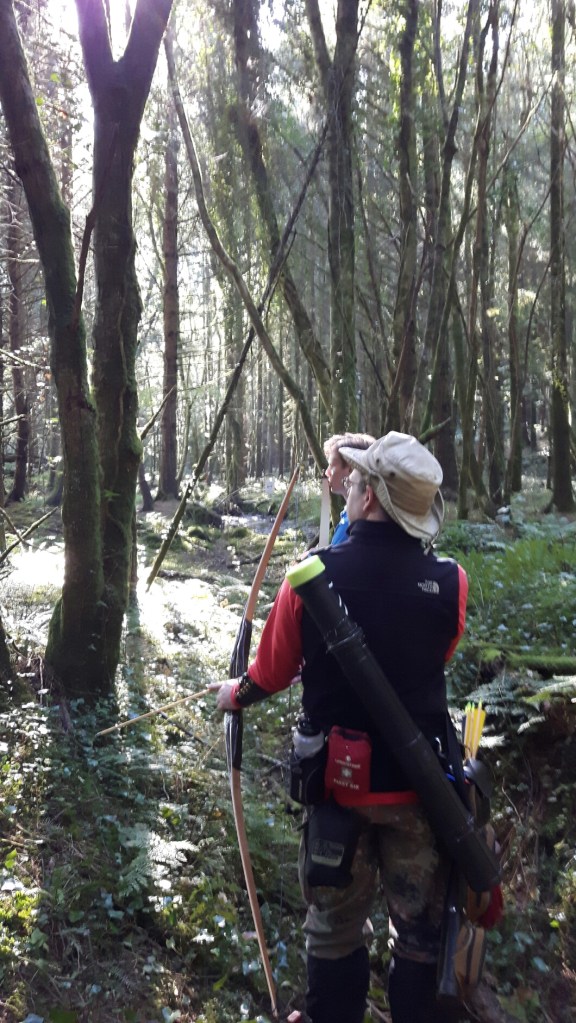
Old  carpet work just as well. As someone who is using some old carpet as an extra layer of protection to stop arrows, it may sound strange to say old carpets don’t work. The truth is they don’t work as well a proper net. I use a double thickness carpet at the end of my range. The thing to remember is this is 60ft behind the target boss on the fence line. Before any arrow gets that far it has to go through 50ft wide copse of trees as shown in this photo.
Close up of Sharon shooting

Close up of Sharon shooting

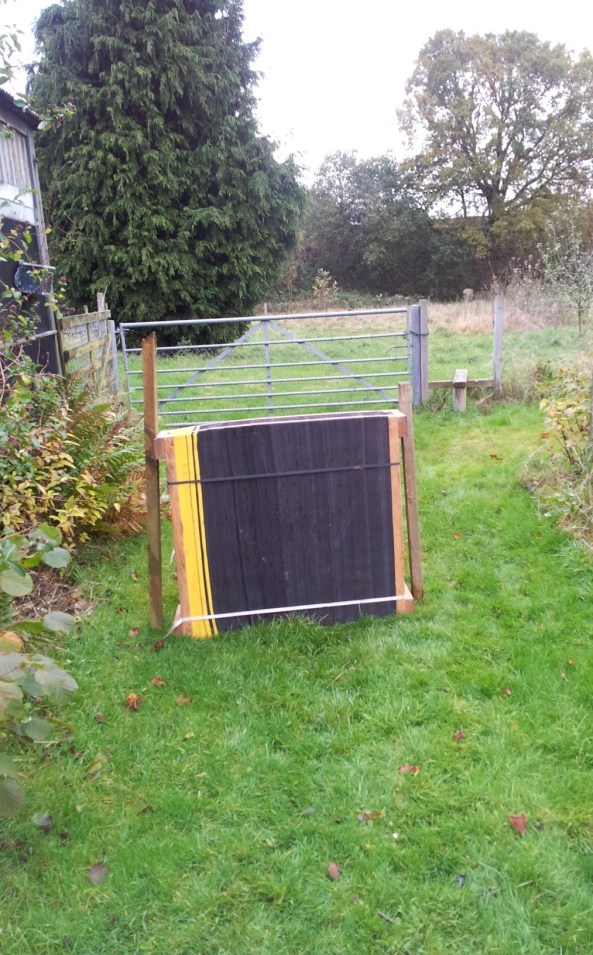
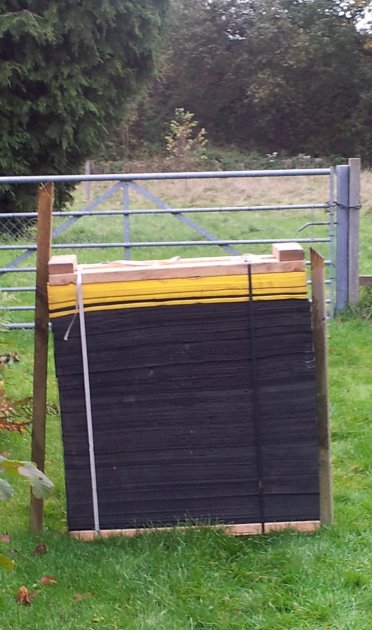
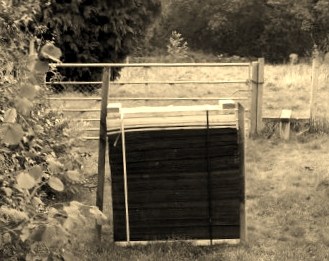
Lets have a quick look at a set up as an example. In this photograph we can see a net hung ready to be used. What do people think? Can you see any problems or issues?
Archery Backstop Net

Archery Backstop Net

Here’s a thought, what’s behind the net? You can see from the second photo there are vehicles behind so any arrow passing through the net is likely to impact one of the vehicles.
Archery Backstop Net - different angle

Archery Backstop Net – different angle

The other thing to consider is the net is strung up quite tight, with no pleats so any arrow hitting the net is likely to pass through.
By the way, this is not where the net normally hangs as I had just put it up to dry out after it being used on our clubs course the week before.
I hope this provides an insight into the use of backstop nets. It’s not a definitive list of topics but hopefully an eye opener.
Stay safe and thanks for reading.

Setting up a target boss – revisited

With recent worldwide developments concerning COVID-19 seeing more and people self isolating, working from home or simply having a lot more spare time on their hands, there has been quite a lot of posts on Facebook and other sites about home ranges, or practising at home.

I am going to highlight a few things you might need to consider. I am no expert and this is by no means a definitive list, but more of a starting point of things for you to consider.

  • What are you going to shoot at? What type of target or target boss? Will it be sturdy enough to stop your arrows at close range? Check out What target is best for me?
  • Can you safely shoot in your garden without endangering yourself or others? Think of pets, child, wildlife or even surrounding livestock? Consider also garden sheds, greenhouse and garages.
  • What of overshoots into neighbouring gardens, farmers fields etc?
  • Do you have insurance if anything goes wrong? Chances are your house insurance won’t cover you and you may have to take out some form of specific insurance.

Location, location, location

No I’m not talking about the TV property program commonly seen in the UK, but the physical location of your target boss. Look at the space surrounding the boss in the image below. What do you see?

Target Boss

Firstly there appears to be a stile behind and to the right of the boss. Does this mean there is a footpath behind the gate and we are likely to see people walking past?

What about the space behind the boss with regards to overshoot? Do you need to have something that will catch and stop a stray arrow? A safe over shoot area is vital for any target positioning. The metal gate seen behind this boss is also a risk. If an arrow misses the boss and hits the gate it is likely to deflect in any direction.

Did you spot the wall of the building to the left side of the target? You wouldn’t be able to see people approaching from that direction.

Securing the boss to the stakes is vital to ensure it doesn’t topple over when arrows are removed. It is worth considering whether the stakes need to be proud of the boss, unlike the image below. Also try to put them to the side or rear of the boss frame so as to avoid or limit the number of arrows hitting them.

One quick cautionary tale of a friend who set up a target boss in his garden. Unfortunately it was quite an old target boss and the arrow went through it, through the wooden shed wall behind and straight into his lawnmower! He wasn’t allowed to practise at home anymore.

Those are a few thoughts and topics to consider when positioning practise bosses. Have you got any further advice? If so why not add a comment below. Lets look at the orientation and securing of the target boss now.

Securing the boss

Setting up a boss is a common activity, but does require some thought and care to ensure it is done both correctly and safely, whether this be on an archery course or as in this example in the garden for a home practice range. Here you can see a boss having been erected ready for practise. Looks good? Can you spot any issues?closeup

Well one commonly made mistake when setting up a boss of this nature is forgetting to check where the metal binding for the plastic strapping is located. These should always be on the back of the boss and never facing the direction of the shot.

Why? The binding clips used for banding can damage arrow tips if they are hit. I have also seen arrows shot from a compound bow hit one of these metal fastenings and bounce straight back some 15 yards, landing at the archers feet.

You should also ensure the wood frame of the boss is always to the side and not on top or bottom.

Why? If the arrow falls low, it will run the risk of hitting and embedding itself in the wooden frame, which is likely to  result in some work to extract. If the arrow impacts at the top of the boss it runs the risk of deflecting off in any direction . So rotate the boss to ensure the wood frames are on the side of the boss.

Target Boss

Insurance

Give some serious consideration when it comes to insurance. Some people believe that being members of a national archery society or club gives them cover to shoot at home, which isn’t necessarily true. I know this is something that has come up on the National Field Archery Society Facebook group and I expect it the subject has been raised on other sites too.

We have our own personal insurance that covers Sharon and myself when shooting on our home range, which we got through Gunplan (https://www.gunplan.co.uk/) . The field is also registered as one of the clubs sites as we use it for training sessions.

N.B. The target boss doesn’t normally sit there, it was simply positioned there for the photos for this post. It’s normally in the field beyond the gate. We are fortunate in owning the field at the rear of the property and know there is no public access or routes to it other than via our boundary. We have set up a 40 yard pegged range, with a 60ft over shoot before a backstop of old carpets at the fence line and then  30ft high earth embankment beyond.

I hope you find this article of interest and if you have any comments let me know. I’m putting a brief one together on the use of backstop nets too, when I get the chance. Thanks for reading and stay safe everyone.

Some thoughts on the first bits and pieces a new archer should buy

Quick break from my series on target panic to revisit a topic which I think will be of interest to many.

Several years ago I wrote a post offering advice on what equipment newbies should consider purchasing, before buying their first bow. Since I have been working with several new archers in the recent months I thought it a good time to revisit this post and update it where necessary.

As a coach I often get asked by my students about buying a bow. How much do they cost? What should I got for?  Where do you recommend I go?  I’ve seen one on E-Bay is it any good? I always reply by saying wait a few weeks or even a couple of months before you buy one. In that time use the club equipment for until you have a better idea of what is suitable for you.
But sooner or later your students will want to purchase their own bow (which is great don’t get me wrong) but there are a few things that might be worth getting first. So I have put this post together to offer some thoughts.

First things for any new archer to buy (before a bow) should be
Whistle – What a whistle? What’s that got to do with archery? Well put simply it’s for safety calls and is a necessity for insurance on some club sites including ours. All members of the NFAS should have a whistle on them so they can signal if necessary.

A tab or glove of their own. Normally I recommend a beginner starts with using a tab to protect their fingers. As they progress I have them trying both a tab and glove, along with trying different sizes and shapes until they find something they prefer. Recently I’ve found several students opting for a glove which I think is partly due to the colder weather.

This is the single thickness tab

This is the single thickness tab


Personally I think a tab is best, though it took me ages to find one that I was completely comfortable with. I feel tabs are easier on their fingers and promotes good finger position on the string.

Quiver, you can pay a small fortune for some quivers, but when you are starting out go for something simple. So long as it will hold 4-6 arrows and is comfortable to carry on your belt it’s a winner. Quick note about back quivers here. I’ve tried back quivers, several in fact and never found one I was happy with so have stuck with a field quiver. I know some people  love them but for your first quiver, keep it simple.

simple quiver image

simple quiver

Some quivers will have a pocket or pouch on them which can very be useful for holder a whistle, stringer, spare string.

Top Top – pick up an arrow tube to store arrows when not in quiver. I carry 3 or 4 arrows in my quiver and the rest are in an arrow tube on my back. Safe, dry and there if I need them. You can use an extendable poster tube, which are cheaper, just make sure you drop some foam in the bottom of the tube to protect it and stop arrows puncturing the plastic. 

Rob trying to judge distance to a shot

Rob trying to judge distance to a shot

An arm bracer or arm guard that fits. What I mean is it doesn’t fall down the arm or is so tight it cuts off circulation to your arm. Like quivers there are loads of different designs, some that go all the way up the arm, others that only cover the forearm. Some are plain others are covered in intricate designs carved into the leather. At the end of the day function is more important, so get one that fits, works and you like.

Arrow puller, while not the most glamorous of archery elements they do makes life easier for drawing arrows, allowing you to grip the shaft more easily, especially on cold days.
Arrow rake – no matter how good you are, sooner or later you will be needing one for finding those arrows that fall short (a cheap decorating roller can be used, once modified for the purpose )

What kind of bow should I buy?

I will cover this in more detail in a separate post but what I will say is in my opinion for a first bow the most sensible option is the take down recurve practise bow.
They are relatively cheap (£55-£75 depending on where you get them), so if they don’t stick with the hobby it’s not such a huge investment. Also you might be able to pick one up from club member who has progressed. The advantage of a takedown is the limbs can be upgraded to heavier poundage as archer develop their strength and skill (I did this after a few months myself, with some shops giving a discount if you trade your old limbs in). Worth noting that not all limbs fit all bows, but I will go into more details in a future post about fittings and ILF bows (International Limb Fittings).
I have found the bows are forgiving to use which is what you want as a beginner.
Such bows come in a vast variety of sizes, shapes, poundage so good for all abilities, heights, draw lengths etc. so are easy to find one suitable for all shapes and sizes of archer.
As I said I will cover this in more details in the next post.

Thanks for reading