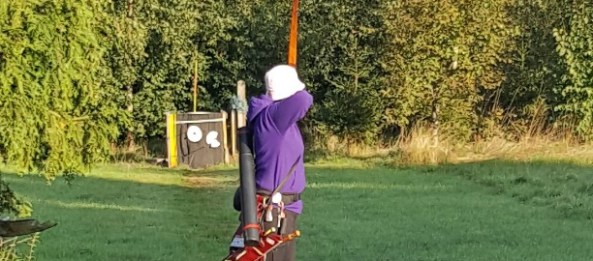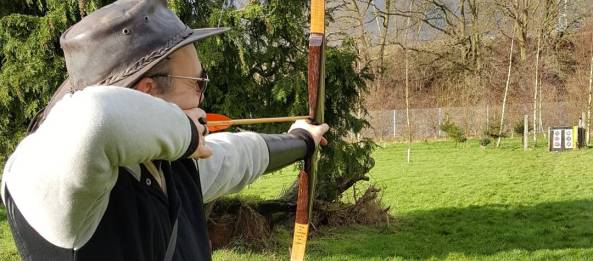
Me trying to remember to shoot

Target Panic techniques – drawing down

As promised we are going to start on the shooting techniques that can help with you overcoming target panic or anxiety when shooting.
So let’s look at one technique, which I feel is the best to start with and is a good one for any archer to develop whether suffering from target panic or not. Ironically it is something you probably did lots when you started but have maybe forgotten and thought is no longer needed. What am I talking about? The ability to draw down from a shot.
A while back I wrote a series of articles on what I thought were the “Hardest lessons to learn in Archery“. In those articles, I shared some coaching tips and ideas. One of these was on the skill of drawing down, sometimes called coming down from a shot. I’m going to revisit it here as it is a good technique to master when on the road to overcoming target panic. If you take nothing from this post, other than the thought of the importance of drawing down from a shot, fine believe me it’s going to help you.
First a quick definition -So drawing down is when you have drawn up your bow on your target, ready to release, and then lower it back down, without releasing the arrow and taking the shot.
Chances are you do it as a beginner when you first start, as it’s not uncommon for us to flick the arrow off the rest, normally because we are twisting the string, but as time progresses chances are you do it less and less often.
I would go as far as saying that learning to draw down your bow is probably my top tip for all archers, whether they suffer from anxiety, target panic or not. I firmly believe it is as equally important whether you shoot a trad bow or a compound. You have to be able to stop and come down from your shot safely.
I would like to share an example, which I feel ideal demonstrates the importance of practising this technique and how vital it can be.
When I was at a national tournament in a country park. This was a little over 4 years ago and I was about to shoot a 3D target about 15 yards away when a dog ran out in front of me!
I was at full draw, focusing on the target and about to release. In that split second, I reacted and followed my training and came down but it could have ended very differently.
The dog had been let off its lead by its owner on a public footpath running through the wood, after ignoring the warning signs to keep dogs on the lead due to the tournament. It was a close call and I was pretty shaken up and yes I did report the incident to the marshalling team.
It is quite common for those suffering from target panic to be unable to reach or hold at full draw, with many being unable to draw down. So building a training program that encourages it, developing it in such a way as it becomes a natural process is a good plan.
Think of it from this perspective, taking a shot is part physical, part mental. Over time your muscles develop in strength and flexibility, but your head is different. You think you may have learnt what to do. You’ve got yourself psyched up to take that shot and then at the last stage, you have to admit something is wrong or doesn’t feel right. That can feel like a big hit to your confidence, especially if people are watching. So the anxiety hits and you either release the string too early, as you can’t get to anchor or maybe do something else. If this behaviour persists then it becomes a habit and part of your shot sequence.

Train the brain

Okay now think of your brain as a computer and we train our brain through actions we undertake. If your brain believes every time you draw up on a target you have to shoot then it becomes very hard to stop this chain of events, even when you want or have to. If I hadn’t been able to stop when that dog ran out in front of me, well things could have been much worse.
Developing the ability of drawing down helps to program our brain, training it to know that just because we draw up onto a target doesn’t mean we have to shoot.
When drawing up to take your shot, there is the programming in your head or maybe I should say the expectation to release the arrow. In the back of your mind, you don’t want to admit that something is wrong or that you may have done something wrong.
One way you can overcome this problem is to condition yourself to draw down, or rather condition your head to accept that each time you draw up you don’t have to shoot.
An analogy – When you are driving a car and approaching a roundabout or junction, we might be able to arrive at said junction, observe no traffic and go. This is similar to us drawing up and encountering no problems, so we shoot. However, those of us who drive know we often have to stop at junctions due to the traffic we observe. Those observations provide information to us and are similar to drawing up and it feels wrong or uncomfortable.
Through repeated practise and experience of driving, we know we have to stop to avoid a collision. If we can do this when driving a car, which is far more complicated than shooting a bow, then we should be able to come down from a shot. Well, that’s the theory.

So what can you do?

One way of trying to overcome this mental block is to start programming your brain that
  1. The action of drawing up does not mean you have to shoot.
  2. The action of drawing down is normal.
There are a couple of effective ways of doing this. One method sees you using your normal bow, the other has you using a lighter draw weight. The techniques goal is to train yourself i.e. your brain during practising learns to not take each shot, i.e. removing the expectation that every time you draw up you have to shoot.

Step 1

So when you are shooting your normal bow and on the practise bosses, try this addition to your normal program. It’s really simple. Don’t shot your 3rd arrow immediately.
When you get to your 3rd arrow draw up as normal, anchor, settle aim and at the point, you would normally release the string, stop.
Instead of releasing, drawdown, go back to your ready position. Take you hand off the string, leave the arrow on the string and relax. Take a couple of breaths and then draw up and if it feels right take the shot.
So why do this?
Well it starts to condition your mind into that mindset we are wanting i.e when you draw up it does not mean you will have to always take the shot. Effectively you are retraining your brain to be more flexible.
This may sound strange but it helps build your muscle memory and gives you confidence, it helps to make you realise that you don’t always have to take the shot. This, in turn, goes a long way to improve your shot control. Don’t get me wrong, it won’t be easy. There are times you draw up and feel perfect, but if it is your third arrow come down and do it again. You might draw up and down 3 or 4 times but over time you will get used to the feel and not let it affect you.

Step 2

The other technique has you doing a similar exercise using a lighter weight bow, I have an 18lb recurve I use. With this method, you draw up, anchor and come down, then draw up anchor and shoot. Because you are effectively drawing up twice for each shot you need to use a lower draw weight bow, otherwise, you are going to get tired and fatigued very quickly. I find doing this for a couple of sets of 4 arrows works best.
The key point of this technique is for you to learn that just because you draw back your nocked arrow, it doesn’t mean you have to take the shot. It can be a hard lesson to learn, but when it works and it will with practise, it feels great. It feels like you have retaken control of the shot and your archery.
Try the technique and let me know if it works for you or if you have something else that works. I sincerely hope this has helped, please let me know what you think.
Thanks for reading and as I have said previously feel free to drop me a line with any questions or thoughts you might have.
Sharon on the range

Before we start a quick reminder

So we have looked at two sides of the archers triangle, that of the arrow and bow. Now let’s look at what many see as the hardest element to gain control of, the archer.

archers triangle graphic

The archers triangle

Before we dive into this I want you to think for a moment about your mindset and how you approach these ideas.
It’s good to be optimistic when it comes to combating target panic but you have to temper this with a level of realism. So please be realistic in what you can achieve with the time you have available. Try and plan your activities so your time is used effectively and efficiently. Just like you need to allocate time for tuning your bow or making arrows you need to give yourself time to practice these techniques.
You will need to consider planning your time effectively. Don’t just go out and shoot lots of arrows believing it will cure your anxiety. It might build your muscle strength but I doubt it will solve the anxiety you feel.  Consider the fact that shooting 100 poor shots does not work as well as 30 well executed shots.

So think about practice regime and exercises you can do to help build confidence and resolve. Working on your chosen techniques whether these be focusing on your own form, shot sequence steps or exercises like drawing down off a shot have to be factored into your training regime.

view of the range

view of the range

Consider carefully how much time you can allocate to the techniques I will suggest. It may well require you to allocate 20 to 30 minutes a session in the early stages to get used to the drills. This is the sort of commitment required in the early stages.
Once you have regained control its still worth practicing the techniques every few sessions partly so they remain fresh in your mind and partly because they can help you remain in control.
Your objective is not to hit the target but to gain control over your target panic / shot anxietyremember this. Don’t let your focus move to hitting the gold, it has to be on control.
Too often we focus and perceive success as making the shot score highly. That is an outcome from solving the anxiety, your true goal is to take back control of the shot.

Physical Practise is one way but remember we are training your brain too. I mentioned in the previous article about mindset and changing the way you think about things. This includes how we consider things such as how we recall what we consider to be good or bad shots, productive or unproductive practice. Often when we start experiencing target panic we tend to recall the poor shots, what we consider bad ones. These prey on your mind, possibly because you missed a shot or scored less than you wanted. In reality the shot has gone, its in the past. remember to learn from it and move on.
You may have heard of the phrase “Making mistakes is not failure unless you let it be.” or something similar.
I firmly believe that making mistakes should not be viewed as a failure as it can provide a great learning experience. The reality is if we don’t learn from our mistakes we are likely to repeat them. Think of this for a moment. Shooting the wrong spine of arrow and identifying this only comes about from the mistake of shooting the wrong arrows in the first place.
Where archery is concerned this is very important to remember as you might try a technique and it doesn’t gell with you for whatever reason. The crucial thing to remember is you’ve tried something and made a step in gaining back control.
One way you can think of it is as if you are going to a new restaurant. You decide to try something new on the menu that sounds interesting. You might like it or you might hate it, without trying you’ll never know.

Getting good at something takes practice.
Getting better at doing the same thing takes more good practice.
Getting to a level where you are a master, can take a lifetime.

This is true if you are field archer, target shooter, fisherman, golfer or even a surgeon.
It is equally true of physical and mental practices. They take time to learn and for you to develop.

Natural Aptitude and learnt skill

Basic talent or natural aptitude only goes so far, after that its perseverance and good practice. Someone with natural talent will often start off well or ahead of another who has to work on shooting a bow. The thing is the person who is a “natural” may struggle later in their progression as they may have relied on their talent rather than developing skill. I’ve seen it time and time before affect the archers confidence as they start to struggle, wondering why it’s become so hard all of a sudden.

Modern fix, quick fix

In a modern world where people are always looking for short cuts or quick answers to fix complex issues the concept of spending time ensuring we learn the skill properly is sometimes overlooked.
Increasingly society looks for the easy fast solution. Here is a fact, target panic requires time to overcome. There maybe some quick tips that can help you find your right road, which is why I started writing these articles but there are no shortcuts or magic arrow.
The important thing to remember is effort can work and will work if the effort is focused.
Knowledge and effort makes a difference or at least it can if effort is directed and focused correctly. These posts are here to help you gain some insight and ideas on how to focus on the correct way for you.
Be kind to yourself and give yourself time. You might have been struggling with anxiety for years so don’t expect to learn to control it in hours. Remember in the second post I said there were 3 things

Put some work in – there are no magic arrows that solve everything or a secret draw technique that quells the nerves.
Remember one size doesn’t fit all – what works for one person may or may not work for you.
Be patient – it takes time to work out what helps you and this means time spent working at it too.

In the next couple of posts I’m going to cover a few techniques that can help.

  • Blank boss work
  • Target fear (where specific target faces trigger anxiety)
  • Drawing down
  • Drawing up but not shooting immediately

I might throw a few other ideas in the mix too. I hope these ideas will help.
Thanks for reading

Sharon on the range

Target Panic and the archer part 3

So in the second post on target panic I wrote at length about shot sequence and tried to set some foundation of ideas for you to build on. In this post I am going to describe some techniques, but first I want to discuss confidence.

Confidence and it’s role in Target Panic

I have always felt that confidence is hard won and easy knocked.  Remembering this it’s my view confidence and target panic go hand in hand, with a lack of confidence in your own ability often sparking some form of anxiety. Think of this cycle for a moment.
A lack or loss of confidence can spark anxiety, which in turn may cause a loss in performance due to nerves. The loss in performance then results in a loss of confidence in ability. It’s not hard to see how this can quickly become self perpetuating.
The possible result is an archer can develop a variety symptoms, not knowing where or how to aim, unable to reach anchor before releasing etc. Bearing this in mind we can look at elements of your shooting process and how we can identify the separate steps in your shot cycle. This was why in the last article I spoke at length about shot sequence.
As for building confidence, well that is a huge element of archery so I’ll come back to that later in this series of articles. To start let’s look at what I think of as our mindset.

How your mindset plays a vital part

I feel you can be your own worse enemy at times or rather your mindset and memories can help weaken your resolve. How you perceive or approach a target can have a huge impact on how you shoot. Ask yourself this, have you either thought any of these when you see a target?
“I always miss this shot.” ,
“I never hit this face.” ,
” I don’t like long shots.”
The best I think I have heard is “I hate things standing on legs like 3D deer as I always go between the legs.”
Statements like these have an effect on your mindset long before you nock the arrow on the string. Effectively you are starting preparing for your shot by talking yourself out of making the shot successfully, before you even start! Almost as though these are the excuses you can use for when you miss. You might not realise it but I believe this mentality adds stress and starts pre-programming your brain into a negative mindset. So please stop doing it.
You want to avoid trying to use these descriptions when effectively talking to yourself about a shot. So much or archery is in your mind and how you approach or talk to yourself about shots, that talking in negative terms starts a downhill spiral.
I think it was Nelson Mandela who said “I never lose. Either I win or I learn.” I think this could be modified for archers to “I miss and I learn, I hit and I learn more.”
Why do I believe this? When you shoot and miss you might realise you judged the distance wrong or performed a poor release. When you shoot well and hit, you remind yourself you can judge the distance, execute the release, you help to remind yourself you are a capable archer. This helps to build individual confidence it also helps build a reservoir of successful shots.

Remember the good shots

Too often we recall the shots that we perceive as failure or target faces we hate to shoot. This can make us over analyse the shots we take,  going over them again and again in the virtual world of our mind. This can also re-enforces a negative cycle in our brains. I will admit this is something I have struggled with for years. I have a good memory a d remember shots and courses, sometimes for years. The problem was I often recall the poor shots or the ones I felt I should have done better, rather than celebrating the good shots, the successes. It has taken a lot of work to retrain my brain and shift it’s focus, but if I can do it so can you.
For this reason I started to actively remind myself of the good shots, whether this was at the range or at a competition. Changing the terms I would describe events in my own head. I shifted  my focus to remember the actions that made them good shots and I found I could then repeat them more easily. I stopped looking at what I was doing wrong and reminding myself what I was doing or capable  of doing right. I can trace how that change in mindset helped me back to a couple of instances one of which I will recall now.

This is what helped me?

Starting to remember the good shots and learning from them, rather than constantly re-analysing the misses. Knowing why and how I missed is important, but you can overdo things. I would finish a competition shoot feeling down and when asked how I did I’d reply not well. It wasn’t until a mate said your bad days are better than most people good days, I realised I needed to change how I saw my results. (By the way, thanks Jim as it made me think)
There is one specific shot at a NFAS 3D championships a couple of years ago that helped me and was a turning point. I had started a few weeks before the event focusing on the positive, trying to remember the good shots and not to be so negative. I knew this tournament would be the testing ground for my new outlook. The target that brought it home for me was a standing 3D stag, about 60 yards or more. My shooting group was waiting to shoot the target as the groups in front appeared to  pepper the undergrowth. None were hitting it from the first peg and most were taking 3 arrows to score or come close. I think it was fair to say that this wasn’t filling any of us in the group along with others with a sense of confidence. By the time it was my groups turn to shoot there were others groups waiting behind us. Each member of the group took it in turn to shoot before me and only one hit with their third arrow. By the time it was my go the viewing audience of other archers had grown to several groups. I’m not a big fan of being watched when I shoot, so have a couple of dozen people watching me wasn’t high on my list of things to enjoy.
I remember feeling the anxiety build, long before I was on the shooting peg. I took my place at the peg and breathed out, forcing my shoulders down and to relax. I nocked the arrow and slowly breathed in and out a couple more times, smiling to myself while thinking I must be mad to do this to myself.  I remember the conversation in my head ” Come on you’ve shot this distance before over harder terrain. Any doubts then just focus on form and smile.
I focused my concentration on my form, my balance on my feet, my grip on the bow and how my fingers felt on the string. All the time looking at the target. I breathed in and drew up in one fluid motion, bending at the waste for the distance. I reached anchor and when I was ready I released the string, letting the arrow fly towards the target.
I then heard the thud of an impact, not a sound of arrow burying into the ground but the dull thud of an arrow in a 3D.
Lowering my bow arm I could see my arrow central in the body. A good shot, a first arrow hit scoring me 20 points. More importantly it told my doubting head I could do this archery lark.
Now when faced with shots that make me nervous I think back to that shot. How I focused on form, my shot sequence and most important remembering the positive outcome it gave me then and since. I would go on to come second in my class at that national tournament.
So start today to focus on the elements you are doing right and build on them. It will take a bit of time and you’ll probably catch yourself more than once being negative but believe me it’s worth it.
Sharon forcing me to pose for my shot on elk

Sharon forcing me to pose for my shot on elk

With Christmas round the corner I want to share a top tip that many retailers will hate me for. Please don’t spend lots of money on new equipment or upgrades believing this will help with your shot anxiety. IT WON’T. All it will result in is you potentially missing faster, getting more frustrated after spending money, sometimes a lot of money and being back at square one.
Your objective is not to hit the target but to gain control over your target panic / shot anxiety – remember this. Too often we focus and perceive success as making the shot score highly. That is an outcome from solving the anxiety, your true goal is to take back control of the shot.
Thanks for reading and as I have said previously feel free to drop me a line with any questions or thoughts you might have.