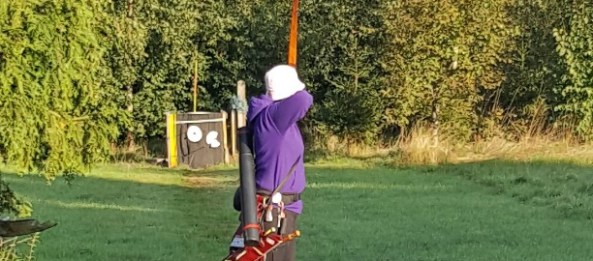
Sharon on the range

Before we start a quick reminder

So we have looked at two sides of the archers triangle, that of the arrow and bow. Now let’s look at what many see as the hardest element to gain control of, the archer.

archers triangle graphic

The archers triangle

Before we dive into this I want you to think for a moment about your mindset and how you approach these ideas.
It’s good to be optimistic when it comes to combating target panic but you have to temper this with a level of realism. So please be realistic in what you can achieve with the time you have available. Try and plan your activities so your time is used effectively and efficiently. Just like you need to allocate time for tuning your bow or making arrows you need to give yourself time to practice these techniques.
You will need to consider planning your time effectively. Don’t just go out and shoot lots of arrows believing it will cure your anxiety. It might build your muscle strength but I doubt it will solve the anxiety you feel.  Consider the fact that shooting 100 poor shots does not work as well as 30 well executed shots.

So think about practice regime and exercises you can do to help build confidence and resolve. Working on your chosen techniques whether these be focusing on your own form, shot sequence steps or exercises like drawing down off a shot have to be factored into your training regime.

view of the range

view of the range

Consider carefully how much time you can allocate to the techniques I will suggest. It may well require you to allocate 20 to 30 minutes a session in the early stages to get used to the drills. This is the sort of commitment required in the early stages.
Once you have regained control its still worth practicing the techniques every few sessions partly so they remain fresh in your mind and partly because they can help you remain in control.
Your objective is not to hit the target but to gain control over your target panic / shot anxietyremember this. Don’t let your focus move to hitting the gold, it has to be on control.
Too often we focus and perceive success as making the shot score highly. That is an outcome from solving the anxiety, your true goal is to take back control of the shot.

Physical Practise is one way but remember we are training your brain too. I mentioned in the previous article about mindset and changing the way you think about things. This includes how we consider things such as how we recall what we consider to be good or bad shots, productive or unproductive practice. Often when we start experiencing target panic we tend to recall the poor shots, what we consider bad ones. These prey on your mind, possibly because you missed a shot or scored less than you wanted. In reality the shot has gone, its in the past. remember to learn from it and move on.
You may have heard of the phrase “Making mistakes is not failure unless you let it be.” or something similar.
I firmly believe that making mistakes should not be viewed as a failure as it can provide a great learning experience. The reality is if we don’t learn from our mistakes we are likely to repeat them. Think of this for a moment. Shooting the wrong spine of arrow and identifying this only comes about from the mistake of shooting the wrong arrows in the first place.
Where archery is concerned this is very important to remember as you might try a technique and it doesn’t gell with you for whatever reason. The crucial thing to remember is you’ve tried something and made a step in gaining back control.
One way you can think of it is as if you are going to a new restaurant. You decide to try something new on the menu that sounds interesting. You might like it or you might hate it, without trying you’ll never know.

Getting good at something takes practice.
Getting better at doing the same thing takes more good practice.
Getting to a level where you are a master, can take a lifetime.

This is true if you are field archer, target shooter, fisherman, golfer or even a surgeon.
It is equally true of physical and mental practices. They take time to learn and for you to develop.

Natural Aptitude and learnt skill

Basic talent or natural aptitude only goes so far, after that its perseverance and good practice. Someone with natural talent will often start off well or ahead of another who has to work on shooting a bow. The thing is the person who is a “natural” may struggle later in their progression as they may have relied on their talent rather than developing skill. I’ve seen it time and time before affect the archers confidence as they start to struggle, wondering why it’s become so hard all of a sudden.

Modern fix, quick fix

In a modern world where people are always looking for short cuts or quick answers to fix complex issues the concept of spending time ensuring we learn the skill properly is sometimes overlooked.
Increasingly society looks for the easy fast solution. Here is a fact, target panic requires time to overcome. There maybe some quick tips that can help you find your right road, which is why I started writing these articles but there are no shortcuts or magic arrow.
The important thing to remember is effort can work and will work if the effort is focused.
Knowledge and effort makes a difference or at least it can if effort is directed and focused correctly. These posts are here to help you gain some insight and ideas on how to focus on the correct way for you.
Be kind to yourself and give yourself time. You might have been struggling with anxiety for years so don’t expect to learn to control it in hours. Remember in the second post I said there were 3 things

Put some work in – there are no magic arrows that solve everything or a secret draw technique that quells the nerves.
Remember one size doesn’t fit all – what works for one person may or may not work for you.
Be patient – it takes time to work out what helps you and this means time spent working at it too.

In the next couple of posts I’m going to cover a few techniques that can help.

  • Blank boss work
  • Target fear (where specific target faces trigger anxiety)
  • Drawing down
  • Drawing up but not shooting immediately

I might throw a few other ideas in the mix too. I hope these ideas will help.
Thanks for reading

Arrows role in overcoming target panic

Forest of arrows

Forest of arrows

In the previous posts, I talked about personal confidence and your mindset. In the next couple of articles, I am going to look at the role of equipment setup and how these can affect your confidence in both positive and negative ways. As ever if you have any questions or queries drop me a line.
How can we build self-confidence?
Well, that is not an easy question as there are so many different potential answers. From my perspective, I’m going to use something I call the Archer’s triangle, to help break this down into manageable elements.

archers triangle graphic

The archers triangle

The triangle is what I see as the three key elements that are relevant for all archers, whether you are a target archer, hunter or field shooter. It consists of three components, Archer, Arrow and Bow. These three need to work together successfully for the best outcome. I am not saying they all have to be perfect, but they do have to work together. Since there are three I have always thought of them as the three sides of a triangle.

Arrow – all elements from shaft construction, spinning, point weight, length, etc.
Bow – covering bow mass weight, draw weight, length, brace height, etc.
Archer –  cover draw dynamic, shot sequence, mindset, draw length, release, etc.

Building personal confidence i.e. the Archer element takes time and practise, but we can build confidence via the other two sides, slightly more quickly. So I’m going to summaries some ideas on the Arrow and Bow aspects initially.
Don’t worry I’m not ignoring the Archer element or how we build the archers confidence. I will cover this. but initially I want to focus on the kit aspects and provide a few ideas on how you can develop confidence through your kit set up.

Building confidence with arrows

So we are going to start with our projectiles, whether wood, carbon or aluminium. Arrows are a vital component for all archers. For this reason, I want to offer you a thought “If you don’t have confidence in how your equipment will behave, then you will find every shot doubly challenging?

Think about this for a moment. If your quiver is full of arrows of different lengths, weights, spines then do you think each arrow is likely to perform in the same way?

A quick Google search will provide you with a bewildering amount of information on arrows, how-to guides on construction techniques, what works, what doesn’t work, etc. So I’m not going to cover that. What I am going to outline is how making my arrows helped me build confidence in their performance and behaviour. This, in turn, gave me confidence when shooting them.
You could argue that this is from the perspective of a traditional archer, making mostly wooden arrows, with feather fletchings, but I feel it is just as applicable for all archers, whether you are shooting Easton X7, XX75 or Easton Carbon Ones. So here goes.
Over the years I’ve probably spent hours making and tuning my wooden arrows to the different bows I shoot. Trying different combinations of arrow spine, arrow length, pile weight, fletching size and shape, matching total arrow weight, etc. I would document all this in various notebooks so I could refer back to them. Then I would shoot the combinations for a couple of weeks to properly test them at different distances and in varying weather conditions. If they worked fantastic, if not back to the drawing board and start again with the next set of variable until I found a combination that worked.
Sure I made mistakes along the way, that’s part of learning. I firmly believe that making mistakes should not be viewed as a failure. It can provide a great learning experience if we let it. Too many times I’ve seen people not learn from mistakes only to repeat them.

I found the process of making the arrows strangely relaxing after a day spent in front of a computer screen. The ability to focus on the single task of construction and stages involved in construction brought an element of mindfulness.
I also feel all this work paid dividends in two ways. I developed skills in making arrows, which I have been able to apply and teach to others. Secondly and more importantly, it meant I developed confidence in the arrow set up and how they would behave.

I may have told you this story before, but I believe it is worth another outing and helps to highlight how not being aware of your kits variances can affect your anxiety.

An archer came to me for some coaching. Their goal was to increase their consistency, especially at longer distances where they struggled most. They felt a lack of confidence shooting at distance and couldn’t understand why sometimes things worked and others times they would go high and next time low.

Reviewing their form and shot execution showed them to have a strong and consistent routine. It was only when I reviewed their equipment did an answer appear as to why they were struggling. Their arrows had a huge variance in mass weight, with the heaviest being over 100 grains more than the lightest. This would explain why over longer distances, 35 yards plus, the archer would see completely different results depending on which arrow they used. This leads them to believe it was something they were doing wrong, which had the effect of causing anxiety and loss of confidence.

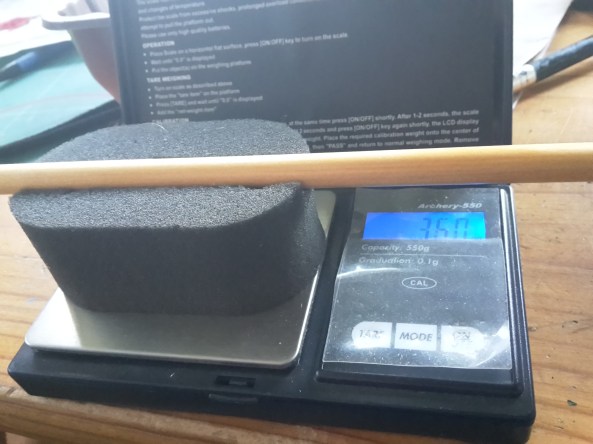
Top Tip – pickup a digital grain scale so you can weigh your arrows easily. They are quite inexpensive and can be easily picked up off the internet or local archery shop. I wrote an article a while back on my use of them. Make sure they will weigh items in grains.

Digital grain scales

Grain scales with sponge

Obviously, there are far more potential variations in shaft weight, arrow spinning etc when making wooden arrows due to the nature of the materials. When compared with constructing arrows from machined aluminium or carbon, where the manufacturing tolerances are far more predictable. Gaining consistency in your arrow set up is vital and is one reason so many people use carbon.

You might feel you don’t have the skills to build your own arrows, but everyone can develop these skills. If nothing else you can review and check the length and weight of your arrows to ensure a level of consistency.

Grouping by weight

I group my arrows into batches by weight so all the ones I shoot are closely matched, whether they are used for first, second or thirds. So 12 of my arrows might weigh in at 460 to 480 grains. I would group all the ones from 460 to 470 grains together and have a separate grouping of 470 to 480 grains.
Unlike some archers, I don’t use my lightest arrows for my first arrows (normally the longest shots), working down to my third arrows being the heaviest (normally the closest). I prefer to know they are all in the same weight range and hence will perform consistently.

Monitoring

The thing to remember is that arrows wear out over time, especially wooden arrows. Eventually, the fibres in the shaft will no longer keep their strength, following constantly impacting targets or the ground. This is sometimes called shooting the heart out of the arrow. This can have an effect on the archer as you can quickly lose confidence in yourself if you feel you are doing everything right but your arrows aren’t flying well.
For this reason, I suggest you monitor your arrows and check they are remaining straight and undamaged. This is vital for all archers to consider, especially when shooting carbon arrows as these too can fail and sometimes in quite dramatic manners. I’ve seen some carbon arrows explode when released from the bow due to the archer not being aware the arrow is damaged and the stresses involved at the point of release caused a catastrophic failure.
Like wooden arrows, aluminium shafts can become damaged and dented over time; resulting in less than ideal flight trajectory, so it’s worth keeping track of them too. Sharon used to find the Easton X7 a great arrow when shooting barebow as they could take a hit or two without deforming. Which provided her with confidence in their performance.

Thanks for reading and as I have said previously, feel free to drop me a line with any questions or thoughts you might have on topics I am covering.

Sharon on the range

Target Panic and the archer part 3

So in the second post on target panic I wrote at length about shot sequence and tried to set some foundation of ideas for you to build on. In this post I am going to describe some techniques, but first I want to discuss confidence.

Confidence and it’s role in Target Panic

I have always felt that confidence is hard won and easy knocked.  Remembering this it’s my view confidence and target panic go hand in hand, with a lack of confidence in your own ability often sparking some form of anxiety. Think of this cycle for a moment.
A lack or loss of confidence can spark anxiety, which in turn may cause a loss in performance due to nerves. The loss in performance then results in a loss of confidence in ability. It’s not hard to see how this can quickly become self perpetuating.
The possible result is an archer can develop a variety symptoms, not knowing where or how to aim, unable to reach anchor before releasing etc. Bearing this in mind we can look at elements of your shooting process and how we can identify the separate steps in your shot cycle. This was why in the last article I spoke at length about shot sequence.
As for building confidence, well that is a huge element of archery so I’ll come back to that later in this series of articles. To start let’s look at what I think of as our mindset.

How your mindset plays a vital part

I feel you can be your own worse enemy at times or rather your mindset and memories can help weaken your resolve. How you perceive or approach a target can have a huge impact on how you shoot. Ask yourself this, have you either thought any of these when you see a target?
“I always miss this shot.” ,
“I never hit this face.” ,
” I don’t like long shots.”
The best I think I have heard is “I hate things standing on legs like 3D deer as I always go between the legs.”
Statements like these have an effect on your mindset long before you nock the arrow on the string. Effectively you are starting preparing for your shot by talking yourself out of making the shot successfully, before you even start! Almost as though these are the excuses you can use for when you miss. You might not realise it but I believe this mentality adds stress and starts pre-programming your brain into a negative mindset. So please stop doing it.
You want to avoid trying to use these descriptions when effectively talking to yourself about a shot. So much or archery is in your mind and how you approach or talk to yourself about shots, that talking in negative terms starts a downhill spiral.
I think it was Nelson Mandela who said “I never lose. Either I win or I learn.” I think this could be modified for archers to “I miss and I learn, I hit and I learn more.”
Why do I believe this? When you shoot and miss you might realise you judged the distance wrong or performed a poor release. When you shoot well and hit, you remind yourself you can judge the distance, execute the release, you help to remind yourself you are a capable archer. This helps to build individual confidence it also helps build a reservoir of successful shots.

Remember the good shots

Too often we recall the shots that we perceive as failure or target faces we hate to shoot. This can make us over analyse the shots we take,  going over them again and again in the virtual world of our mind. This can also re-enforces a negative cycle in our brains. I will admit this is something I have struggled with for years. I have a good memory a d remember shots and courses, sometimes for years. The problem was I often recall the poor shots or the ones I felt I should have done better, rather than celebrating the good shots, the successes. It has taken a lot of work to retrain my brain and shift it’s focus, but if I can do it so can you.
For this reason I started to actively remind myself of the good shots, whether this was at the range or at a competition. Changing the terms I would describe events in my own head. I shifted  my focus to remember the actions that made them good shots and I found I could then repeat them more easily. I stopped looking at what I was doing wrong and reminding myself what I was doing or capable  of doing right. I can trace how that change in mindset helped me back to a couple of instances one of which I will recall now.

This is what helped me?

Starting to remember the good shots and learning from them, rather than constantly re-analysing the misses. Knowing why and how I missed is important, but you can overdo things. I would finish a competition shoot feeling down and when asked how I did I’d reply not well. It wasn’t until a mate said your bad days are better than most people good days, I realised I needed to change how I saw my results. (By the way, thanks Jim as it made me think)
There is one specific shot at a NFAS 3D championships a couple of years ago that helped me and was a turning point. I had started a few weeks before the event focusing on the positive, trying to remember the good shots and not to be so negative. I knew this tournament would be the testing ground for my new outlook. The target that brought it home for me was a standing 3D stag, about 60 yards or more. My shooting group was waiting to shoot the target as the groups in front appeared to  pepper the undergrowth. None were hitting it from the first peg and most were taking 3 arrows to score or come close. I think it was fair to say that this wasn’t filling any of us in the group along with others with a sense of confidence. By the time it was my groups turn to shoot there were others groups waiting behind us. Each member of the group took it in turn to shoot before me and only one hit with their third arrow. By the time it was my go the viewing audience of other archers had grown to several groups. I’m not a big fan of being watched when I shoot, so have a couple of dozen people watching me wasn’t high on my list of things to enjoy.
I remember feeling the anxiety build, long before I was on the shooting peg. I took my place at the peg and breathed out, forcing my shoulders down and to relax. I nocked the arrow and slowly breathed in and out a couple more times, smiling to myself while thinking I must be mad to do this to myself.  I remember the conversation in my head ” Come on you’ve shot this distance before over harder terrain. Any doubts then just focus on form and smile.
I focused my concentration on my form, my balance on my feet, my grip on the bow and how my fingers felt on the string. All the time looking at the target. I breathed in and drew up in one fluid motion, bending at the waste for the distance. I reached anchor and when I was ready I released the string, letting the arrow fly towards the target.
I then heard the thud of an impact, not a sound of arrow burying into the ground but the dull thud of an arrow in a 3D.
Lowering my bow arm I could see my arrow central in the body. A good shot, a first arrow hit scoring me 20 points. More importantly it told my doubting head I could do this archery lark.
Now when faced with shots that make me nervous I think back to that shot. How I focused on form, my shot sequence and most important remembering the positive outcome it gave me then and since. I would go on to come second in my class at that national tournament.
So start today to focus on the elements you are doing right and build on them. It will take a bit of time and you’ll probably catch yourself more than once being negative but believe me it’s worth it.
Sharon forcing me to pose for my shot on elk

Sharon forcing me to pose for my shot on elk

With Christmas round the corner I want to share a top tip that many retailers will hate me for. Please don’t spend lots of money on new equipment or upgrades believing this will help with your shot anxiety. IT WON’T. All it will result in is you potentially missing faster, getting more frustrated after spending money, sometimes a lot of money and being back at square one.
Your objective is not to hit the target but to gain control over your target panic / shot anxiety – remember this. Too often we focus and perceive success as making the shot score highly. That is an outcome from solving the anxiety, your true goal is to take back control of the shot.
Thanks for reading and as I have said previously feel free to drop me a line with any questions or thoughts you might have.