Okay so hopefully you have read my last two posts on setting archery goals and going to competition, etc. If not, then why not? They aren’t that bad, even if I do say so myself.
In this, the last one of the series I’m going to be talking about shooting form, physical and mental fitness. It may seem strange leaving this bit to last, but there is some logic to my madness. I think, well I hope!

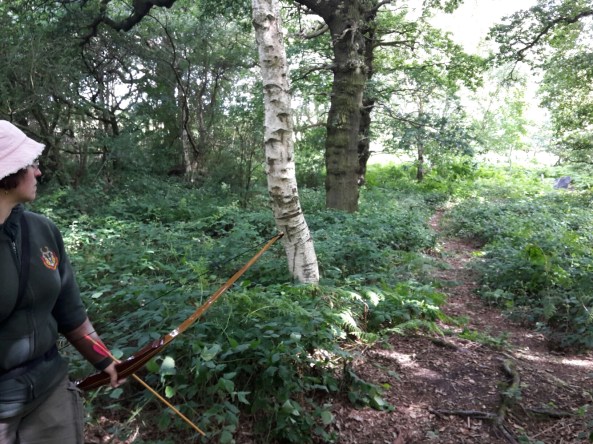
Sharon on the range
Shooting technique / form
There are countless resources available offering archers advise on shooting technique or shooting form, along with proposed steps for improvements. Such resources include YouTube videos, podcasts, articles and books that explore different techniques for improvements and I have to say all are useless!
Yes you read that right, I said useless, even the stuff I write here, where I try and help you are completely useless.
Why?
Simple, they are useless unless you can apply the rights one for you. You are drawing the bow, making the decisions, executing the shot. Not the person who wrote the advice or shot the video.
So remembering this I have a question for you. Can you list all the steps you go through when preparing and executing the shot? This shot sequence might be 4 steps or 14 but the steps should be the same with every shot you take, i.e. repeatable for every shot.
If you can’t describe the steps you take, how can you know or remember what you need to do to be able to repeat it, and therefore how can you be consistent? In the last article I mentioned how having confidence in your kit helps with consistency as it reduces variables. Well confidence in your form and technique also helps.
When coaching archers, whether newbies or experienced I ask them what steps they go through, what is their shooting cycle? I then get them to write the steps down and review them after each shot in the session, adding or modifying it until it covers all the steps they perform. This gives them a base line to follow and return to when things go wrong. It may sound long winded and not very instinctive, but it works for focusing the mind. There is one lady archer I’ve had the pleasure in coaching who followed my advice and has noted her steps down. I know she revisits the list when she’s had a bad shot and I also know she has been placed at recent shoots too.
Whilst talking about coaching I would advise any archer whether a newbie or experienced to seek advice and guidance from a coach. It’s always worth getting some coaching – lots of people will offer advice but it is worth seeking out a good coach to get some guidance. I’ve been skiing for over 10 years but every time I go on a ski holiday I book session with a coach to help iron out bad habits and improve.
When focusing on form I find it beneficial to use a lighter poundage bow than I normally shoot. This allows me to focus on my form and not be “fighting” the heavier poundage competition bow.
When talking shooting techniques you have to talk about those bad habits we all pick up over time.
It is very easy to develop poor form, but it’s a lot harder to get rid of it later. Poor shooting technique can take several different forms.
You might start shooting very quickly, too quickly, before you’ve had time to settle. You are drawing up and releasing the arrow immediately, no time to aim or anything. Another example can be short drawing where the archer does not come fully back to the anchor. Maybe your shoulders are shaking so as you release you are flinching.
Why does this happen, well maybe because your muscles can’t cope with the strain of drawing and holding the bow at full draw to aim. Maybe you are over bowed? I cover this later in the physical aspect of this article.
Sadly this is not an uncommon problem and I see this time and time again whether it is with a recurve bow or a compound bow. The effect it can have on the archer is both physical and mental. Physical injury can be sustained, with muscle strains, torn muscles etc. Mentally the archer can become dejected and not want to shoot and then muscles don’t develop and it becomes hard for them to draw the bow. This then turns into a downhill spiral. So many give up when things are not going well, sadly very few seek advice or help.
It can also have a knock on effect and this can lead to bigger problems like Target panic, but that is a topic for another day I think.
So you have your shooting technique and even more importantly your own confidence added to this is your own resilience which is really important. I cover this a little latter in this article, but for now let’s look at your physical fitness.
Physical Fitness
I think most of us would agree that we could be physically fitter in one way or another than we actually are, and it is often a New Year’s resolution topic. Your physical fitness has an impact on everything that we do, so obviously it has an effect on your archery goals and progress.
Think about how you would answer these questions,
- How many arrows do you shoot in practise or throughout the week?
- How often do you shoot, weekends only or during week too?
- How do you feel physically after shooting, do any of your muscles ache?
If you only shoot once or twice a week and then only a few arrows, you are unlikely to build your physical fitness with respect to shooting to a level where shooting for two days at national competition is doable with ease.
So what can you do? Well shooting more often can help to build your stamina, but don’t rush and start shooting every day as your muscles need time to build up and strengthen. In the summer months when days are longer I shoot every other day in the week so 2 or 3 days, where I’ll be shooting between 80 to 120 arrows at distances from 3 yards to 40 yards. Practice in the wood on Saturday and at a competition on the Sunday. But I’ll build up to that level of shooting so at start of the summer I’ll shoot 40 or so arrows at practise.
During the off months you can use exercise bands like therabands that come in different strengths to build should muscles. If you are member of gym, have a chat with one of the instructors / fitness coaches there who might be able to give you advice or suitable exercises. Simple push ups also help to build the shoulder muscles.
Muscle strength is one thing but stamina is important too, it’s all well and good to be able to draw a 45lb bow but if you can’t repeat this for the whole day, then you know you need to work on stamina.
Also consider your hydration level when you are shooting, it is very easy to become dehydrated on an field archery course as you are on your feet for several hours carrying your gear all the time.
One quick point about muscle tone and fitness is that muscles work best when warm, so in cold weather make sure you are wearing suitable clothing. I’ve always found wearing several layers better than a few thick layers that can restrict movement. The other advantage of this method is you can easily remove a layer if you get too warm.
Lots of archers work on developing their shoulder and back muscles, but it is worth also working on your core too as this provides stability.
Over bowed I mentioned this earlier and it is when an archer is shooting a bow that is too heavy for them to draw and use properly. When I say heavy I mean the draw weight of the bow is too high for the archer to be able to shoot consistently.
I see this time and time again whether it is with a recurve bow or a compound bow. The effect it can have on the archer is both physical and mental. Physical injury can be sustained, with muscle strains, torn muscles. Mentally the archer can become dejected and not want to shoot and then muscles don’t develop and it becomes hard for them to draw the bow. So it can become a downhill spiral.
There are a few ways over bowing can be identified. The archer is shooting too quickly, because your muscles can’t cope with the strain of drawing and holding the bow at full draw to aim. They are drawing up and releasing the arrow immediately. Another problem can be short drawing, where the archer does not come fully back to the anchor. Maybe your shoulders are shaking so as you release you are flinching
The solutions can come in a number of forms, drop to a lighter bow and build yourself up gradually. Shoot less arrows, what I hear you say! How can I build strengthen? Well shot less, so you aren’t shooting to the point of muscle fatigue. Look at exercise routine to improve strength.
So that was physical fitness, what about your mental fitness, your resilience?

Me trying to remember to shoot
Resilience
So what do I mean about resilience? I guess I am thinking about mental toughness, the willingness to keep going after a bad shot or training session that didn’t go well.
First thing to remember is that each shot you take is a fresh shot, true it is based on your experiences of the previous shots you have made, but it is a fresh shot. Hopefully the more opportunity you have to shoot the more you have the opportunity to learn, by learn I mean learning from your successful shots and learning from your misses to move on and develop. It is very important that you remember your good shots, the ones that landed exactly where you wanted. As you can use this as a trigger to remind yourself “yes you can” do this.
Of course that statement “move on” is easier said than done. A missed shot affects us in different ways. Some people can put it behind them and move on almost immediately, others get annoyed usually with themselves. Those that can put it behind them have developed coping strategies or resilience. Missing or having a bad day can be one of the hardest things to overcome in archery. How many times have you seen archers get dejected when they can’t make the shot and it’s not just beginners but us experienced archers too.
I’ve seen many archers end up on the blue peg, taking their 3rd and final chance of a scoring arrow because they have rushed their second arrow. Why, because they have been annoyed or self-conscious of their failure in front of others
So what can you do?
As I write this I recall an old military quote “A plan never survives first contact with the enemy” – this can be applied to archery too. The important thing to think about is what happens when the plan fails! Your plan is to shoot your arrow and hit the target successfully. In an ideal world this would happen every time, but it doesn’t in the real world and when it doesn’t have you got a tactic to overcome the “enemy”, whether that enemy is poor weather, target panic, or something else?
We all have good days, we all have bad days. We can rationalise these bad days based on lack of sleep, stress at work, etc. but not always, some days you can try too hard. It is those days when it is very easy to develop bad habits, but it’s a lot hard to unlearn them.
A quote from my old coach comes to mind while writing this. He would say focus on your form and the shot will come and I have to say he is very true.
For me if I’ve missed a shot or not having a good day I go back to the basics. I focus on my shooting form, your shot sequence and steps. I take a deep breath and let it out long and slow, forcing my shoulders to relax. It doesn’t always work, but it is a starting point and does work some times.
The other thing is focus on the positive, focus on the next arrow going into the gold or the spot. Have a read of this blog as there have been a few posts on the mental game and positivity. (https://archeryponderings.wordpress.com/2018/02/09/mental-training-positivity/)
This is something that I am struggling with a lot at present, as I’m not reaching the level I feel I have or are capable of, guess my resilience is being tested, sadly this archer can’t always practise what they preach. I’m fighting those internal demons at present.
I think I will close this part on a quote from Babe Ruth who said “Never let the fear of striking out keep you from coming up to bat.”
Final word
Last take away thought. I’ve found there are two types of people in the archery community. The ones that offer help and the ones that keep their knowledge to themselves. Most will be willing to share but you will find some like to keep their success secret. I personally believe it’s better to be someone who is willing to share and for that reason I started this blog.
I hope you have found these last few articles of interest or even possibly of use.
Thanks for reading.






 My Archery Experiences