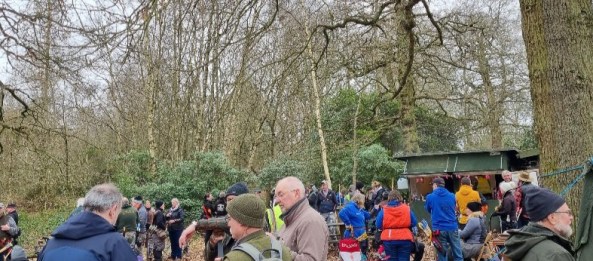
Photo of archers gathering before the start

Shoot Report – Harlequin Valentine Fun shoot – February 2023

Harlequin Valentines day shoot

This is the first shoot report I’ve written from the perspective of a competing archer in several years and to be honest I think I’m as rusty in writing this as I was in shooting Harlequins open course the other weekend.

Joy preparing to shoot

Situated in the Midlands, Harlequin host several competition shoots throughout the year and this was to be their Valentine Day fun shoot. Initially the organisers had set this as a 36 target course, though this was increased to 40 targets due to the numbers wanting to book in.
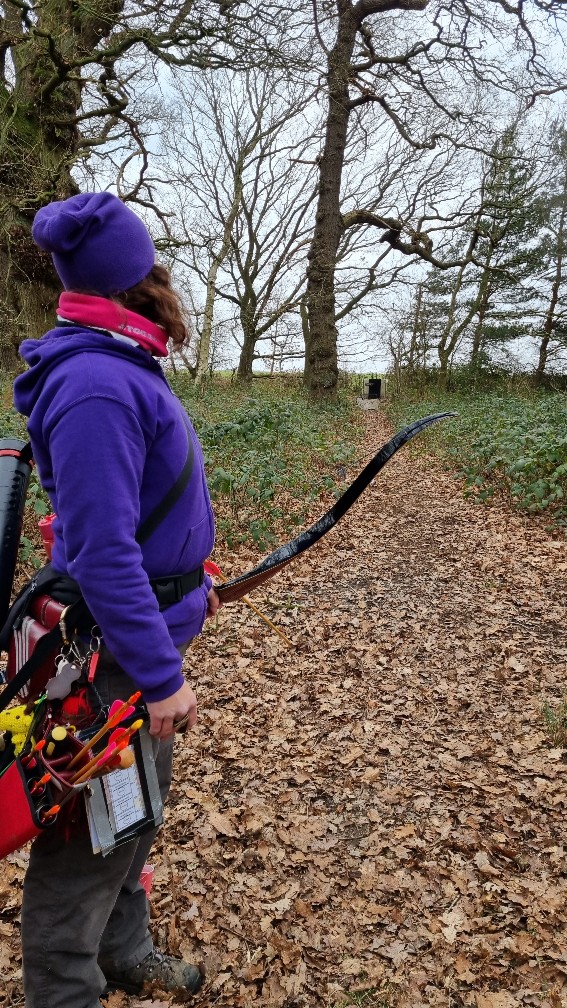
Sharon preparing to shoot a 2D lynx

I’d forgotten how long a NFAS competition day it can be. We started shooting at 10.30 and were not finished shooting until 4.30 pm, leaving the site a little after 5.30pm.  Of course, the day started much earlier with us packing the car for the hour-long drive to get there just after 9. This allowed for registration, breakfast, warm up etc.

We started on target 19 with Joy, an old Briar Rose club member, joining us for the day.
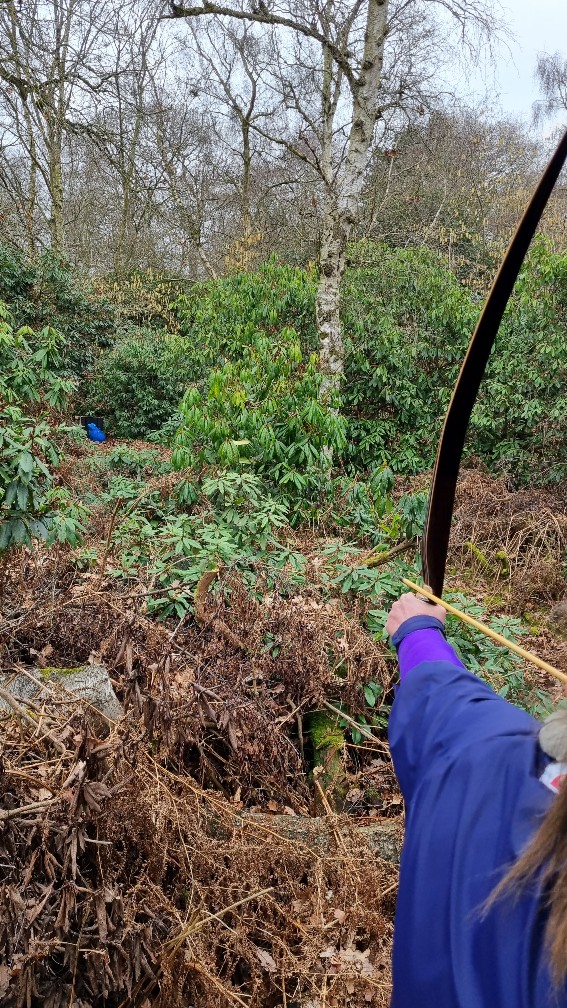
Joy shooting 3D blue frog

Starting on target 19 meant we would shoot over 20 targets before stopping for lunch break when we got to target 40.

The Harlequin’s grounds are set in a mixed deciduous woodland, with areas of thick rhododendron bushes, which were used at times to hide distances of the shots. In fact, there was some really clever use of vegetation to create areas of dead ground on a few shots. All the targets were 3D or large 2D targets, though I think the standing bear could do with some TLC repairs.

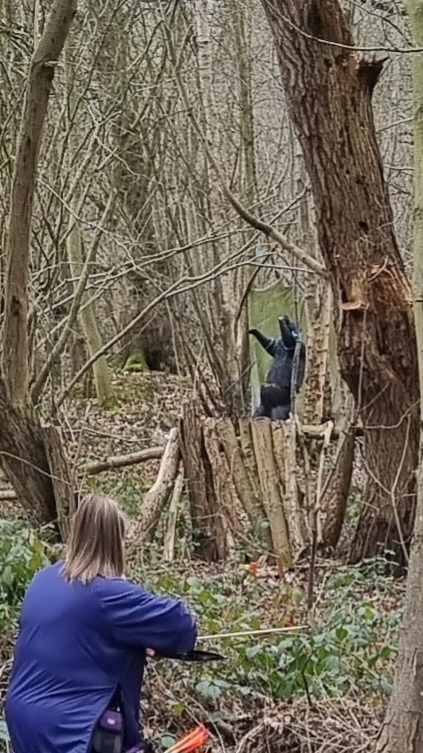
View from red peg of large 3d bear between trees
Zoomed in on the large 3d bear between trees
Joy shooting from blue peg

To be honest I think this is likely to be something several clubs are going to have to be doing as prices of 3D targets are ever increasing.

I’ve shared this next observational feedback already with Harlequin organiser and it concerns their peg placements for cubs and junior archers. There were some shooting pegs set way too far back or worse still behind obstacles that adults could easily see over but anyone under 4ft tall couldn’t. It’s a simple oversight, especially if the club doesn’t have many junior or cub archers.

To be fair to Harlequin they are supportive of juniors as there was no entrance fee for them and all who attended received a Harlequin keyring, no matter what they scored.

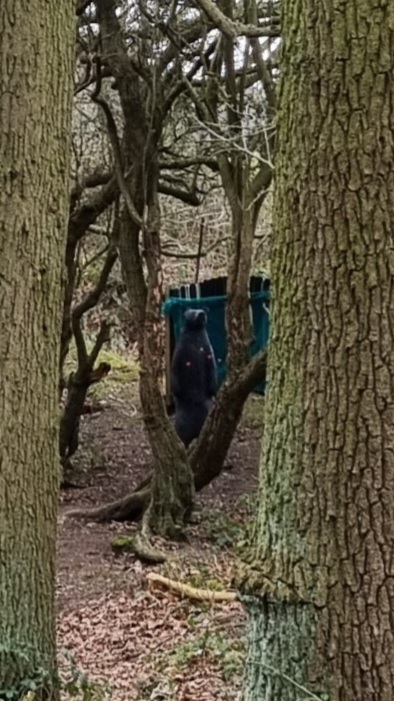
Black bear 3D seen from the red peg
Showing Zoomed in photo of the bear between trees
Zoomed in on the bear between trees

As for other parts of the course, there were some cleverly framed shots between trees, though I do feel there were a few shots I felt were stretched like the 3d tortoise. A target little over 10 to 12 inches in height and width, set at a distance beyond 20 yards is pushing it in my view. Maybe that is just my inexperience talking, though Sharon broke an arrow on this as hit it and deflected off into boss, snapping in half.

They weren’t doing normal prizes, instead there were handmade couples trophies for sighted, unsighted and mixed pairs.

Wasp pegs – I’m a big fan of using wasp pegs for sighted compound and crossbow archers. When used correctly they offer the opportunity for the course layers to give archers in those classes a challenge, with smaller windows etc. Personally, I feel if a club is setting a course and using wasp pegs I think the pegs should be present for all targets. That way you get used to seeing them and not walking to red and then realise there is a wasp further back. Even if on some shots the wasp pegs are next to the red, it means you know they are on every target.

Personal performance or lack of.

Over recent weeks I’d worked hard to build strength back to enable me to shoot. The week prior to Harlequin I had been able to shoot my 38lb recurve for the first time in nearly 3 years and had chosen to shoot this for the competition in hunting tackle class. I think in hindsight I’d have been better shooting the 30lb flatbow. I kept misjudging distances and I think that’s partly down to good course laying on some shots and partly down to being an instinctive shooter who has not been shooting much with the bow. After all I was shooting a faster bow of different poundage so arrow flights are different. I know I need to spend more time and hone my instincts with shooting the bow. I don’t see that being a quick process and it’s fair to say it has given me a lot to process and think about over the next few weeks.

It was nice to see people again, many of whom I’ve lost touch with in recent years. Joy was great company all day, keeping our spirits up. It was only when speaking to a few, explaining how poorly I’ve been over last 12 months I realised how out of touch with people and things I am. As I said earlier, it’s given me a lot to think about.

Thanks for reading.

Bison target face

New NFAS Target Faces review

The number of different target faces for field archery courses is quite simply astounding, probably numbering in the hundreds when you consider the different suppliers. I’m not talking about the round ones of different sizes and colours, but those depicting animal targets. So the JVD, Merlin, Delta etc. Over the last 12 months the National Field Archery Society, here in the UK has designed and produced a series of its own target faces to fit their needs.

These new faces were designed from the outset to be suitable for the NFAS championships and available for clubs to buy. The results of all this hard work being a collection of 80 custom faces, across 4 size groups giving organisers 20 target faces in each size group to choose from.

These faces can be printed on either paper or a plastic like mesh, (more on the mesh later) depending on the clubs requirements. The target faces have been designed with individual scoring zones ideal for NFAS competitions covering wound, kill and inner kill.

Explanation of Scoring zones

It’s worth noting NFAS made the decision when creating these faces that they wanted to make the scorings zones in some ways generous whilst still being challenging. The result was a series of target faces where the wound lines are running round the edge of the animal, thereby making the possibility of scoring a wound significantly easier than with other faces, This means not only the head and body area scores but also the legs, something very different to many other target faces currently on the market. Having said this the kill and especially the inner kill is small, making it challenging to get an inner kill,

At this point it might be worth explaining how the most common NFAS field course round – The Big Game round is scored. Everything is shot over unmarked distances and no range finding equipment is allowed. The goal for all archers is to go round and hit the target with their first arrow. Something I have never achieved. Courses are usually 36 or 40 targets set at distances from 5 yards to 70 plus yards. Yes, I did say 5 yards. Courses are set mostly in woodland and unlike other societies who insist on clear shooting lanes NFAS course layers will use all the vegetation and terrain to disguise the distances and make for a challenging shot.

The shooting distances are the same for all genders, the only difference being the age of the archer. younger archers shoot from junior pegs. This means you could have a compound archer shooting from the same peg as a longbow or Olympic recurve.

When you hit, what you score is dependent on which arrow you first hit with. Therefore if you hit the target with

  • First arrow wound is 16 points a kill 20 points inner kill 24 points, if you miss you go again.
  • Second arrow wound is 10 points a kill 14 points inner kill 14 points, if you miss you go again.
  • Third arrow wound is 4 points a kill 8 points inner kill 8 points. If you miss with your third attempt then you blank the target and move on.
    The inner kill area only bestowing a bonus score on the first shot, after that point it scores the same as the kill zone.

On a personal note I would like to see the faces organised in a northern / southern hemisphere . This simple is because I prefer seeing target faces in woodlands I could imagine being present historically in the country. So wolves, bears, deer, etc I’m not a fan of a lion, zebra or hippo. This is an entirely personal point of view.

The faces can be bought from the NFAS website https://nfas.net/

To give you an idea of the cost a group 1 target, printed on the mesh is £9.76 and a group 2 is £8.66 (this is at December 2022)

The testing of the mesh

Over the past few months the field Archery club (Briar Rose Field Archers) I belong to have had some of these new NFAS target faces out in our woodland course, as well as using them for the open competition a few months ago.

The bison shown below has been out since our clubs open shoot and lasted really well. The target is on a 1300 mm x 1300 mm boss so you can get an idea of size.

Bison target face
Bison target face

To give you an idea of what the target looks like from the shooting peg, I’ve taken the photo below. On the day of the shoot we had to fit a catching net at the back of the target due to so many people misjudging the distances. It is actually under 40 yard shot.

Bison target from shooting pegs

These target faces are printed not on paper but a plastic mess, which according to NFAS website can last several months or even a couple of years. It has certainly lasted a couple of months so far.

Image of the ostrich target face

There has been a few discussions about the line colours being a little hard to see at a distance or the contrast being a little unclear on some faces.

The mesh has proved to be a lot more resistant to the wet weather we’ve been experiencing. Unlike some printed faces these mesh ones don’t seem to be eaten by slugs and snails. A big problem with some of the old JVD faces which when they get wet seem to disappear due to slugs and snails almost overnight.

I’m reviewing the mess faces here, but you can order them printed on paper if you rather. Below you can see a closeup of the target face, showing the holes in the mesh. This highlights the only drawback with the target face we’ve found. Our experience has shown that the weave closes up pretty well for most arrows but some wooden arrows where the pile can sometimes snag when the arrow is drawn out. This can create a slightly larger hole, which is visible in the photo below. It;s not for all wooden arrows just those where there is almost a groove behind the pile, so not quite flush to the shaft.

close up of target face
Close up of target face

I’ve recorded a couple YouTube videos available on my channel, showing a couple of the target faces we have been using at the wood.

One tip I’d like to offer anyone considering using these faces, is covering the target bosses with black fabric. This may sound a little strange, but consider this. Many target bosses are made up of layered foam, sometimes of different colours. By wrapping or covering the bosses you don’t see the different colours and said bosses are less visually intrusive in the woods. It also means when holes are made in the target face the brightly coloured foam is not visible. To keep costs down we use the weed suppressing material available online or from garden centres.

So are they worth the money?

At a time where every penny counts this is of vital importance for many clubs and individuals alike. I don’t think the mesh is worth it for small target faces (group 4) as I think they would be shot out too quickly. For our club where paper faces are likely to be eaten by slugs and snails, before they are shot out. Then yes there is a benefit. If you are looking for a target faces that is weather resistant and look good then they work well. I’ll freely admit that I was a bit skeptical originally largely due to the costs and concerns on how long they last but they have lasted well and still going.

It’s also nice to see some new faces, with very friendly wound lines. It might encourage more clubs to use paper faces. I think the 24 are small and could do with being a little larger. I don’t know if NFAS are going to add more faces over time, but that I think would be great idea.

Thanks for reading.

Specific rules for an NFAS championship event.

The National Field Archery Society, National championships are this coming weekend and whether its the 3D Championships or the Nationals the NFAS have some extra rules where it comes to championship competitions.

Here I will discuss some of the rules while also providing some tips and advice on things to remember. I hope it’s of use to experienced archers as a reminder and newbies. It’s probably not as extensive as it could be, hopefully I’ve not got anything wrong either.

Most of all though, remember to have a great time.

Preparations beforehand

Long before you get there, there are a few things you can do to make life easier.

  • It may be a long day so plan for this carry snacks and an extra layer if cold or expecting rain.
  • Chances are you will walk several miles so keep hydrated.
  • Wear sensible cloths and comfortable shoes, you’ll be on your feet for hours. I’ve walked over 8 miles at past championships each day.
  • Bug repellent and suntan lotion are a couple of things to consider.
  • Check your bow and double check it. (have you got spare shot in string, spare arrow rest, shooting tab or glove, etc
  • Check your arrows, to make sure they are straight and marked up correctly. They need your name and shooting order on.
  • Ensure you have spare arrows for the two days
  • WALKERS must be listed as such on the entry form.
  • Family groups are usually broken up so one parent and one child per group. (This is beginning to occur on normal shoots too). This is partly for safety i.e. keeping track of more than one child could be difficult in the heat of competition and partly etiquette as other archers may not want to have the distraction of more than one child in a group.
    • Juniors/Cubs MUST BE ACCOMPANIED BY A PARENT/SHOOT GUARDIAN. Please make this clear on the entry form.
    • Only one Junior/Cub per parent/shoot guardian.
    • A Junior/Cub who has a birthday on the Saturday will be classed as being in the higher age group for the duration of the competition. A Junior/ Cub who has a birthday on the Sunday will remain in the lower age group.

On the day

Arrive early as registration is a lot earlier than normal shoots, 8 am to 9 am Saturday and 7 am to 8 am on Sunday is not unusual. Miss this and no shooting.

You can only collect your score card, no-one else can for you and you have to go through arrow checks first.

You shoot under the club on your NFAS membership card.

Arrow checks – These takes place both days, so allow time for this. Remember there maybe several hundred archers and only a few people doing arrow checks, so queues can form.

  • Arrows don’t have to have clubs listed.
  • All arrows that you might use must have your name and shooting order clearly marked. 15) All arrows must bear the archer’s name. This identification should be a minimum of the archer’s initial and surname.

Bow Checks – keep an ear out for announcements as you might be called for bow checks. This is nothing to worry about. It’s simply there are random selection of archers called for bow checks each day.

Give yourself time to have a few warm up shots and to get something to eat.

If you end up on the wrong peg you are no longer competing and shooting Non-comp so make sure you get this right.

During the day

Double scoring is conducted as at other shoots but, there are a few subtle differences Double scoring is when there are 2 score cards an 2 separate people rite the scores, calculating the totals etc

  • Take your time and have regular checks on the scores, a good tip is to check at tea or food stops.

  • Once you’ve scored the target, try not to spend time discussing the shot after scoring as you may come across as a slow group. Remember someone in your group might be feeling down after the shot and not want it analysed.

You will probably shoot targets at further distances than normal and probably more arrows, so don’t let that get to you.

You might only pass catering once so check with marshals if you can drop your bag and when you are likely to pass the tea stop again.

It’s not unusual to be held up, while waiting for group in front. Use this time to hydrate, check the maths on score cards, etc.

Here are a few general thoughts.

Some people will go to great lengths to win so if you are in with a chance my advice is being whiter than white, especially when calling scoring arrows or scoring.

I have known others to forcibly encourage a shooting order in the groups. It is worth remembering there are no rules associated with shooting order in the NFAS.

Carry a rule book with you as some archers will love to quote rules they have heard.

After the shoot ends

Make sure cards are handed in at end of the day promptly, you would be surprised how many people forget.

A good tip is at the end of each day, take a photograph of your score card so you have a record of it. It also means you can review it later if you wish.

Most important thing to remember is to have a good time. The championships are a great experience and be very rewarding even if you don’t get placed.

Final point, say thanks

There are times when I have really struggled at championships, either with my own form, group dynamics or the course being shot, but I always try to recognise the work that has gone in to the preparation, running and clear up afterwards. So if you have the opportunity say thank you to the marshalling crew. Believe me it goes a long way.

Thanks for reading.