Richard Head Longbows have put together this YouTube video report from the 3D Championships for those that are interested. Love the out takes at the end.
Tag Archives: youtube

Course and Target Laying – Distance
In this series of posts I’ve been looking at course laying and shot selection. The last post covered some thoughts on elevation and in this one I’m going to cover distance.
Society Rules
In the NFAS (National Field Archery Society) you shoot over unmarked distances so it is down to the archers own skills in distance judgement to calculate how far the target is. You aren’t allowed to use any range finding equipment and only a few classes are allowed to use sights. I know other societies allow the use of range finders or shoot marked distances. Likewise some societies specify you have to have x number of 30 yard shots, y number of 40 yard etc.
On this topic some would say the role of the course layer is to try and make the judgement of distance difficult by using dead ground or the like. Personally I would say a good course layer should be able to lay a course that encourages sighted archers to change their sight marks or pins.
What effect does distance have?
Well the further the shot the longer time in air the arrow has and therefore more chance for environment to effect the arrows flight. What I mean by environment is maybe gust of wind or when shooting in the rain. The other thing to consider is a shot can’t be too close.
Why?
Well think of the archers paradox, you need to give the arrow chance to straighten, for this reason I would say never put a shot in closer that 3 yards. Look at this weasel shot form the 2013 Nationals.
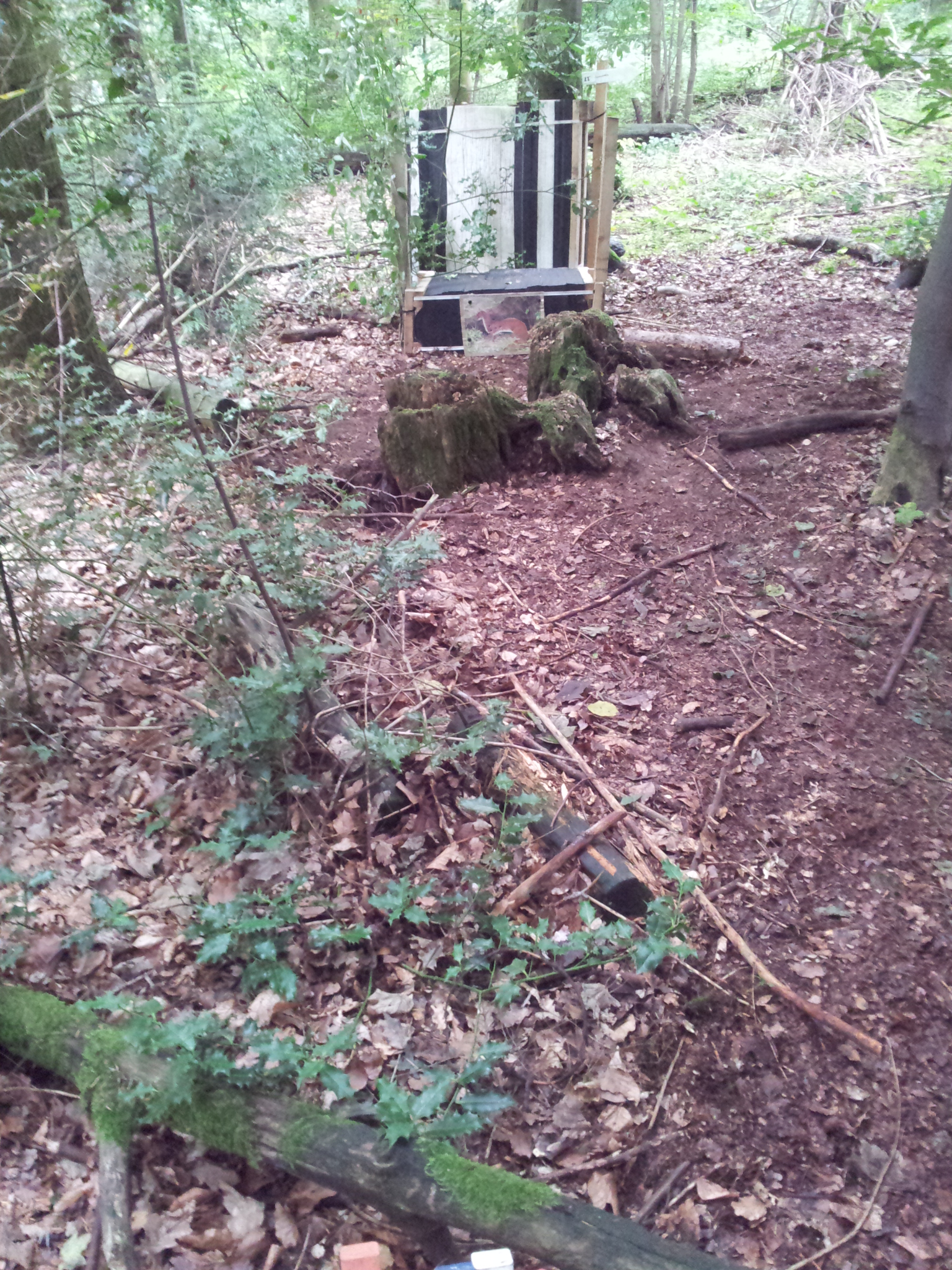
Paper Ermin
It was only a few yards away from the shooting pegs but the level it was set at and height off the ground along with proximity to the stumps made you think. It goes to show that a long distance relative to target size is obvious but sometimes a close shot can challenging.
Below is a good example of a medium shot of just about 30 yards. The reason I include this here is it also highlights the effect tree branches can have. If you putting a longish shot in keep a thought for overhanging tree branches, you might need to clear a few to ensure the shot is safe.

First view from Red peg
Stretched shot
I can’t cover distance without saying a word or two on stretched shots. Stretched shot are not challenging, simply beyond the distance it should be. This differs from a long shot, which can be challenging if there is a good chance of hitting.
The 3d tiger was a long shot as far as distance is concerned being over 50 yards but as it’s a large target its still hittable.
The 3d tiger was a long shot as far as distance is concerned being over 50 yards but as it’s a large target its still hittable.

3D tiger from red peg
Wolverine Archers are famous for their long shot Kong. Just to give you an idea here is a video of the distance
)
What is long or is considered long varies. Personally I think anything over 40 yards is boarding on long for most archers. Don’t get me wrong I like the occasional longer shot, so long as the target size is appropriate.
In the next post on course and target planning I will address the ideas and issues associated with identifying suitable target size.
If you find this useful or have any questions then please contact me.
As always thanks for reading.
Share this:

bad archery über alles
An excellent commentary on this video on how bows are used in films. In this case very badly. Made me smile and laugh lots. Thanks for posting.

A man after my own heart. Nikolas Lloyd on YouTube has produced an entire video detailing the bad archery, terrible combat strategies, and nitpicky errors in the 2003 miniseries Helen Of Troy. Regular readers of The Infinite Curve will note that I have frequently picked up on ‘bad archery’ in the media, e.g. here, here, and here.
Coupla points: the reason why ‘stage’ bows do that pinging, doingy release is because the string is often a rubber band, which is why the limbs barely move. The reason why they are so low-powered is so as not to kill anybody on the set! Yes, they are hoping the audience won’t know/notice. Also, you don’t necessarily need three fletchings to stabilise an arrow, it’s just that three work very well. And bows can creak; have heard longbows creak on the line and my older wooden recurve limbs do the…
View original post 6 more words

 My Archery Experiences