It may sound a little strange, even a bit far fetched to many, but I have found that using a six sided dice can prove very helpful and no I’m not talking about gambling.
Firstly though I have to say that I can’t claim this was entirely my own idea though, as it was spawned from a book I’ve been reading on archery. Many of you know I enjoy reading on all topics of archery and am slowly building a decent library of material, which I share with my students and fellow coaches.
The book in question which generated this idea is “Instinctive archery insights” by Jay Kidwell.
This was a book recommend to me by another coach and I’ll type up a full literature review on it shortly, but for now I’m going to focus on one aspect, that of practice to overcome target panic. There you go I have said it “Target Panic”
I really hate that phrase, as I personally prefer describing target panic as “shot anxiety”, since I see it manifest in so many different ways in archers, often long before the archer ever gets to draw up on the target. Anyway back to how a six sided die can help along your with archery practice.
In the exercises described the archer practices drawing up on the target but not shooting. Rather than immediately releasing, they move on and off the gold or centre spot a random number of times. Jay suggests having a coach or buddy saying a number to denote the number of times but you might be practicing on your own so I came up with the idea of using a die.
I modified the dice so there was no 1,5 or 6. This was easily done by sticking a blank label over the numbers. I wanted the die to show 1 four, 3 two’s and 2 threes. This may sound strange but you don’t want too many higher numbers when performing the exercise as you would get fatigued.
I then housed the die in a small clear plastic tub large enough to allow the die to roll and clear enough to see the result.
Dice in a box
There are three exercises in the book, the key thing to remember with all of them is using a light poundage bow rather than your competition bow. I use a 16lb-18lb draw weight recurve with my students.
I’ll briefly describe the way I use this. The archer rolls the die and obtains a random number, say 3.
They draw up and when they get to full draw on the gold they pass to the right and then left, whilst not releasing. In this case they would pass over the gold 3 times before coming down. When I am coaching this technique I recommend the student does this for 15- 20 minutes. Anymore and it can become tedious and the students tend to lose concentration.
The theory behind this is best described int he book but to put it simply it helps to train the brain into not releasing the arrow and being able to move on and off the target.
Further exercises work on the same principle but having you hold on the target for a second and then move off.
I’ve found the exercise works well as I have used them with people and die gives you a random number so you are not always doing 2 or 3 each time.
I hope this helps. I’m going to try and write up some target anxiety material.
I’m calling all the archery coaches and instructors out there for your input please.
If you coach complete beginners or nationals champions, traditional archer or Olympic recurve. I’m trying to compile some coaching materials on two main topics, one being the most common faults you encounter and the other being areas of improvement you target with your students.
So can I ask you, what you think are the 3 top or most common faults that you encounter when coaching archers?
Maybe you think its’ stance, or release? What about consistency in anchor?
Secondly what are the top 3 things that you think make the greatest impact on improving someone you are coaching?
Likewise this might be associated with shot sequence or simply slowing down? What about equipment and tuning?
The list is endless and I’m looking forward to hearing your input
Okay, so for the past several months I have been trying out a new flethching profile on my arrow set up. In the past I have always stuck with the shield profile, with Sharon preferring a parabolic profile on her arrows. I feel that a lot of the time it is personal preference, but I’ve found a 4 or 5 inch shield to work well on my flatbows and a 3 inch has always been my preferred choice on my recurves.
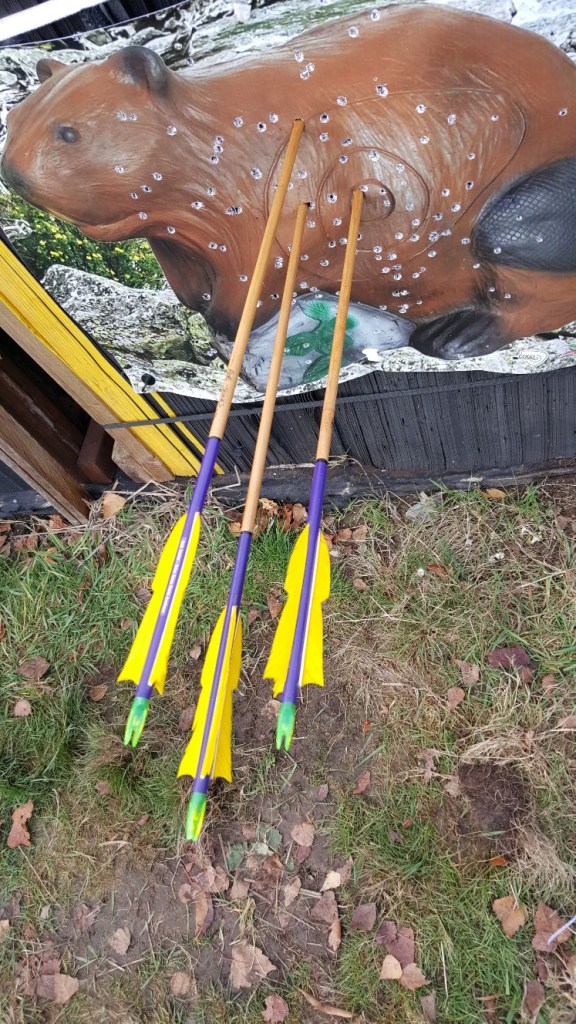
These new fletching are a completely different profile called Batwing and being produced by Gateway (https://www.gatewayfeathers.com/ ). So would they prove to be a Joker in the deck or a hidden ace? Sorry had to include some kind of Batman related joke. You can partly blame Sharon for the joke as she’s nicknamed this batch of arrows the Jokers due to the colour scheme resemblimg the colours of the Jokers suit from Batman. Then again it might be nothing to do with colours and more to do with how I shoot them.
So why those colours? Well I went with bright yellow fletchings and green nocks in the hope I would be able to see them in the target against the purple cresting.
Batwing fletching
The purple was partly because of it being club colours and a follow on from testing out the paints Lee had provided me for the Goblin Snot paint review a few months back. If you haven’t seen the review I was quite impressed by the paints.
Back to this review, the fletschings come in three sizes, 2 inch, 3 ½ inch and 4 ½ inch. Though I have all three sizes I’ve only tried out the latter two sizes on my flatbow. Of these two, I found that for my flatbow setup the 4 ½ inch have proved best. I know a couple of compound archers have tried the smaller size on their arrows with some success too.
For reference I normally shoot a 5 inch shield fletching. Whilst the 3 ½ worked ok, I found that they weren’t as forgiving when I had a poor release.
I’ve found the 4 1/2 inch offer stability in flight which is comparable to the larger five inch fletchings.
As I know some of you will be wondering about arrows speed and having put the arrows through a chrono the arrows are coming in at 176-180 Feet Per Second. That may not sound very fast but remember I’m not shooting carbon arrows, but wood ones. For those interested the arrows weigh between 455 and 465 grains, with a 80 grain pile up front and measuring 29 ½ inches being made from port orford cedar.
I wanted to wait before writing up this review so I could test them in a variety of conditions, which I think I have now managed. For those of you who shoot field, you know what it can be like shooting in a wood with variable cross winds between trees. One thing I have noticed with shooting these over the last few months is they don’t appear to be as adversely affected by wind as my previous choice of five inch shield.
Wet weather, yes it is something that we as field archers have to encounter and despite having one of the warmest and driest summers on record in the UK we did get some rainy days. Wet weather has a huge effect on feather fletchings, often resulting in the feathers profile flattening down and offering very little stability. I was curious to see how these would cope in wet weather and whether the shape would make a difference. I have to report they don’t appear to have the same problem as normal shield that collapse and flatten.
I was a bit worried that their shape might result in them not coping with the occasional foray into the undergrowth which can happen when I miss the target, but so far so good. They don’t seem to have a problem with returning



 My Archery Experiences