I’ve had a question about target boss repair and the type of banding fastener I use as it allows the banding to be adjusted, i.e., tightened if the boss is not compressed enough.
The original post goes into some details and another on boss repairs.
They are a type of buckle that holds the banding tight, and if like I do, you leave a long tail on the banding and don’t cut it short. You will have enough to feed back into your banding machine and can then tighten the boss if needed.
close up of banding buckleleaving 5-6 inches tail on the end of the banding seems to work well for my banding machine.
Thanks for reading and if you have any questions drop me a line.
Those of you who read this site and live in the UK will know that a few days ago the country was hit by Storm Arwen. This brought storm force winds and heavy snow to some areas, resulting in thousands of homes losing power for several days, some of these are still without power 5 days later. This was the first winter storm to hit the UK.
So what does this have to do with an archery? The impact of the storm on woodland has been dramatic to some clubs like The Redoubtables, who have seen countless trees uprooted, branches down and their course devastated. These are the obvious impacts from such storms, the less obvious issues such storms bring are the broken branches hung up in trees.
An example can be seen in the brief recording below I made when checking our field course.
I hope it goes some way to demonstrate how important it is to check your field courses for safety . It’s very easy to focus on the things in front of you, paths, trip hazards etc., but it is equally important to look upwards.
The second recording is more of a stroll round and hopefully provides you with an idea of the woodland we use.
If you check out my YouTube channel you will see a few recordings I’ve taken over the months.
In the previous post I wrote of the importance of feedback to course layers. In this post, I’m looking at some of the preparations that an event organising team should consider. These being both in time and the expenditure clubs have to fork out in advance before the event when it comes to target faces, 3Ds, shooting pegs, etc. I think a logical way to begin is with a few questions, based on whether a club has the necessary stores to host an event. This is even more important for newly formed clubs or a small clubs that have fewer funds to draw on and resources to draw on. So here goes with a simple question, or do you have enough…
Have you got enough target faces for the course? Remember you are going to need spares and replacements.
What about shooting pegs? Do sufficient in the right colours for all the shots?
Do you need to repair/replace any target bosses?
Are there enough scorecards for all attendees?
What about your 3Ds doe they need repair or replacement? Have you got enough securing pins?
The above is just a brief list, which can go on and on. So, I’m going to explore a single element in more detail, that of target faces and the preparation of these.
The Prep
Long before the day or even the weekend of the event, there is work going on at the hosting club and club members homes. Some of you may be familiar with the work in setting the course out, clearing paths, staking target bosses, etc. Away from these physical aspects of the course laying process, there is the planning for what faces are required? Where to source them from? Whether they are in stock or not at your preferred suppliers?. To give you an idea, we had to paste up over 70 target faces for our shoot ranging from small ones (group 4 ) to large ones that just fit on a 1300 mm square boss. This was for only 24 targets out of the 36 targets on the course in question, the others would be 2D or 3D targets. So why did we need so many? I will cover that a little later.
The club was hosting an NFAS open shoot, which means all targets were set on unmarked distances, ranging from 6 yards to over 50 yards. It would be a big game round, so all targets would be animal paper faces, 2D or 3D targets.
Pasting up
Mounting the target faces in itself takes time and ideally good weather; read warm, dry weather. We paste all the faces onto corrugated cardboard, so they last longer. We also paste an extra piece of card behind the highest scoring area as this tends to prolong the life of the target.
Card on the back
This means the first hurdle is sourcing sufficient cardboard to mount the target faces, which can be an uphill struggle in itself when you think of the sizes of some of the larger target faces. For our last shoot, we were very fortunate. You could say we hit gold twice thanks to a local Halfords branch and a couple of club members who secured loads. We’ve tried lots of different glues and found Hobbycraft PVA to be the most cost-effective if doing small numbers. The other alternative is to use diluted builders sealant PVA. You really need to factor in the time it takes to do this too.
Not only are you sorting suitable size cards, glueing the faces to the card. You have to trim the card down afterwards. Sort them to ensure you have the right ones for the right targets. This is where getting club members involved and helping can make a huge difference. We were very fortunate to have some great volunteers in the club who came around for several days.
How many faces are needed?
Scoring faces that are severely damaged by other archers arrows or have deteriorated to mush due to wet weather is not easy or fun. So to be fair to all competitors, you want to provide decent target faces that are easy to score. Add to this that small faces get shot out quicker due to the very nature of numerous arrows impacting into a small space. Wet weather and paper faces don’t mix. Carboard becomes sodden, ripping easily, glue gives up its adhesive properties, and so on. All this means you will need to replace them more regularly. Much as you hope for dry weather, you have to plan for all eventualities. This means for a shot that would be a group 4 target face, we wanted 6 to 8 copies. That may sound a lot but think of it this way. We capped the numbers of archers at 120 competing, all shooting at least 1 arrow, often 2 for some faces means probably 120 to 180 arrows. Divide 180 by 6 and you get 20 arrows into a small piece of paper. Factor in possible wet weather and the effect this has on paper. You begin to realise why you need multiple copies For group 1 faces (the largest), we ensured we had a spare on the day.
JVD Red Squirrel target face
Spares were stored either in bin bags behind the target bosses to keep them dry or back at the admin hut, so they were there when required.
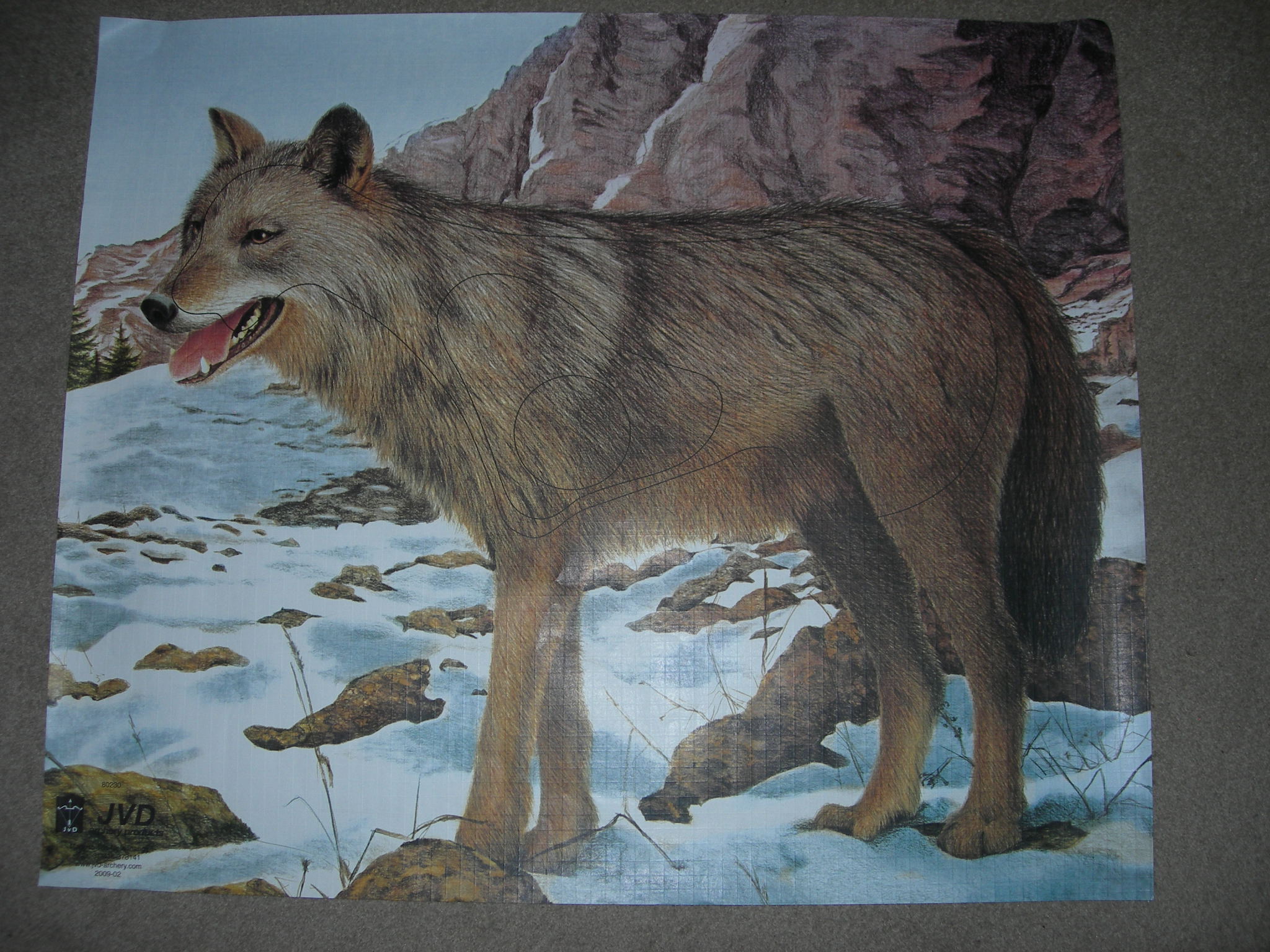
One quick tip or advice I would offer is if the budget for the event can afford it, buy a few spare different target faces of the different group sizes. It means on the setup day, usually the day before the shoot, you can tweak shots. You might find a JVD wolf would look better than, say a Delta ram on a particular target. One thing to remember is, that setting a shot that looks good, adds to the enjoyment for the competitors.
Wolf picture
So that I hope provides you with an insight into the preparation and time required when it comes to target faces. In the following article, I’ll look at some of the physical aspects and considerations in respect to shooting peg positions to allow with all bow styles. In the meantime, please keep safe and well. Thanks for reading.






 My Archery Experiences