So following a brief lapse in postings, I am returning to the topic of Target Panic or shot anxiety associated with shooting. I want to finish off the series of articles with posts on practical exercises you can undertake yourself to start you on the road of overcoming such anxiety.
For those that aren’t sure of what I mean when talking about shot anxiety, more commonly known as Target Panic, I thought it worth just listing the articles I have already written on this. These goes into more details of the nature of target panic and how you can start regaining control. My goal was to end the series looking at practical techniques you can apply.
Blank boss work versus target face fears
So having looked at drawing down as a technique in the
last post, let us now look at another popular technique, blank boss shooting and discuss anxiety triggered by shooting target faces. Blank boss practice is one technique which some people swear by and others aren’t so keen on. For those that aren’t sure what I mean, here is a brief description.
This blank boss technique is when you fall back on practising your shot sequence and control while shooting at a boss with no target face on it i.e. the boss is blank, hence the name “blank boss”.
The technique is normally performed at mid-range distances, so 10 to 25 yards.
The advantage of this technique is it often is seen as removing the pressure the archer can feel when drawing upon a target face. I’ve heard this sometimes called being gold shy. For those interested the Push Podcast guys in Episode 128 – Joel Turner briefly discuss this.
Whilst this can be of benefit for the archer to focus on form, draw, release etc, there is a flip side to this technique. If the person has anxiety triggered by drawing up and locking on to the gold or central score zone of a 3D, then they may well be able to draw upon a blank boss, but when then faced with a target face their anxiety returns.
Don’t get me wrong I know this has helped some people but for me, this doesn’t work. I think this is because I need an identifiable point to aim for or more accurately to focus on. Without that spot I can’t focus, my concentration goes and eyes wander. Where your eyes go, the arrow follows. Its a similar thing when I shoot 3Ds with no identifiable markings to pick out, so I hate shooting things that are all one colour.
As I’ve said, some people do find this a useful technique to help overcome target panic, so I’m going to give you an example from one of my coaching experiences of how removing the target face can help.
Several years ago I was asked by a very good friend to offer some advice to his wife. She was struggling with confidence despite being a very capable archer. I started by asking her how she felt about her shooting and one topic she would return to was about the focus on target faces, as she tended to shoot at the face and not focus on a spot.
So I removed the target face from the boss and put a target pin, about 10 mm in diameter in the centre. That would be what she would be shooting at. A small spot in a large boss for her to focus on.
After spending some time talking through her shot sequence and ironing out a couple of areas to develop we started shooting. Initially starting at 5 yards she shot at the pin, using it as a focus point. Notice I’m saying focus point rather than aim and that choice of words is deliberate. The archer is struggling with focusing on a spot not aiming her bow.
Over the afternoon we gradually moved back until we reached 20 yards. All the time focusing on her form, with the pin simply being a focal point for her shooting.
By the end of the session, she had hit the pin from 20 yards using her English longbow.
Form and focus is key.
One thing this technique can be beneficial for is when the archer wishes to work on their form. When you couple this work with a lighter poundage draw weight bow then you can have some great results. With a lighter bow, you have time to draw and focus on the steps and actions you are performing.
It is worth remembering that when you are presented with a stressful situation and you feel the anxiety building, I have found that a good technique for coping is to focus on your form. Focus on the steps you consciously or unconsciously go through and the shot will come.
So that is part one, blank boss shooting, but the other aspect is target anxiety
Target face anxiety or gold shy
Strange as it may sound, but specific target faces can trigger target panic and corresponding increased anxiety for some people. You might wonder why is this the case? Well, take a moment to think about it. Sometimes we put pressure on ourselves based on previous experiences. What about the JVD Ermin or Jay, I know Sharon hated the Merlin Tiger face for a while. They can be seen as the targets some archers love to hate.
Remember I mentioned this concept in the
third post when I talked about mindset and how if you say “
I never hit this face.”, it will have a negative effect on how you approach the shot.

JVD Ermine target face
On our practise range I tend not to use commercially available target faces. Instead, I use circular pieces of card which are actually, the cardboard bases from pre-made pizza bases. They are about 8 inches in diameter and I then draw a black dot in the centre approximately two inches in diameter. This gives me a cheap relative effective target which is easily visible at longer distances.

Simple target face
So why use these other than being cheap and me being a skinflint? Well, there are a few advantages.
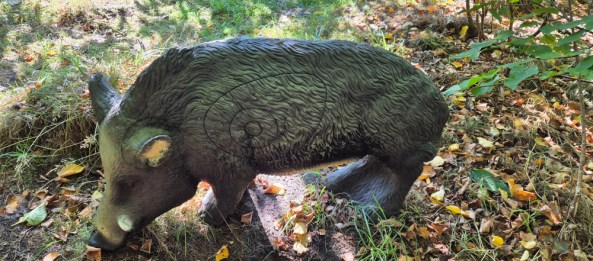
The faces are small enough for me to move around the boss. This means if I want to practise shooting at a low target I can. This is useful as there are a few 3D targets like the crocodile which has a low body silhouette.
Moving the target face round the boss means I don’t shoot out one area of the boss e.g. the centre, so prolonging the life of the boss.
It stops me focusing on specific target faces, whether these are animal faces used in big game rounds or roundall, with multicoloured rings. Instead, it has me focusing on a small spot no matter the distance.
Drawing horizontal and vertical lines through the centre of the spot also helps as I can use it as a guide for one exercise, which I’ll cover in a future post. First, let’s go back to what are the options when confronted with a target face you dislike?
Well if you are on a field course, friendly shoot or competition, the best thing you can do is take a breath, stay calm and smile. Smile! Yes, smile, as this immediately starts to get your brain away from negativity. As a side note, it can also confuse any of your competitors who might be watching you waiting for a reaction.
One method I know works as I and others have used it repeatedly is to mentally overlay the rogue target face with one you prefer. I know this may sound a bit strange but let me explain this a bit more, based on my own experience.
On one of our old bag bosses, we draw 4 small black spots about an inch in diameter over the pre-existing marks. Imagine drawing 2 lines on the boss one horizontal and one vertical, one halfway up and one halfway across the boss. Effectively dividing it into 4 equal squares. Then in the centre of each square mark a black spot.
You might be able to see them on the white boss in the picture below.

Mybo bag target
We would have 5 arrows and would shoot at each spot until we hit it and then move onto the next. The goal is to shoot one arrow into each and have a spare in the quiver. We would start at 5 yards and move back to 15 yards. (5/7/10/12/15 yards) It’s a great practise method as it focuses your mind on a small spot, along with forcing you to shoot at targets at different heights.
The second advantage is when you are faced with a target you don’t like, say a JVD Jay or Ermin all I would do is ignore the face and image the black dot from the target boss.
Away from a competition, I have known archers to buy target faces they struggle with and shoot it to death on their practice bosses. Shooting the face until they don’t feel any negativity towards it. The ghosts of past shots having been laid to rest you good say.
The key is to find a system that works for you.
I hope this advice helps. Thanks for reading, stay safe and well.




 My Archery Experiences