How a couple of strips of tape can help your archery?

What you need is a length of card board about 3 foot 6 inches in length and about six inches wide. This may sound a little Blue Peter but it does work. (For anyone who was not raised in the UK, Blue Peter is a long running TV program famous for making stuff with double sided sticky tape, especially in the early 70s and 80s).
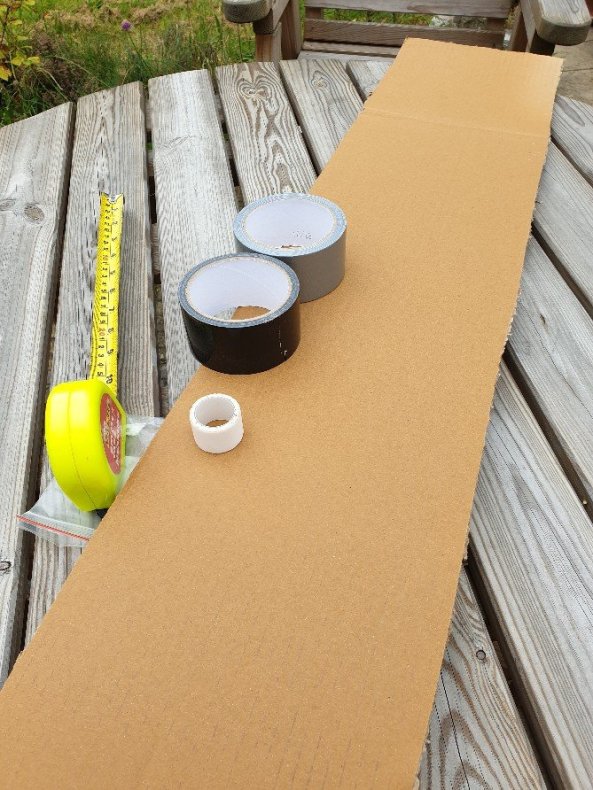
3 colours of tape and card board

The idea is similar to the concept I shared the other week with using a bamboo pole to help distance.

My practice bosses as 3ft tall so by making the card 6 inches longer I can attach the card on top of the boss.
In my example I applied a strip of grey tape down the centre of the cardboard along its length.

Grey tape

I then added 6 inch strips of black tape alternating so you had a strip of black then a 6 inch gap showing grey.

Marking out 6 inch sections
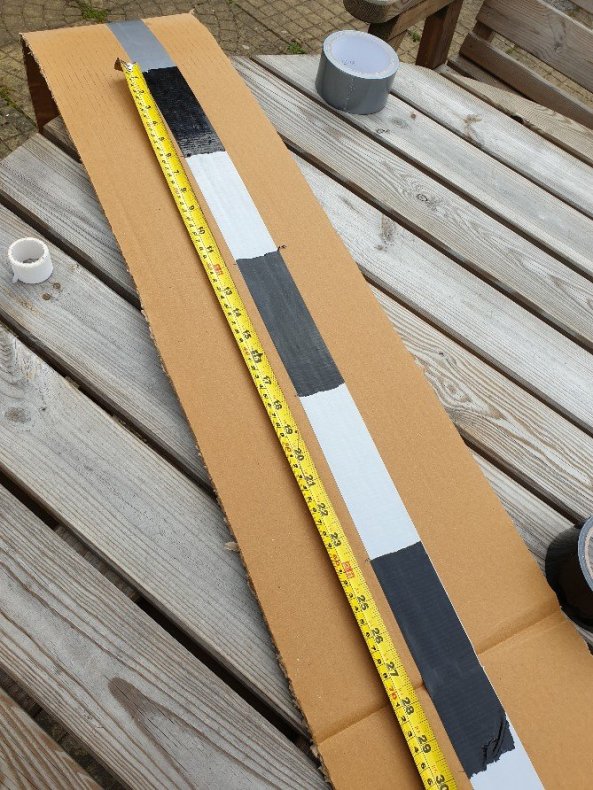
The idea being to alternate black and grey so the archer can us it to aid distance and aiming. Some might want to use 4 inch sections but I keep it to 6 so it ties into the bamboo cane method.

White tape

The last thing is to apply a strip of white tape down the centre of the black and grey tape. Cheap masking tape works perfectly for this.
The white tape is what you will be shooting at. The coloured tape is there to aid in distance judgement and to act as a contrast.

Card on the boss

So how do you use this?

Fix the target to the boss and then at 5 yards shoot a set of arrows. I normally shoot 4 arrows in a set when I’m practicing.
I start at lower part of the boss, bottom 6 inches and try and get my arrows in a vertical line gradually moving up the boss and in the white tape.
When I’ve reached the top of the boss I repeat the exercise but moving down from the top of the boss.
The focus is on you being able to put your arrows in the white tape consistently.
When that’s done I move back to my next distance and repeat. I’ll usually do this to about 15 yards or so. Reapplying white tape when needed.
Past 20 yards I focus on my arrows being in the silver or back tape. The way I look at it is if I am in the tape at this distance I’m hoping I should be in the highest score zone when shooting on a course.
The technique is not that dissimilar to one my first archery coach used to use where they would dangle a coloured ribbon down the boss and aim for that.
If you really want to challenge yourself try replacing the white tape with string and ensure each of your arrows are touching it.

So why do this?

Not all scoring zones are central to the boss. If you look at different target faces or 3Ds the height off the ground varies. You might be shooting a deer 3D where the kills 24 inches or more off the ground. With the next target being a 3D crocodile where the highest scoring zones inches off the ground.
I recall one championship where the paper face ermine was on ground level about 8ft away.

Paper Ermin

So this technique helps you focus on keeping your line and adjusting for height.

It also aids you in bending at the waste, sometimes called tea-potting. If you recall the children’s nursery rhyme “I’m a little teapot” that is where it gets it name from.

By the way the keen eyed among you will notice the target doesn’t have the white tape on it. This is because I took the photograph and then realised I hadn’t applied the tape. So I went back and applied it so you had a photograph of what it should look like.

Thanks for reading.

The hardest lessons to learn in archery are…

I’ve had a great response to my question “What they feel is the hardest lesson to learn?” and for that I would like to thank all my followers and readers for their input.
I know that there are many people out there that will have your own opinion on what they feel is the hardest lesson to learn,but based on the responses, there are a few things coming up time and time again.
  • Aiming or rather, how do you aim whether you are a gap shooter or instinctive archer?
  • Stance and footing on a field shoot, where you might not be on level ground.
  • Coupled with aiming is distance judgement, which can be especially tough on a well set field course, where the course layer has used every trick inthe book to fool you.
  • I think the biggest one though has to be drawing down or coming down when you’ve drawn up on a target but feel you have to release, even though you know something is wrong.
  • I’m also working on a post about the importance of arrow weights and importance of not shooting too light an arrow.
  • Over bowing, being to identify when you are shooting too heavy a draw weight bow.
My hope is to create a post on each of these topics in the next few weeks.
I’m planning on covering aiming in a future article but for those interested check out one of the recent coaching podcasts from the guys at The Push, which covers instinctive and gap aiming.
Thanks for reading.

Question from a reader – Aiming without sights

Recently I had a couple of questions sent to the blog by one of my readers.
It’s always good to have feedback and if I can help I will.  The subject matter of the questions posed are ones I think many would find interesting as one concerns the concepts of aiming and the other is on reducing the size of your grouping in the target.
I will try and answer each in turn over the next few weeks. Firstly I will discuss focus and aiming. The question was
“When you place your concentration on a small point at the target or animal, while you are pulling and about to get to your anchor point, do you take your eyes off the target for a second, and look at  the aliment of arrow with it ,or simply never see nothing else but the target point…”

There are a couple of things to consider here. One is focus on target with the other being arrow alignment.

Arrow alignment

When I first started archery I was very aware of the arrow. Sighting down the arrow to ensure it was pointing the right way.
This is what is taught to most archers to ensure they are lined up with the target.
I find now that I only do this when using a new bow or one I’m unfamiliar with. The rest of the time it is purely subconscious.
I try to fix my focus on a spot on the target where I want my arrow to hit.

Focus

So the simple answer to this question is no I don’t let my focus wander. I try to keep my point of focus set on where I want to hit. This is far easier said than done and takes practice and concentration. I  find if my eyes wander, then the arrow will follow where I am looking and not where I wanted it to go. Sharon and I both use this technique.
It takes discipline and practice, a lot of practise and I  don’t think I have fully mastered the technique yet.

The only problem is when you can’t pick a point on the target due to poor lighting. Something that can happen on shoots or at the end of the day as the shadows increase and light begins to fade.
Some of you will be aware that I’m not a gap shooter and consider myself as instinctive archer. Subconsciously my brain or should that read brain cell ☺is calculating the distance and telling my limbs when to release when i have where drawn up to. Great in theory but requires constant practice to maintain that awareness and internal sight map. It is also very fatiguing as it takes concentration of all things to relax and not second guess yourself.

Obviously this method doesn’t work for those archers using scopes or sights as they have to calculate the distance to be able to adjust the sights accordingly.

One book I have found resonates with me is Beginners guide to traditional archery by Brian Sorrells (book review here)
 Beginner's guide to tradional archery

The mindset of the author and style of writing is one I have found easy to follow and explain to others.
The concept of one arrow shooting I find  beneficial for developing focus. Here the author explains how you shoot only one arrow and then retrieve it and shoot again. This helps you focus on the individual shot and your form.

Another useful article is this one on various forms of aiming. It covers different forms of aiming from instinctive to gap shooters.

In the next post I will try to answer the question on improving grouping.
Thanks for reading.