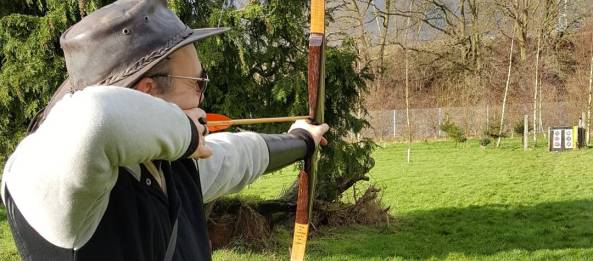
Full Draw

Why your Draw length is not the same as arrow length?

Here is a quick post following a question I’ve had asked of me “Why your Draw length is not the same as arrow length?
Before I start though, some of the more regular readers may have noticed I’m not doing many shoot reports and instead focusing on coaching articles. This is intentional as I’ve written loads of shoot reports over the years and currently I’m not getting out to many shoots. So I’m trying to produce some archery resources or publish material that all archers will find useful.
So if you have any questions let me know. I’m working on something about target panic and hope to put that out shortly but it’s taking a while to write and get it right, or should I say useful.
So back to the question on draw length and arrow length. First things first, here is a definition or two.
Draw length – Put simply your draw length is how far you draw back the bow string to your anchor point. This is measured in inches so mine is a just under 28 inches 27 1/2 if you want to be exact.
Arrow length – Your arrow length is how long your arrow is. This is normally measured from the bottom of the groove in the arrow nock to the tip of the arrow shaft behind the point.
Your arrow length should be longer than your draw length to allow the arrow to clear the bow or arrow rest and more importantly not to come off your rest if you over draw slightly as this could be dangerous. I have to say I cringe when I see some archers draw back and their arrows come within millimetres of coming off their rest. Yes it can demonstrate very good draw consistency but it doesn’t take much to go from great consistency to accident. Especially in wet conditions or when they are at full draw and sudden a bug decides to have a munch on their arm. I’ve seen both and neither ended well.
So, if your draw is 28 inches your arrows should be over 28 inches. I’m going to offer a couple of what I hope are useful tips. Let me know what you think.
Useful tip #1 – For beginners who are still developing a sound draw and static anchor point or junior archers who are still growing, I tend to recommend them having the arrow length a couple of inches longer so if your draw length is 24 inches your arrows should be 26 inches. When the archers settle or stop growing the arrow length can be reduced.
For those of you who shoot wooden arrows.
Useful tip #2 – When I started shooting wooden arrows, all those years ago. I always made them slightly longer than needed so if the arrow snapped just behind the pile, the arrow would still be long enough to use. I could simply fit a new point to the slightly shorter arrow.
I still do as you can see in the photo below.
Rob Shooting

Rob Shooting

Measuring draw length is really easy and you can either use a measuring stick or use a mathematical  based approach. Height in inches divided by 2•5
I’m 5 feet 8 inches  so that is 68 / 2•5 = 27•2.  This provides a rough guide as in my case my draw is slightly under 28 inches.
Full Draw

Full Draw

 You can buy draw length gauges from most archery stores or alternatively I made a measuring stick from an arrow shaft, marking it up in inch bands of green and red.
Measuring Arrow

Homemade Measuring Arrow

I hope you find this useful. Thanks for reading.

Richard Head Longbows video – Reusing arrow heads and points

There is an old saying “Great minds think alike.” The problem is the second part of that phrase is “fools seldom differ.” Some of you might recall I wrote an article in September 2015 giving  advice on removing broken wooden arrow tips from inside your arrow pile.
Well Richard Head Longbows have produced a video on their channel on how they suggest to remove piles which is worth a view. ( https://www.youtube.com/watch?v=0IRuiBaA0L4)
Their process is slightly different but works just as well. One additional thing is if you use either method make sure you clean the inside of the pile, removing any glue residue before reusing it.
By the way I’m going with the great minds think alike.
Thanks for reading
Me trying to remember to shoot

Hardest lessons to learn in Archery – Drawing down

So for the first of the “Hardest lessons to learn in Archery” articles I promised I am going to go with one of the most popular topics drawing down, sometimes called coming down from a shot. These articles are designed to help archers and are based on a survey and poll I posted on Facebook and Tumblr, where I asked what archers found the hardest.
So drawing down is when you have drawn up to your target, ready to release, but know something is wrong. for one reason or another it doesn’t feel right,  but you still take the shot usually with negative results of a miss and knowing you shouldn’t have taken the shot. For some reason you can’t hit that reset button, finding it impossible to draw down your bow and start again.
So why is it so hard? Why can’t we just hit the magic reset button and draw down?
You do it as a beginner when you first start.
Well think of it from this point of view, taking a shot is part physical part mental. Your muscles know what to do but your head is different. You’ve got yourself psyched up to take that shot and then at the last stage, you have to admit something is wrong or doesn’t feel right. That can feel like a big hit to your confidence, especially if people are watching.
Why might you need to draw down?
when we start down our archery path, it’s not uncommon for us to flick the arrow off the rest, normally because we are twisting the string. As we progress and skills develop this happens less often, but maybe other things happen.
You might see movement behind the target, that catches your eye, distracting you from the shot.
When drawing up to take your shot, there is the programming in your head or maybe I should say the expectation to release the arrow. In back of your mind you don’t want to admit that something is wrong or that you may have done something wrong.
One way you can try to overcome this problem is to condition yourself to draw down, or rather condition your head to accept that each time you draw up you don’t have to shoot.
So what can you do?
One way of trying to overcome this mental block is to start programming your brain that the action of drawing down is normal. An effective way of doing this s to train yourself when practising to not to take each shot, i.e. every time you draw up does not result in a taking a shoot.
So when you are on the practise bosses, try this addition to your normal program, don’t shot your 3rd arrow immediately.
Allow me to explain, when you get to shoot the 3rd arrow draw up as normal, anchor, settle aim and at the point you would normally release the string, don’t.
Instead draw down, go back to your ready position. Take you hand off the string and relax. Take a couple of breaths and then draw up and if it feels right take the shot. So why do this?
Well it starts to condition your mind into that mind set that  when you draw up it does not mean you will have to always take the shot. Effectively retraining your brain.
This may sound strange but builds your muscle memory and gets your confidence, it helps to make you realise that you don’t always have to take the shot. It goes a long way to improve your control.
Don’t get me wrong as it won’t be easy. There are times you draw up and feel perfect, but if it is your third arrow come down and do it again. You might draw up 2 ,3, 4 or more times but over time you will get used to the feel and not let it effect you.
Try to remember just because you draw back doesn’t mean you have to take the shot.
It is a hard lesson to learn, but when it works and it will with practise, it feels great. It feels like you have retaken control of the shot and your archery.
Try the technique and let me know if it works for you or if you have something else that works. I sincerely hope this has helped, please let me know what you think.
As always Thanks for reading.