Digital grain scales

Hardest lessons to learn in archery – Watch the weight Or why we need to watch our weight

No not a comment on obesity in archery but a quick look at how weight in many different forms can effect archery, whether we are talking about the draw weight of your bow or the weight of the arrows used.

So when can too light be a bad thing, and again I’m not talking about the archers weight here or anorexic, but in fact arrow weights.

Before I launch into this article though I’d like to thank my guest co-author another Rob, Rob Cook.

Rob Cook

Rob Cook

As many of you know I’m a big traditional archer shooting wooden bows and wooden arrows, so when it came to checking my facts with carbon arrows and so on, so I enlisted Robs help. Rob was also one of the originators of the new Traditional Bow hunter class in the NFAS and has extensive knowledge on the bare bow scene.

Bow International ran an article a few issues back on the effect of arrows weights on arrow flight and I know other sites including The Push have talked about the importance of matching your arrows to the bow.

Too light an arrow and archers can encounter several issues. Light arrows can fly faster and some say further, but they can be affected by wind to a greater degree. also there may not be the mass weight to absorb the energy from the bow limbs on release as effectively. in essence its like a mini dry fire.

Most bow manufacturers will specify an optimum mass weight for your arrow and if you look on just about ever carbon arrow in production will give you an arrow weight in grains per inch

To give you an example of what I mean, a bow maker might say the arrow should be 9 grains per pound of draw weight, so for my draw weight of 45lbs that would be 405 grain arrow weight. Through a lot of trial and error I have found an arrow round 450 to 460 works best from the bow, anything below 420 and the bow becomes noisy  and the arrows don’t perform as well.

Rob has created this table of data on different arrow specs and weights for some of the more common arrows on the market. We’ve used a 100 grain pile in all the arrows below calculations and show two lengths 28 inches and 30 inches, so we can give a total weight. To keep it simple Rob has used a 45lb bow weight for spine as I used that weight in the above calculation. It should all make sense but if you have any questions let us know.

Manufacturer Shaft Type                    spine @28 Arrow Weight gpp spine @ 30 Arrow Weight gpp
Avalon TecOne 600 330 7.3 600 344 7.6
Beman Classic 600 367 8.2 500 434 9.6
Carbon Express Predator II 2040 354 7.9 2040 370 8.2
Carbon Express Heritage 75 388 8.6 90 424 9.4
Easton Carbon One 660 325 7.2 550 347 7.7
Easton Axis 600 340 7.6 600 355 7.9
Easton 5MM Axis Traditional 600 357 7.9 600 373 8.3
Easton ST Axis N-Fused Camo/Axis Trad 600 360 8.0 600 376 8.4
Easton Apollo 610 367 8.2 560 392 8.7
Gold Tip Traditional 600 373 8.3 600 388 8.6


So why is this so important and why am I bringing it up here on this blog?

The NFAS has seen a new bow style recently, that of Traditional Bow Hunter. This style allows archers to shoot carbon or aluminium arrows off the bow shelf (no arrow rests). It is seeing a number of traditional archers that shoot flatbow or hunting tackle which uses wooden arrows giving it a go. They are buying carbon arrows of the right spine but I wonder if they are considering the effect of shooting lighter arrows on their bows? I was discussing this with a couple of people including Rob, so we thought we would put this together.

It is worth remembering that a lot of traditional wooden bows have not been constructed to take ultra-light carbon arrows often used in target archery or are sold as cheap alternatives to wooden or aluminium arrrows. Please don’t get me wrong some bows have been constructed to take such arrows but not all.

N.B. Adding a heavier pile to the arrow will increase the overall weight but it will also change the dynamic spine of the arrow, making it more flexible or weaker.

So what can you do?

  • Check the weight of your wooden arrows and carbons so you know the difference.
  • Check what your limb / bow manufactures recommended weights are. Most if not all will have this information on their websites or would be happy to share it with you. After all they don’t want to see you trash your bow as it reflects badly on them.
  • Going for slightly longer arrows as this will increase the mass weight too, this is why we have included two sizes in the above table.

I hope this has proved interesting and helpful. I would like to say thank you to Rob for all his help and number crunching with this. He produced a load of data on different arrows in a long excel document, as well as speaking to several bow manufactures to check minimal weights.

Thanks for reading.


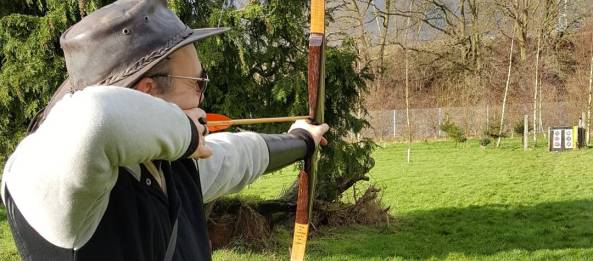
Me trying to remember to shoot

Hardest lessons to learn in Archery – Drawing down

So for the first of the “Hardest lessons to learn in Archery” articles I promised I am going to go with one of the most popular topics drawing down, sometimes called coming down from a shot. These articles are designed to help archers and are based on a survey and poll I posted on Facebook and Tumblr, where I asked what archers found the hardest.
So drawing down is when you have drawn up to your target, ready to release, but know something is wrong. for one reason or another it doesn’t feel right,  but you still take the shot usually with negative results of a miss and knowing you shouldn’t have taken the shot. For some reason you can’t hit that reset button, finding it impossible to draw down your bow and start again.
So why is it so hard? Why can’t we just hit the magic reset button and draw down?
You do it as a beginner when you first start.
Well think of it from this point of view, taking a shot is part physical part mental. Your muscles know what to do but your head is different. You’ve got yourself psyched up to take that shot and then at the last stage, you have to admit something is wrong or doesn’t feel right. That can feel like a big hit to your confidence, especially if people are watching.
Why might you need to draw down?
when we start down our archery path, it’s not uncommon for us to flick the arrow off the rest, normally because we are twisting the string. As we progress and skills develop this happens less often, but maybe other things happen.
You might see movement behind the target, that catches your eye, distracting you from the shot.
When drawing up to take your shot, there is the programming in your head or maybe I should say the expectation to release the arrow. In back of your mind you don’t want to admit that something is wrong or that you may have done something wrong.
One way you can try to overcome this problem is to condition yourself to draw down, or rather condition your head to accept that each time you draw up you don’t have to shoot.
So what can you do?
One way of trying to overcome this mental block is to start programming your brain that the action of drawing down is normal. An effective way of doing this s to train yourself when practising to not to take each shot, i.e. every time you draw up does not result in a taking a shoot.
So when you are on the practise bosses, try this addition to your normal program, don’t shot your 3rd arrow immediately.
Allow me to explain, when you get to shoot the 3rd arrow draw up as normal, anchor, settle aim and at the point you would normally release the string, don’t.
Instead draw down, go back to your ready position. Take you hand off the string and relax. Take a couple of breaths and then draw up and if it feels right take the shot. So why do this?
Well it starts to condition your mind into that mind set that  when you draw up it does not mean you will have to always take the shot. Effectively retraining your brain.
This may sound strange but builds your muscle memory and gets your confidence, it helps to make you realise that you don’t always have to take the shot. It goes a long way to improve your control.
Don’t get me wrong as it won’t be easy. There are times you draw up and feel perfect, but if it is your third arrow come down and do it again. You might draw up 2 ,3, 4 or more times but over time you will get used to the feel and not let it effect you.
Try to remember just because you draw back doesn’t mean you have to take the shot.
It is a hard lesson to learn, but when it works and it will with practise, it feels great. It feels like you have retaken control of the shot and your archery.
Try the technique and let me know if it works for you or if you have something else that works. I sincerely hope this has helped, please let me know what you think.
As always Thanks for reading.

The hardest lessons to learn in archery are…

I’ve had a great response to my question “What they feel is the hardest lesson to learn?” and for that I would like to thank all my followers and readers for their input.
I know that there are many people out there that will have your own opinion on what they feel is the hardest lesson to learn,but based on the responses, there are a few things coming up time and time again.
  • Aiming or rather, how do you aim whether you are a gap shooter or instinctive archer?
  • Stance and footing on a field shoot, where you might not be on level ground.
  • Coupled with aiming is distance judgement, which can be especially tough on a well set field course, where the course layer has used every trick inthe book to fool you.
  • I think the biggest one though has to be drawing down or coming down when you’ve drawn up on a target but feel you have to release, even though you know something is wrong.
  • I’m also working on a post about the importance of arrow weights and importance of not shooting too light an arrow.
  • Over bowing, being to identify when you are shooting too heavy a draw weight bow.
My hope is to create a post on each of these topics in the next few weeks.
I’m planning on covering aiming in a future article but for those interested check out one of the recent coaching podcasts from the guys at The Push, which covers instinctive and gap aiming.
Thanks for reading.