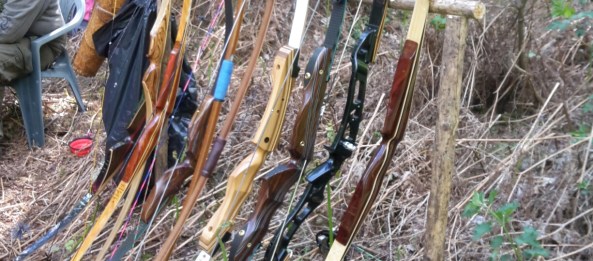
Selection of bows

Target panic and how knowing our bows can help

In the previous post on overcoming target panic I talked about building confidence and how knowing your arrows can help give you confidence. In this post lets look at the second side of the archers triangle the launcher of those projectiles, our bows.
archers triangle graphic

The archers triangle

Our bows come in all shapes and sizes. They can be a hand crafted traditional English longbows or the latest high tech compound from Bowtech. Yet they all share one or two key facts. They are all designed to perform one function, to launch a projectile effectively and hopefully deliver said projectile to the target. They all require correct setting up and maintenance at varying levels of complexity to ensure they perform this task. Just to be clear though I’m not going to go into detail about tuning bows in this post, that’s for another time. What I am will do is give you some points to consider,
So I want to start by pondering a couple of questions.
Does your bow perform exactly the same each time you use it? I’m not talking about how well you shoot it but how well it performs. Hopefully it does, but what if it doesn’t. If we take this question further and look at one element of set up as an example, the brace height.
How often do you check your bows brace height? Each shooting session, once in a while?
For traditional bows or take down recurves the question can be Is the brace height the same each time you string it? Its very easy to drop the string and loses a few twists. Alternatively if it is a new string it could stretch slightly as it beds in.
Without knowing the bow is performing consistently how can you have confidence in its behaviour and its delivery of the arrow to the target.
Definition of brace height the brace height of a bow is the gap from the string (nocking point) to the riser. The actual brace height of different bows vary, but all manufacturers will provide an upper and lower limit. Normally for a recurve this will range from about 7 1/2 inches to 8 3/4 inches.

One tip I will share is using your arrows cresting to help you check the brace height of your bow, as shown in this photo. The black banding is set at the ideal brace height for the bow as it lines up with the white band you can see.
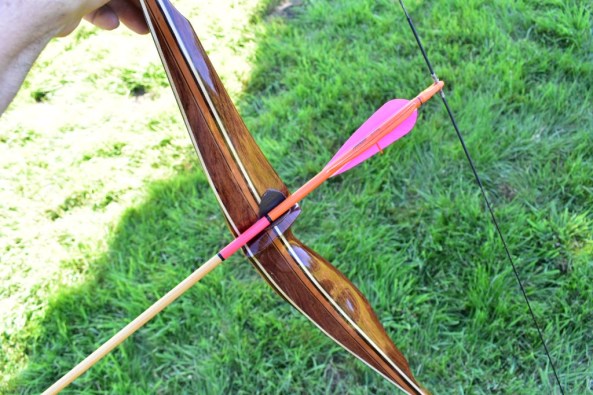
Sharons bow and arrow set up

Sharon’s bow and arrow set up

Tune don’t Twiddle

I would always suggest you spend some time and ensure the bow is set and working at its best, tweaking brace height, nocking point etc. until you reached the optimum. Once it’s tuned and working well stop. Yes, stop. Focus on learning to shoot that bow. If you are constantly altering elements of your bows set up, say the brace height or nocking point, then you will have an ever changing platform on which to try and learn to shoot. This twiddling or constant changing will not help you develop confidence in being able to shot the bow.
Top tip – If you have something that works please don’t be tempted to twiddle or tweak it, especially in the run up to a champs or competition. You might think it will help and get you those extra few points, but the flip side is it could cause all your training to be for nought if it has a negative effect on your setup.
I’ve seen lots of archers spending a fortune on kit, along with hours of time chasing the idea that a slightly different spinning of arrow shafts or couple of extra twists in the string will make the difference. When in reality they already have something that works really well and changing means quite often they lose confidence in their kit. As well as points on the score card.
“Learn to shoot with the bow you have” was something my old coach always said. Know that it works and your arrows work and this will give you confidence.
I tend to record what works well for each of my bows. This means I have a record of string length, brace height, plunger set up, etc. for all my bows and over the years I have found photographing the brace height and nocking point particularly useful. I have found this makes it much easier when setting up a new string. It provides visual guidance something that makes your life much easier. I tend to bring the image up on my tablet screen so it’s large enough to see easily.
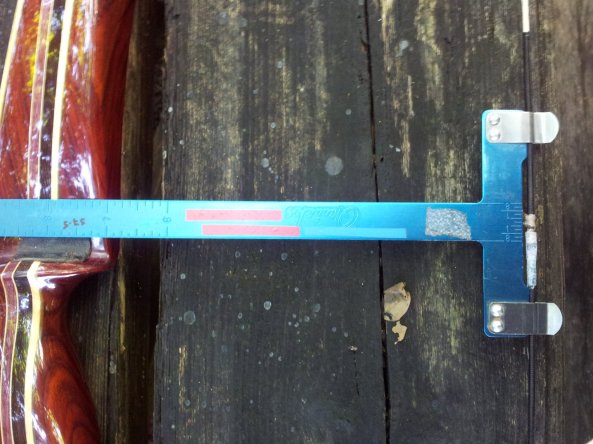
Bracing on bow

Bracing on bow

Using your phone camera is one piece of advice I will offer as it can not only help with set up, but also monitoring any possible problems i.e. how much has the string stretched or worn over the space of a few sessions.
Bows like arrows are susceptible to damage, this can be via accident such as dropping it or through ignorance in improper usage.
dmaged riser

Damaged riser

Again your camera phone can help here for documenting wear and tear on your bow. I’ve know archers to use their phone cameras to photograph the limb bolts after marking them to see if they undo over time. Other forms of damage can occur from incorrect usage such as dry firing.

Dangers of dry firing

What is a dry fire? It’s when you draw back a bow without an arrow loaded on the string and release the string.
Why is this a problem?
All the energy that would normally be transferred to the arrow from the bow has nowhere to go other than back into the bow. This is never good and has seen bow risers break, limbs delaminate or even snap. There are a few YouTube videos on what happens and archery360 has produced a good one.
In short NEVER ever dry fire a bow.

Arrow weights V bow damage

While talking about bow dry fires I want to mention arrow weights. Be mindful of how light your arrows are. Some manufacturers recommend a minimum arrow weight for their bows as a safe guard against potential damage or failure. Shooting an arrow that is too light can be akin to a series of mini dry fires and over time can lead to damage to the bow. So check if the manufacturer’s have a minimum arrow weight.
String maintenance – It sounds like a simple thing to remember but I am always amazed at how few people actually maintain their bow strings. Whether this be waxing it on a regular basis or just checking for any fraying or damage to the serving. If you shoot a compound bow with a d-loop, please keep an eye on these. I’ve seen an archer at full draw have their D-loop snap. The arrow went flying off some 50 yards. Our coaching equipment is regularly checked as we’ve noticed wear and tear on the serving loops from them being fitted and removed constantly.
Please don’t over bow yourselves. I know I have said this so many times before but it’s really important. A well set up bow with well matched arrows often negates the need for heavier draw weights. One final point for you to ponder I’ve written previously about the benefits of having and using a light poundage bow when working on form or recovering from injury etc. So much as it might be tempting to exchange or sell the lighter poundage limbs you might want to hang onto them just in case.
Personal insight
This process of arrow and bow set up certainly gave me confidence when I started. Knowing the quality of the arrows and the bow I was shooting, and they were working correctly together meant there were less things for me to worry about.
Both of these elements are pretty easy to tune given time. The fare harder part is the archer, as unlike the bow and arrow, the archer has a mind of their own. The thing is once you know your kits right, you will inevitability grow in confidence as your bow delivers your arrows with more consistently at short, medium or long distance.
So lets start looking at building confidence in the third and final element, the archer.
Thanks for reading.

Some thoughts on the first bits and pieces a new archer should buy

Quick break from my series on target panic to revisit a topic which I think will be of interest to many.

Several years ago I wrote a post offering advice on what equipment newbies should consider purchasing, before buying their first bow. Since I have been working with several new archers in the recent months I thought it a good time to revisit this post and update it where necessary.

As a coach I often get asked by my students about buying a bow. How much do they cost? What should I got for?  Where do you recommend I go?  I’ve seen one on E-Bay is it any good? I always reply by saying wait a few weeks or even a couple of months before you buy one. In that time use the club equipment for until you have a better idea of what is suitable for you.
But sooner or later your students will want to purchase their own bow (which is great don’t get me wrong) but there are a few things that might be worth getting first. So I have put this post together to offer some thoughts.

First things for any new archer to buy (before a bow) should be
Whistle – What a whistle? What’s that got to do with archery? Well put simply it’s for safety calls and is a necessity for insurance on some club sites including ours. All members of the NFAS should have a whistle on them so they can signal if necessary.

A tab or glove of their own. Normally I recommend a beginner starts with using a tab to protect their fingers. As they progress I have them trying both a tab and glove, along with trying different sizes and shapes until they find something they prefer. Recently I’ve found several students opting for a glove which I think is partly due to the colder weather.

This is the single thickness tab

This is the single thickness tab


Personally I think a tab is best, though it took me ages to find one that I was completely comfortable with. I feel tabs are easier on their fingers and promotes good finger position on the string.

Quiver, you can pay a small fortune for some quivers, but when you are starting out go for something simple. So long as it will hold 4-6 arrows and is comfortable to carry on your belt it’s a winner. Quick note about back quivers here. I’ve tried back quivers, several in fact and never found one I was happy with so have stuck with a field quiver. I know some people  love them but for your first quiver, keep it simple.

simple quiver image

simple quiver

Some quivers will have a pocket or pouch on them which can very be useful for holder a whistle, stringer, spare string.

Top Top – pick up an arrow tube to store arrows when not in quiver. I carry 3 or 4 arrows in my quiver and the rest are in an arrow tube on my back. Safe, dry and there if I need them. You can use an extendable poster tube, which are cheaper, just make sure you drop some foam in the bottom of the tube to protect it and stop arrows puncturing the plastic. 

Rob trying to judge distance to a shot

Rob trying to judge distance to a shot

An arm bracer or arm guard that fits. What I mean is it doesn’t fall down the arm or is so tight it cuts off circulation to your arm. Like quivers there are loads of different designs, some that go all the way up the arm, others that only cover the forearm. Some are plain others are covered in intricate designs carved into the leather. At the end of the day function is more important, so get one that fits, works and you like.

Arrow puller, while not the most glamorous of archery elements they do makes life easier for drawing arrows, allowing you to grip the shaft more easily, especially on cold days.
Arrow rake – no matter how good you are, sooner or later you will be needing one for finding those arrows that fall short (a cheap decorating roller can be used, once modified for the purpose )

What kind of bow should I buy?

I will cover this in more detail in a separate post but what I will say is in my opinion for a first bow the most sensible option is the take down recurve practise bow.
They are relatively cheap (£55-£75 depending on where you get them), so if they don’t stick with the hobby it’s not such a huge investment. Also you might be able to pick one up from club member who has progressed. The advantage of a takedown is the limbs can be upgraded to heavier poundage as archer develop their strength and skill (I did this after a few months myself, with some shops giving a discount if you trade your old limbs in). Worth noting that not all limbs fit all bows, but I will go into more details in a future post about fittings and ILF bows (International Limb Fittings).
I have found the bows are forgiving to use which is what you want as a beginner.
Such bows come in a vast variety of sizes, shapes, poundage so good for all abilities, heights, draw lengths etc. so are easy to find one suitable for all shapes and sizes of archer.
As I said I will cover this in more details in the next post.

Thanks for reading

sharon - old bow

Low poundage bows are not a waste of time or money

So before I start let me wish everyone a very Happy New Year. I hope you all had a fantastic Christmas and are looking forward to the new year, full of archery.

I wanted to start this year by addressing a question that has arisen through recent coaching sessions, that of the use of light draw weight bows.

In many of the techniques I’ve mentioned over the years and will be in these articles on target anxiety or target panic, I’ve sited, you are best using a light poundage bow, rather than your normal draw weight.
This is something I believe is of huge benefit for archers whether they are new to the hobby or experienced.
Bows of relatively light draw weight, say 18lbs provide a useful tool for an archer, as from personal experience I find them heavy enough to allow the person to execute proper back tension, whilst being light enough poundage for them not to have to be fighting to hold it at full draw. I’ve used light draw bows myself when I’ve been struggling with my form or recovering from a shoulder injury so I know it works.
Another advantage with these bows is it allows the archer time to focus on improving different elements such as draw up, release or anchoring more easily. By shooting the lighter draw weight, it allows you to develop good posture, overall form, release, etc. All these elements then go to give you confidence in your ability and shot sequence. In turn building confidence in your shooting when you transit to your normal weight bow.
Think back to when you started shooting. Chances are you didn’t start with a heavy draw weight bow? I’m guessing you started with a lower draw weight bow, so you could develop your skills and muscles, without straining yourself. So does it not make sense to revisit these bows when you are developing your confidence and techniques to overcome target panic?
Remember using these bows is less about being strong and/or hitting the bullseye at 40 yards, it’s about learning to control your anxiety.
I have a couple of such bows in my coaching arsenal that have helped more archers than I can remember. They are simple 18lb takedown recurves, one ILF for those more used to shooting that style and one with wooden riser and simple bolt-in limbs for those who prefer the feel of a wooden riser. I quite enjoy using these bows myself at times to keep my form and technique solid. For those interested, I normally shoot a 45lb flatbow.
Sadly I’ve seen an implied stigma from some archers when you suggest using a lighter bow, as though they see its a failure or not macho. It’s not an indication of failure and this mentality is something I get very annoyed about. So in short and a message to those that think that, grow up.

N.B. Just a quick point here. If you are fighting to draw and hold your bow at full draw, then chances are you are over bowed i.e. the draw weight is too high.

Thanks for reading