Some new ideas from off the arrow shelf site

walk in park

Hi everyone

This is a quick message to say that there are a few new developments here in the near future. I hope to be launching a couple of new sections or categories of articles for this site.

A walk with… will cover informal interviews with archers I’ve met, giving an insight into their love of archery, how they got into it initially and so on. It is based on the idea of chatting with them as they walk round the woods shooting.

Behind the counter… is aimed at businesses associated with archery, whether these produce bows, custom leather worked quivers, or whatever, giving them the opportunity to provide some insight for readers.

So why am I doing this?

This is a new development for the Off the arrow shelf blog so I hope you all enjoy it. The reasoning about this is pretty simple really, like all good ideas. Quite often I am being asked about archery suppliers, where you can get the arrow shafts from or which bow to go for. So I thought I would create a series of articles on different archery related shops, suppliers etc.

Before I start I’d like to make a couple of things clear. I have no company sponsorship or formal connection to these businesses. Yes I may have bought products from them in the past and even written review on some products, but I am not sponsored.

I’ve also met loads of people over the past few years I’ve been doing this hobby and running this site. Some have become good friends and nearly all have a wealth of stories or advice that I feel would be great to share.

I will still be writing shoot reports, equipment reviews and linking to other useful resources for archers.

Let me know what you think and thanks fro reading.

Equipment Review – Timber Creek Wooden arrows

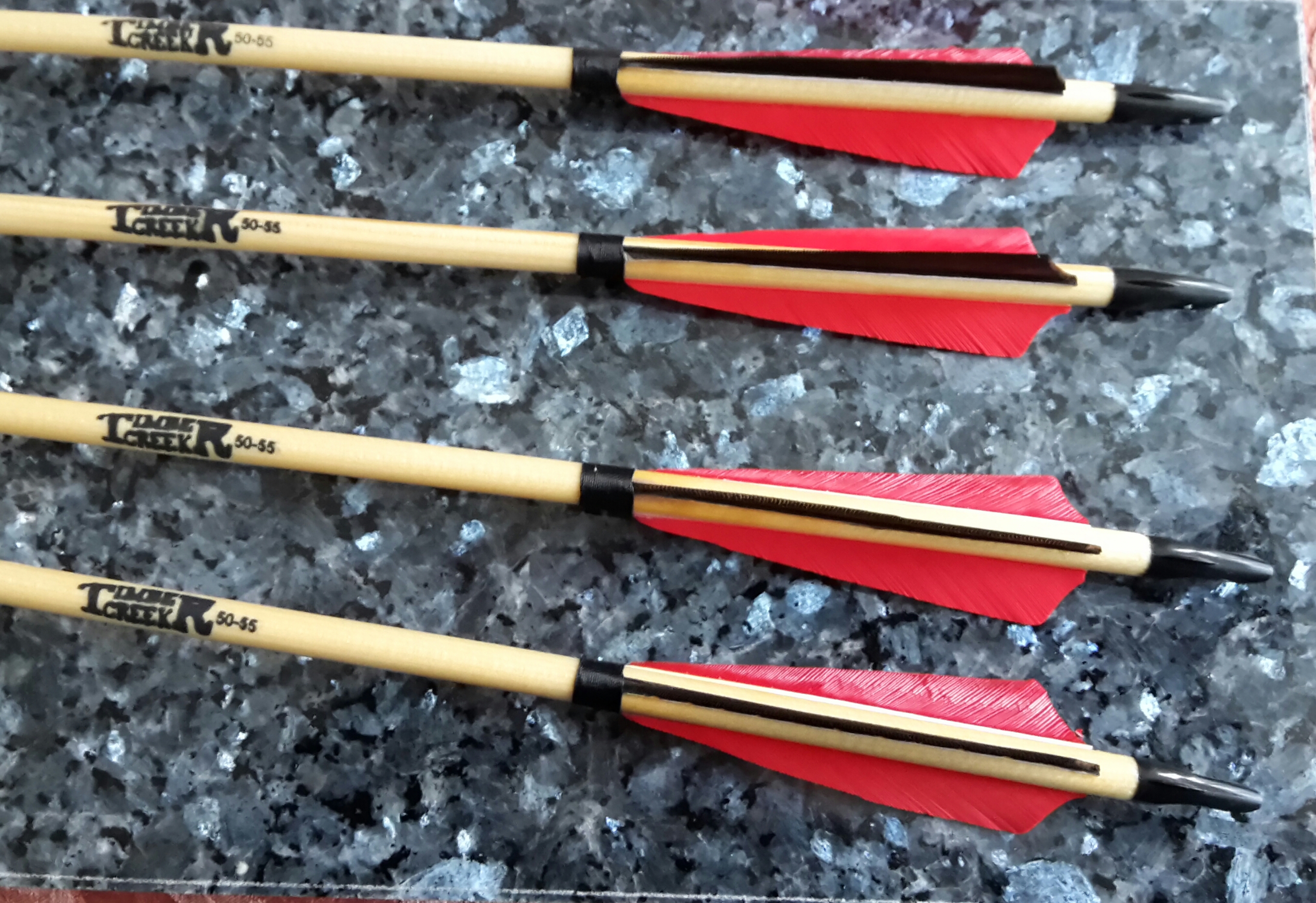
Timber Creek Arrows

Timber Creek Arrows

I recently picked up some Timber Creek wood arrows from Merlin Archery care of Jim Grizzly Kent  and thought it worth putting a review together.
First impressions are positive.
The shafts are 11/32 with a 4 inch feather shield fletchings and black nocks. Made from Siberian spruce, these were spined as 50/55 as I wanted to use them with my flatbow.
The varnish finish is good being smooth and flawless over the entire length of the arrow.
Only thing I don’t like is the nock colour. Whilst they look great, fit well on the string, they are black which makes them very hard to see on longer targets. I like the thread binding at the front of the fletching as this can protect the tip of the fletching.
The shafts are straight and with the clear varnish you can see the quality of the wood grain.
Close up

Close up of fletching and nock

Having weighed them the six arrows come in 30 grains variance which is pretty impressive for unmatched out of box.
The piles are 100 grain field point which will be fine for most but I prefer an 80 grain.

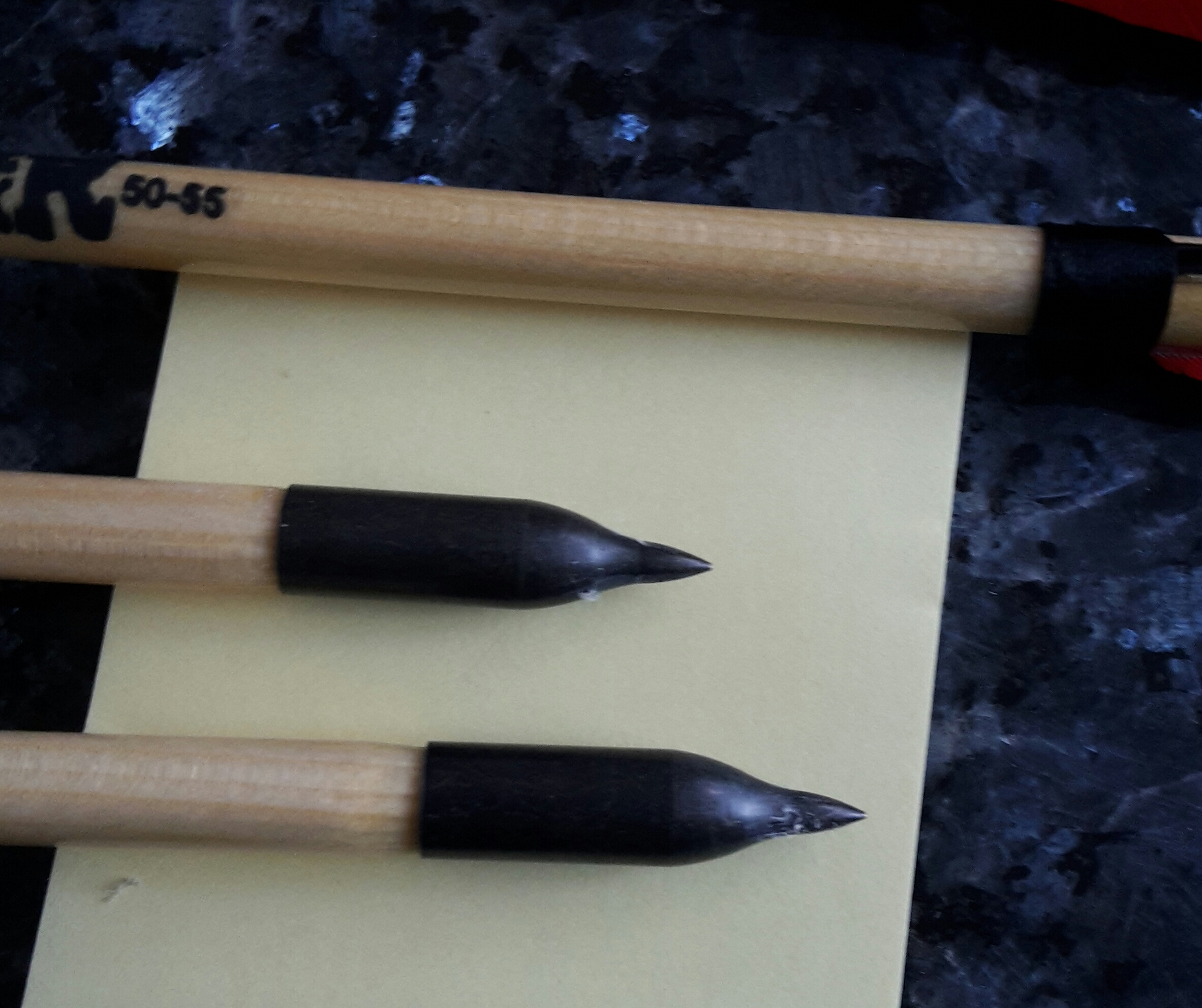
100 grain piles

100 grain piles

Out of the box they are 32 inches in length and come pre – piled and ready to shoot.  Only thing I’ve noticed is the piles on two are very slightly proud of shafts, probably due to the shafts being slightly less than an 11/32. So if shooting a bag boss they can snag on the fabric. In fairness this is not an uncommon problem with wooden shafts and one I’ve encountered when making my own.Initial goes
I’ve tried shooting them at full length and they fly ok at about 12 -15 yards but really need to cut them down to my draw length. At 20-25 yards I was noticing the difference of pile weight and length. My normal arrows are fitted 80grain points so will probably fit 80 grain piles for true comparison.

Further testing 
Having now cut them to my draw length and fitted 80grain points I can add a couple of extra observations.
Being spruce the wood feathers or crumbles a little when tapering them. I found the same with other spruce and to be fair these were better quality.
Removing the old piles was easy using a gas ring to heat them for about 10 seconds and then unscrewing with a pair of pliers. Not sure if the 100 grain field point will blunt if a wayward arrow were to hit a rock, but this is the same for other pile designs and the reason I prefer steel to brass.
Having shot them they fly very slightly high and to the left but only slightly which makes me think slightly stiff.

Grouping at 15 yards

Grouping at 15 yards

Flight wise, they are very good and I’ve shot them a couple of hundred times.
I’ve not missed so badly as to bounce them off a tree yet so not sure of durability but am sure I will find out soon.

UPDATE – First casualty and note to self. If you shoot your own arrow it breaks. Managed to shoot the pile off one.  Yes pile, not nockthat takes skills.

First casulaty

First casulaty of the testing

 Those interested in the Timber Creek range of bows might like to know i recently picked up a Timber Creek Cobra and hope to write a review in the near future.
 If you don’t have the time or expertise to make your own arrows I think they are a good buy being good quality components assembled well. Priced at just under £5 each it’s not bad value. (http://www.merlinarchery.co.uk/timer-creek-wooden-arrows-basic.html)

Overall a 8.5 to 9/10 due to the nock colour.

Thanks for reading

Removing broken wood tip from inside pile

Thought those of you, who like me shoot wooden arrows and sometimes have the misfortune to break the pile off might find this a useful tip. No pun intended.

Quite often I find my arrows break directly behind the pile, leaving a small piece of wood inside the pile which can be difficult to remove especially if you want to reuse the pile.
I know some people drill the wood out and others simply throw away the pile.
Well I thought I would show how I remove the broken piece of wood.

Tools required

Tools required

The tools required are
1 x long wood screw 2 1/2″ is ideal (cross head)
1 x screwdriver
1 x gas stove or gas ring
1-2 x pliers
1 x small pot or basin of water
Step 1
First stage is to carefully take the screw and screw it into the wood still in the pile.
Screw into wood

Screw into wood

Step 2 
Once the screw is secured in the wood, you need to heat the pile up as this breaks down the glue securing the wood to the pile.
Holding it by the screw you can heat the pile using the gas ring. It should only take 10-20 seconds.
Word of warning here. 
I usually use screw on piles, but if you have taper fit or parrell fit you can have the piles pop off as the glue and gases in the glue expand under the heat.
The reason I mention this is on one occasion when removing a pile I left it in the ring to heat up too long as I worked on another. I heard a loud pop and saw the pile shoot across the kitchen towards the window and the screw and wood went in another direction. Fortunately no one was  injured and nothing was broken (otherwise I think Sharon might have injured me)
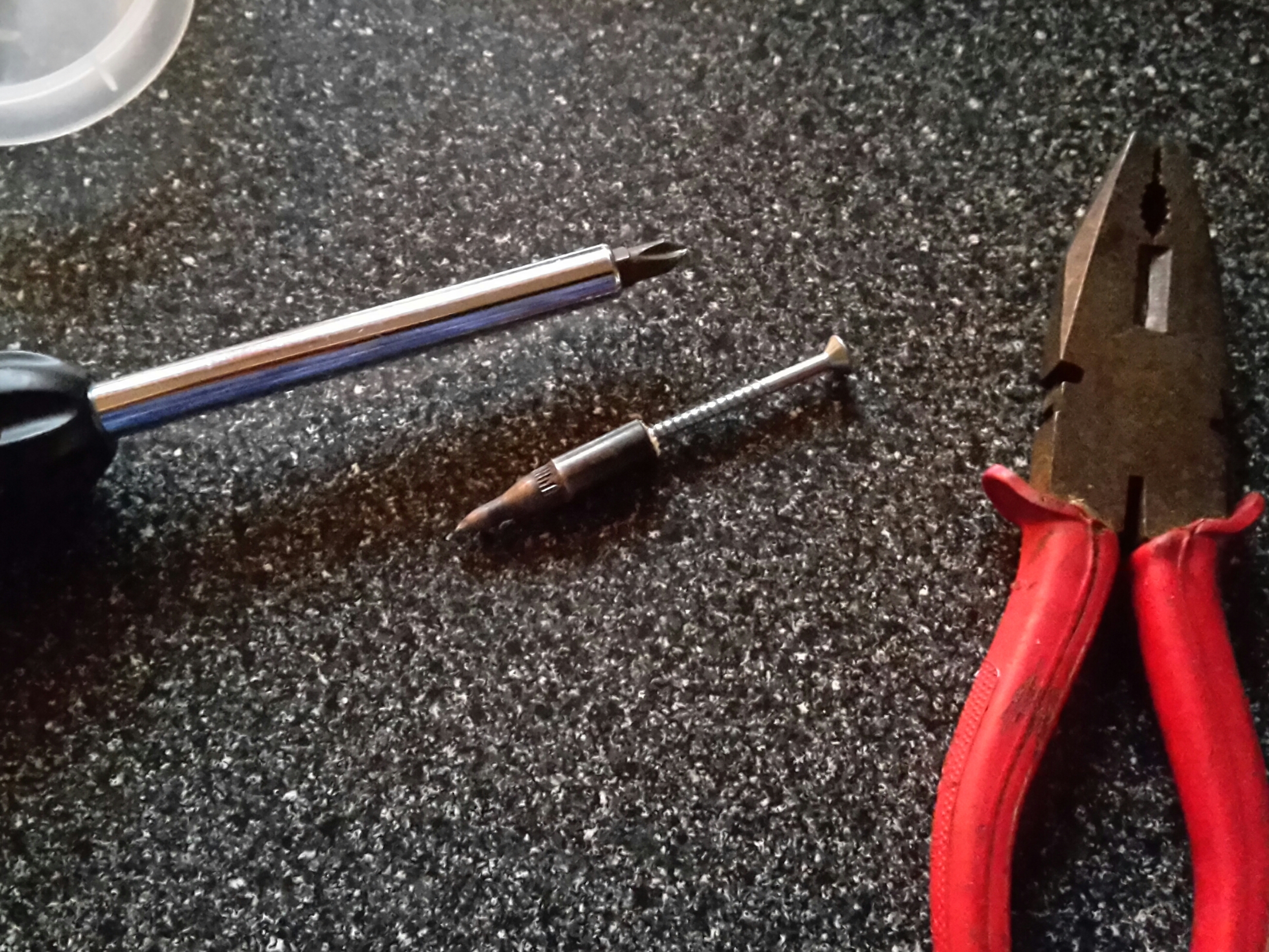
Heating the pile

Heating the pile

The other thing to be careful of is to not let the wood burn as this will not only smoke the kitchen out possibly triggering a smoke detector but also make it harder to remove the wood.
It’s worth doing this in a well ventilated room as the glue can stinks, especially the two part epoxy I use. How long you keep it in the flame will vary depending on the glue. Hot melt, melts quickly whilst some epoxy ones might take 20 seconds. It’s a bit of trial and error here.

Step 3
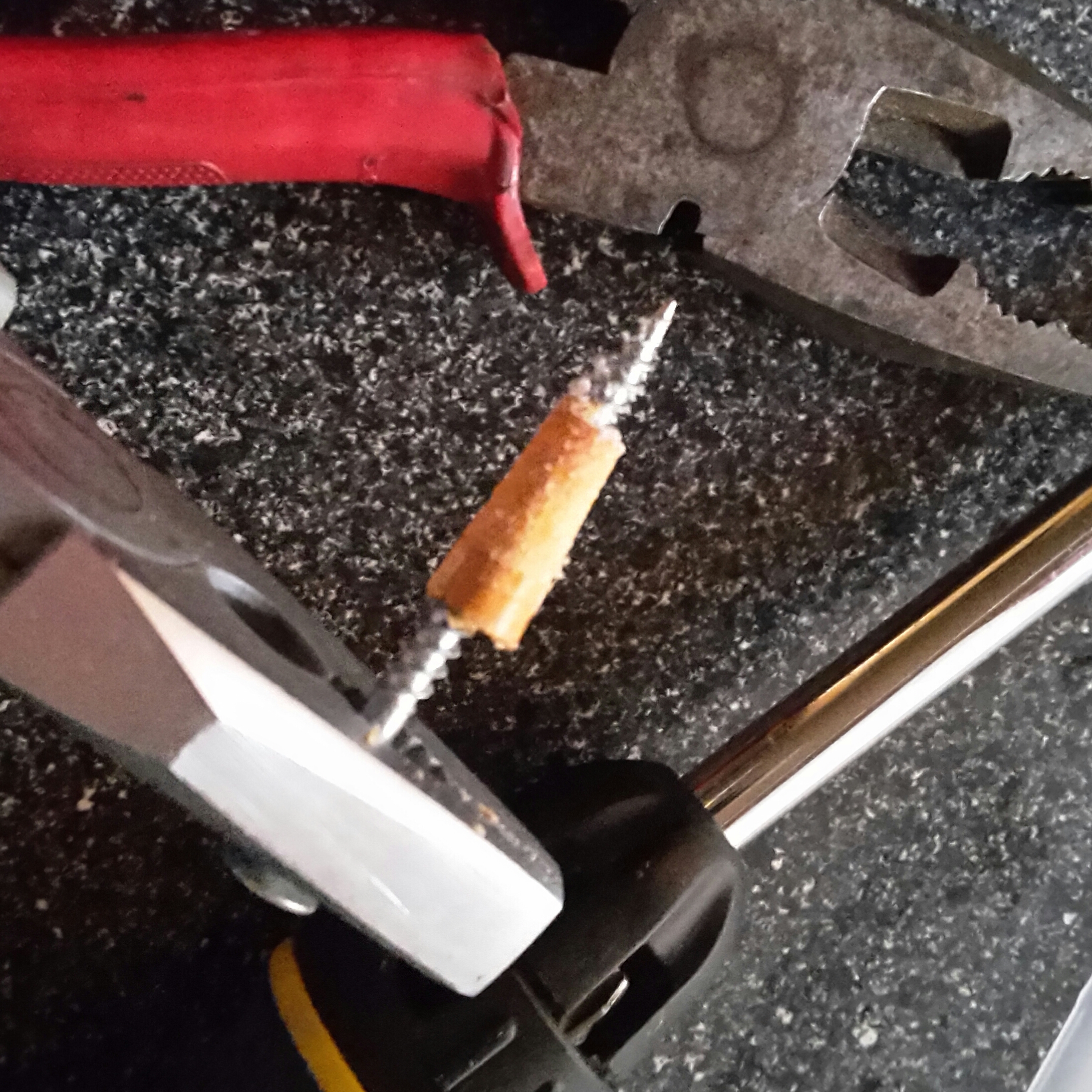
Holding the now heated pile  in the pliers (don’t grab it with your hand as it will be hot) take the screw driver and continue to screw the screw into the wood.
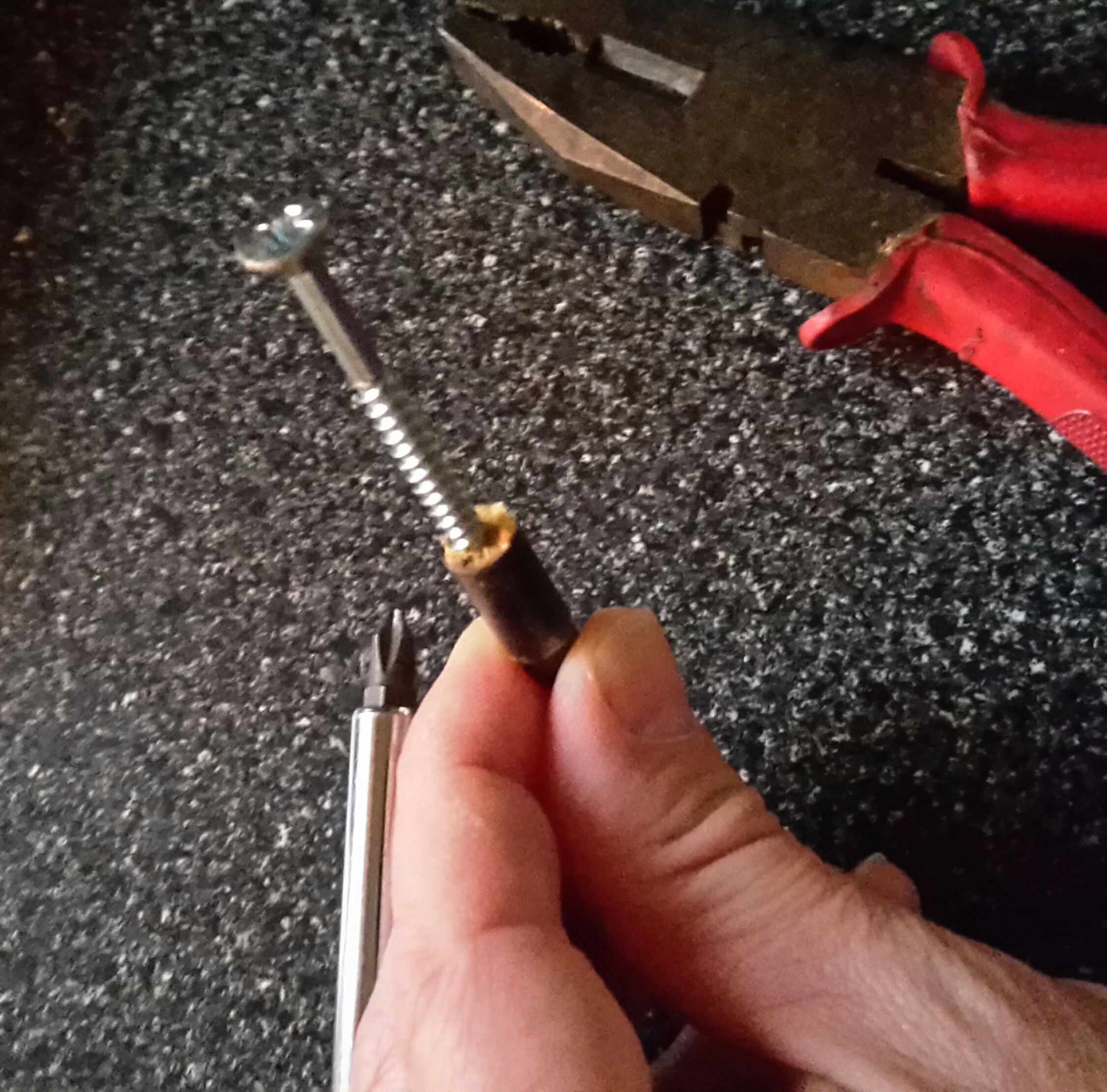
You should find that because the glue has melted and lost adhesion to the pile the screw will force the wood free. Resulting in the wood remaining on the screw and free of the pile.

Wood remains on pile

Wood remains on pile

Step 4 
Drop the pile and screw into a pot of cold water to cool.  Once cool you can dry the pile.
You might need to clean out the inside of the pile of glue residue with a bit of wire wool or I find an old shaft tapered down and screwed in and out a couple of times works well to dislodge any residue.
The easiest way to remove the wood from the screw is to hold the wood in the pliers and then using the screw driver “unscrew” it.
Hope you find this useful.
Thanks for reading.