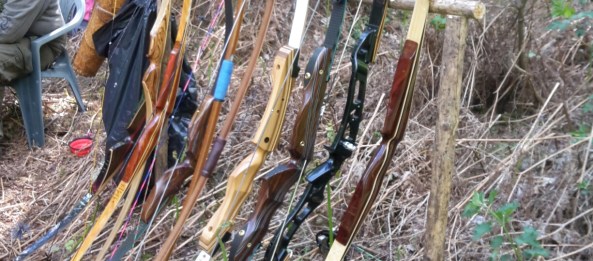
Selection of bows

Target panic and how knowing our bows can help

In the previous post on overcoming target panic I talked about building confidence and how knowing your arrows can help give you confidence. In this post lets look at the second side of the archers triangle the launcher of those projectiles, our bows.
archers triangle graphic

The archers triangle

Our bows come in all shapes and sizes. They can be a hand crafted traditional English longbows or the latest high tech compound from Bowtech. Yet they all share one or two key facts. They are all designed to perform one function, to launch a projectile effectively and hopefully deliver said projectile to the target. They all require correct setting up and maintenance at varying levels of complexity to ensure they perform this task. Just to be clear though I’m not going to go into detail about tuning bows in this post, that’s for another time. What I am will do is give you some points to consider,
So I want to start by pondering a couple of questions.
Does your bow perform exactly the same each time you use it? I’m not talking about how well you shoot it but how well it performs. Hopefully it does, but what if it doesn’t. If we take this question further and look at one element of set up as an example, the brace height.
How often do you check your bows brace height? Each shooting session, once in a while?
For traditional bows or take down recurves the question can be Is the brace height the same each time you string it? Its very easy to drop the string and loses a few twists. Alternatively if it is a new string it could stretch slightly as it beds in.
Without knowing the bow is performing consistently how can you have confidence in its behaviour and its delivery of the arrow to the target.
Definition of brace height the brace height of a bow is the gap from the string (nocking point) to the riser. The actual brace height of different bows vary, but all manufacturers will provide an upper and lower limit. Normally for a recurve this will range from about 7 1/2 inches to 8 3/4 inches.

One tip I will share is using your arrows cresting to help you check the brace height of your bow, as shown in this photo. The black banding is set at the ideal brace height for the bow as it lines up with the white band you can see.
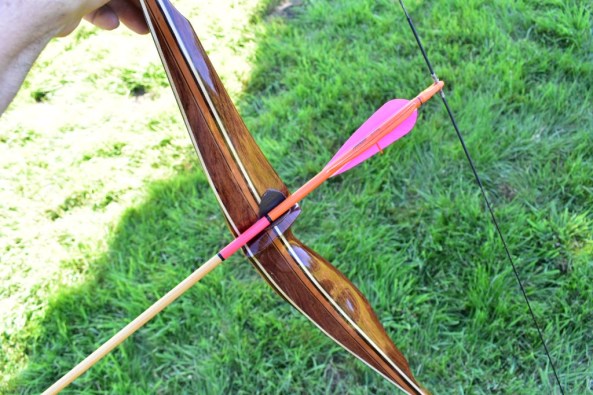
Sharons bow and arrow set up

Sharon’s bow and arrow set up

Tune don’t Twiddle

I would always suggest you spend some time and ensure the bow is set and working at its best, tweaking brace height, nocking point etc. until you reached the optimum. Once it’s tuned and working well stop. Yes, stop. Focus on learning to shoot that bow. If you are constantly altering elements of your bows set up, say the brace height or nocking point, then you will have an ever changing platform on which to try and learn to shoot. This twiddling or constant changing will not help you develop confidence in being able to shot the bow.
Top tip – If you have something that works please don’t be tempted to twiddle or tweak it, especially in the run up to a champs or competition. You might think it will help and get you those extra few points, but the flip side is it could cause all your training to be for nought if it has a negative effect on your setup.
I’ve seen lots of archers spending a fortune on kit, along with hours of time chasing the idea that a slightly different spinning of arrow shafts or couple of extra twists in the string will make the difference. When in reality they already have something that works really well and changing means quite often they lose confidence in their kit. As well as points on the score card.
“Learn to shoot with the bow you have” was something my old coach always said. Know that it works and your arrows work and this will give you confidence.
I tend to record what works well for each of my bows. This means I have a record of string length, brace height, plunger set up, etc. for all my bows and over the years I have found photographing the brace height and nocking point particularly useful. I have found this makes it much easier when setting up a new string. It provides visual guidance something that makes your life much easier. I tend to bring the image up on my tablet screen so it’s large enough to see easily.
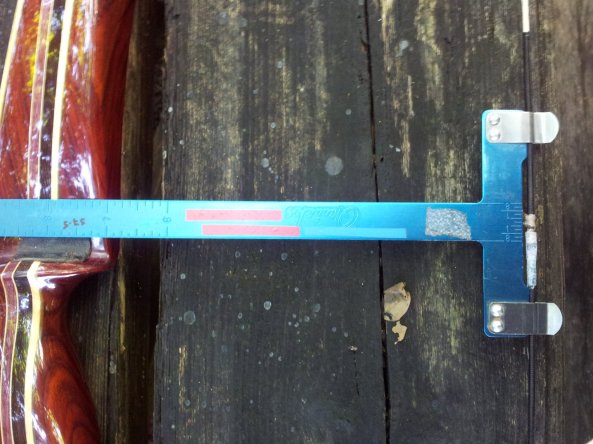
Bracing on bow

Bracing on bow

Using your phone camera is one piece of advice I will offer as it can not only help with set up, but also monitoring any possible problems i.e. how much has the string stretched or worn over the space of a few sessions.
Bows like arrows are susceptible to damage, this can be via accident such as dropping it or through ignorance in improper usage.
dmaged riser

Damaged riser

Again your camera phone can help here for documenting wear and tear on your bow. I’ve know archers to use their phone cameras to photograph the limb bolts after marking them to see if they undo over time. Other forms of damage can occur from incorrect usage such as dry firing.

Dangers of dry firing

What is a dry fire? It’s when you draw back a bow without an arrow loaded on the string and release the string.
Why is this a problem?
All the energy that would normally be transferred to the arrow from the bow has nowhere to go other than back into the bow. This is never good and has seen bow risers break, limbs delaminate or even snap. There are a few YouTube videos on what happens and archery360 has produced a good one.
In short NEVER ever dry fire a bow.

Arrow weights V bow damage

While talking about bow dry fires I want to mention arrow weights. Be mindful of how light your arrows are. Some manufacturers recommend a minimum arrow weight for their bows as a safe guard against potential damage or failure. Shooting an arrow that is too light can be akin to a series of mini dry fires and over time can lead to damage to the bow. So check if the manufacturer’s have a minimum arrow weight.
String maintenance – It sounds like a simple thing to remember but I am always amazed at how few people actually maintain their bow strings. Whether this be waxing it on a regular basis or just checking for any fraying or damage to the serving. If you shoot a compound bow with a d-loop, please keep an eye on these. I’ve seen an archer at full draw have their D-loop snap. The arrow went flying off some 50 yards. Our coaching equipment is regularly checked as we’ve noticed wear and tear on the serving loops from them being fitted and removed constantly.
Please don’t over bow yourselves. I know I have said this so many times before but it’s really important. A well set up bow with well matched arrows often negates the need for heavier draw weights. One final point for you to ponder I’ve written previously about the benefits of having and using a light poundage bow when working on form or recovering from injury etc. So much as it might be tempting to exchange or sell the lighter poundage limbs you might want to hang onto them just in case.
Personal insight
This process of arrow and bow set up certainly gave me confidence when I started. Knowing the quality of the arrows and the bow I was shooting, and they were working correctly together meant there were less things for me to worry about.
Both of these elements are pretty easy to tune given time. The fare harder part is the archer, as unlike the bow and arrow, the archer has a mind of their own. The thing is once you know your kits right, you will inevitability grow in confidence as your bow delivers your arrows with more consistently at short, medium or long distance.
So lets start looking at building confidence in the third and final element, the archer.
Thanks for reading.
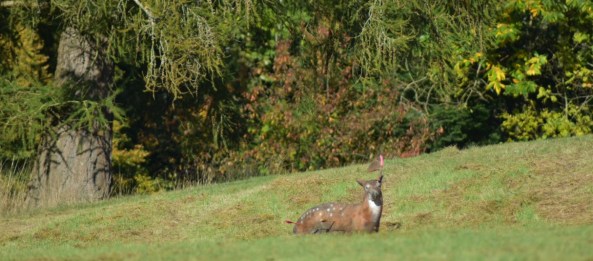
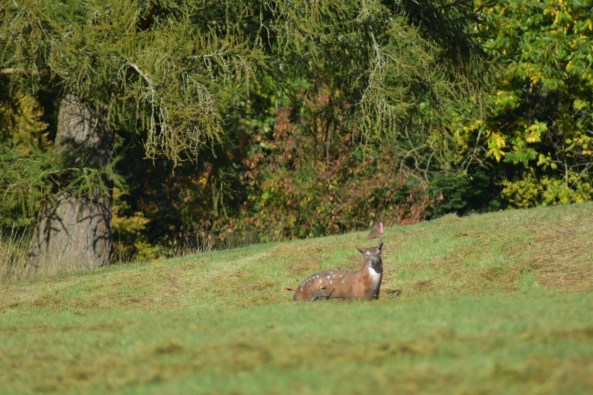
3D deer in field

Shoot Report – Barry Cheadles’ 3D course October 2019

Sun through the trees

Sun through the trees

This was another shoot where I would be behind a camera rather than a bow, but I wanted to get something written and out there as I feel its worth promoting. This isn’t an NFAS club by run Barry Cheadle who does all the course laying and preparation.
Situated at Bower Hill, Nr Button Oak its about a 45 minute drive for us, depending on the traffic. In fact it wasn’t the traffic that delayed us but the weather, as when we were packing the car to leave we were having to scrape the ice off the outside, that was  once we got that far as the padlock on the gate was actually frozen. Anyhow lets get back to the shoot report.
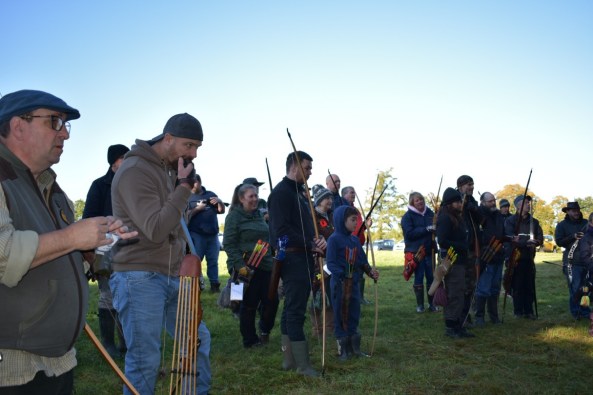
Groups mustering

Groups mustering

The course consisted of 30 targets, all of which were 3D targets ranging in sizes from some small rabbits to wolves, not forgetting the small carp set in the stream.
The grounds are a hillside which comprises a mixed woodland and sections of confers, offering a variety of terrains and lighting.
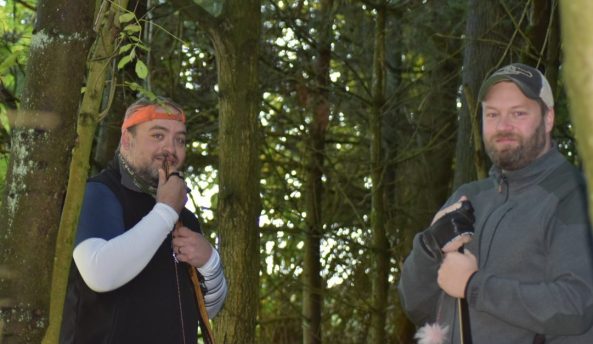
Archers in the woods

Archers in the woods

One negative comment I will make and to be fare was completely outside of Barry’s control. The previous day the area, like much of the UK had had very heavy rain. This made some of the paths and routes through the course quite treacherous underfoot, with them resembling streams rather than pathways. I know Barry is looking at this for his next shoot and as I said I don’t think he was expecting the weather we had the day before.
Archers waiting for the off

Archers waiting for the off

This wasn’t his first shoot and I was glad to see the course numbers were up from previous shoots he’s organised with there being over 40 archers all of them shooting unsighted classes.
Archers gathering

Archers gathering

The scoring system  was different to other competitions but was easy to follow. Barry combined elements from the NFAS and  Border archery competitions. You got your shooting peg on which there was one for an adult and one for a junior. You shot your first arrow and if you were in you were going to score 15 points if in the animal or 20 points if in the kill /  central marked zone. If you were not successful of your first arrow you can take a second row from the same peg, with a potential of 5 points or 10 points. This made it very easy for both the maths and also for newbies or experienced archers. It also made for a pretty fast shoot, which is ideal in the winter months.
Wooden arrow and Carbon arrow

Wooden arrow and Carbon arrow fighting for central spot

Unlike the NFAS you weren’t having to move pegs and it meant you could try and adapt for your second shot if you need one.  I wonder whether it makes it a bit easier for the course layer too as you set your shooting line and have less issues with different positions along that line. I’ve commented already on the weather on the previous day and early morning but have to say that Sunday was a truly glorious day with bright sunshine if a little on the chilly side.
As I said getting round in a few places was quite challenging due to the previous days heavy rain fall. I think a few more direction signs might have helped too as Barry was using new areas of the woodland.
Archers in the field

Archers in the field

Not all targets were in the woods somewhere outside in fields making for a bit of a nice mix. He also has the ability to shoot out from the wood into fields or from fields into the wood which offers a nice contrast.
3D deer in field

3D deer in field

There weren’t that many long shots, by long I mean over 30 yards but I think it is quite a technical course and works well for developing skills.
I hope Barry will run future shoots as I’ve been to a couple of his and each has improved on the previous. He asked for comments and feedback and I think he’s received lots, the majority of which have been positive and constructive in any criticism.
Sharon shooting

Sharon shooting

One interesting thing Barry has to do, which is the same as we have to at our shoot grounds is to mark any deer targets. He actually puts some coloured tape around the ear all the neck to signify it is actually a target, as his area has a small resident wild herd of deer which occasionally puts in an appearance.
On the peg waiting for the start

On the peg waiting for the start

 In all I think it was  a really good day I think the only downside was if the fact that it was 30 targets without a break I think maybe in future he could reorganise the paths so that you can have a break halfway around.
Considering this has been set by one person I think it’s done really well and want to wish him the best of luck in the future.
Thanks for reading.
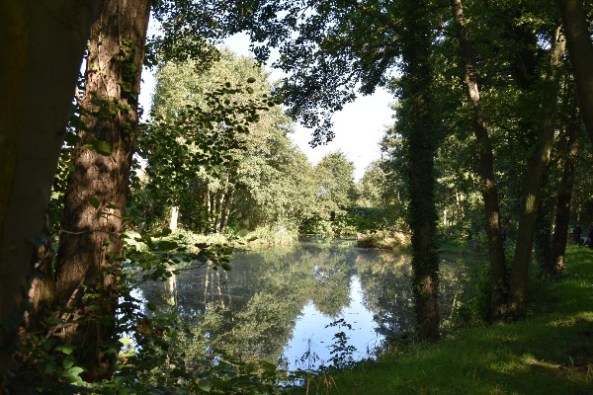
Beautiful lake

Shoot Report – NFAS National Championships

Beautiful lake

Beautiful lake

This shoot report is a little different to others, as though I did shoot this years NFAS National Championships in September,  it wasn’t with my bow, but with my camera. I was lucky enough to be one of the two official photographers for this years event.
This was a wonderful opportunity and allowed me to catch up with lots of friends, but to have a behind-the-scenes view on both courses over the two days.

Background

The National Field Archery Society hosts 2 championships each year, one in May which consists entirely of 3D targets and the National championships run over a weekend in mid September, where all targets are paper faces.
Archers  would compete on two courses, in their chosen style (there are eleven different shooting styles from longbow to sighted compound in the NFAS). Each course consists of 40 targets and as I said are  entirely paper-based, the selection of target faces is massive being  from a variety of suppliers.
This year the two courses were set by Duvelle Archers and a group of volunteers, with Duvelle setting A course and the volunteers B course.
As a new challenge to archers WASP pegs were used for those adults shooting sighted recurves, sighted compounds and crossbows.
Preparation
Long before the archers arrive for the weekend a great deal of work goes in behind the scenes an I feel it only fair to recognise this.  From the entry administration as soon as booking start to arrive weeks before the event, registration on the weekend through to clearing up of the camping site at the end.
Behind the scenes admin team

Behind the scenes admin team

The sheer task of finding suitable woodland to house the event and camping is a massive challenge. Once the site is found, course layers need to be sourced and given access so they can scout out shoots the location, working out routes and paths between targets. The week prior to the event  everything kicks into high gear. The teams will be on site working to move target bosses, clear paths etc.
This year the hosts for the event would be Royle Farm Business Park, Drakelow, Burton upon Trent. This was a new venue to all and provided excellent camping and parking facilities for all attendees.
The grounds themselves were very flat, so the course layers had to work hard at times to make interesting shots. The advantage of this flat ground was to make it much easier to walk round. In addition, the woodlands is quite a young mixed plantation with access paths and open areas, which both course laying teams made use of with shots from the open areas into the darker woods or vice-a-versa.
Shot across the lake

Shot across the lake

A course set by Duvelle were fortunate enough to have a small water feature in the form of a lake which they used too great efficiency. I don’t  know about you but I find judging distance across water always challenging as I think others do. The flip side of this area was it was definitely the muddier part of the wood, especially on Sunday following the heavy rain.
Shoot through to the open

Shoot through to the open

B course on the other hand had more of the plantation aspect.  To their credit they worked hard to cut in a series of steps up to the shooting position for one shot on a steep slope.
Shot between the trees on B course

Shot between the trees on B course

I have to say I found it immensely enjoyable wandering around chatting to people and having the opportunity to take so many photographs. Long before I was into archery I enjoyed photography, something I started in my early teens and it was great to be able to  go round and just shoot more and more photos. I think I came off with about 600 photos of which over 300 are now on the NFAS website.
Compound archer relaxing

Compound archer relaxing – in fact he went on to win it

Back to the shoot report.  Compared to previous events this was quite small championships this year with just over 300 competitors. Past events have seen more than 400 archers and I wonder whether the timing of it, bring in mid-September is part of the problem. Many parents with children will have just seen them returned to school, others like myself who work at a university, struggle to have time off for that time of year.
There is also the fact that some people just don’t like shooting paper faces and prefer 3Ds.
The weather always plays a part in any outdoor event and I think we had everything from bright glorious sunshine of a late summer, early autumn day on Saturday, with archers in t-shirts. Contrasting with torrential downpours on Saturday night and at times Sunday.
Before the rain

Before the rain

The rain made getting round parts of A course a challenge, despite the best efforts of the marshals who put matting out and even built a bridge in one area.
After the rain

After the rain

As I said I saw behind the scenes a lot more this year. A few years ago I’d been fortunate enough to lead a group of volunteers who set a 3D championships course, which provided great sense of achievement. The thing being, we had to focus on one course, this year I got to see far more. With the early starts; I was out with my camera from just after 7 a.m. each day through until arches coming in 6:00 p.m. at night. Then back to the motorhome to grab some food, download the pictures, charge camera batteries oh and get some sleep.

Even the bows need a rest

Registration was from 8 am to 9 am Saturday and 7 am to 8 am Sunday, so pretty early starts on both days especially Sunday. To me there felt like there were fewer archers on Sunday, possibly due to the poor weather forecast or due to them not enjoying the first days shooting. Either way there were more than enough to make the event work, even in the heavy showers.
Open field shot on A course

Open field shot on A course

Saturday morning would see me walking round A course and then swapping to B course in the afternoon. Saturday was definitely the better day for photography and archery as it was warm and more importantly dry. Sunday I spent the day focusing on A course and trying to capture photos between the rain showers.
From my perspective the courses felt different with one having longer shots overall than the other. I’m aware that some archers voiced their concerns over some shots and I believe the course was modified on Saturday night by the course team.
It is very easy to criticise course layers by saying a shot is stretched or bad. A stretched shot being when the distance to the target from the shooting peg is felt to be too far for the size of the animal.
I think everyone, myself included could learn to provide more constructive criticism or constructive comments to courses layers rather than just saying it was poor or  bad shot.
Many of the shots were long and I think were good shots but personally I felt the choice of target face was inappropriate,  being possibly too small all for the distance. Then again it is something about my view of course laying and how I set shots compared to others. I prefer a shorter more technical shot  or closer shot where the top archers will get the 24s and the less able are likely to get a 16 or second arrow. I know on one course there were a lot of second and third arrows shot.
Please remember this is a personal view and and it’s up to you whether you agree, as at the end of the day I wasn’t shooting the course with a bow, l was out shooting with a camera.
One fun thing was spotting all the toy trolls that appeared on A course. I’m not sure how many there were but I know they just appeared from time to time watching us.
Trolls on A course

Trolls on A course

Being able to walk round, chat with people, take photos and generally engage with everyone was great. Also to have the opportunity to see the woodlands, not just as the archer see it when they’re walking through but having  the opportunity to stop for 10-15 minutes or longer in one location and see groups on A  course going through was a great privilege which I really really enjoyed.
Saturday I was able to get round most of both courses, taking advantage of the glorious late summer day. Sunday would see me mostly on A course.

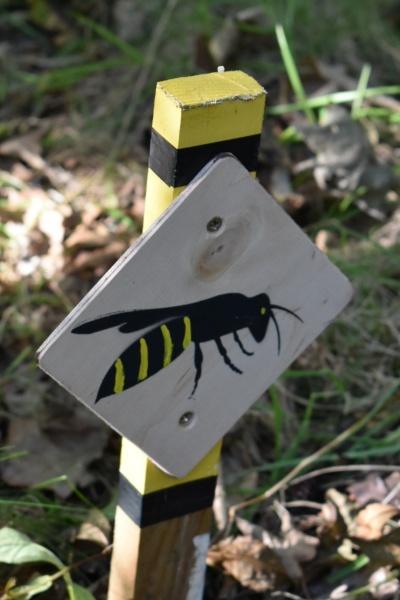
WASP Pegs

I feel the use of wasp pegs or the introduction of them was a good idea. The execution of them or positioning of them didn’t always work. Having a shot with a wasp peg further back, doesn’t always make a more interesting shot or indeed a challenging shot. Greater challenge can be achieved by changing the angle or framing of the shot so the archer has a narrow window to view and shoot through.
Wasp pegs

Wasp pegs

Whether they will be used in future I don’t know I hope so and I think they offer the ability to to give some classes a greater challenge. At the club I shoot for Briar Rose, we use wasp pegs and I think in general we get them right. I hope other clubs will adopt this policy as it allows you to set a challenging shot for sighted compounds and crossbows, while keeping the red peg suitable for other styles.
Thats one thing we do different as we don’t have freestyle shoot from Wasp pegs.
I personally don’t believe that sighted recurve archers, i.e those shooting in the freestyle class should have to shoot from off wasp pegs, because at the end of the day their arrows do not have the same flat trajectory that compounds or crossbow do.
Pretty arrows

Pretty arrows

You can see the full set of photos that myself and Derek shot over the weekend at the NFAS site, along with a listing of the winners.
Congratulations to all those who were placed and who attended, some for the first time. I hope you enjoyed it and will be returning again.
If I had the opportunity to do it all again, I think I would do things a little differently but yes I would give it a go.
Thanks for reading.