Cover photo

Literature Review – Controlled Process Shooting – Joel Turner

It’s been a while, in fact, it’s been far too long since I have added anything to this site, for which I apologise. My attention has been focussed on developing the podcasts (https://anchor.fm/off-the-arrow-shelf) at the expense of the written word. So with only one minor delay to say Happy New year and I hope everyone reading this is well, let’s get on to this book review.

Cover photo
Cover Photo

Those of you who are familiar with field archery in the United States or other areas of the world for that matter may well have heard of Joel Turner. I have mentioned him a few times on this site and on my podcasts. He is a highly respected archer and coach, appearing in countless podcasts, videos and articles.

Joel has also authored Controlled Process Shooting – the science of target panic which is going to be the focus of this review. ISBN 9781981346431

Onto the first impressions, well these may not be positive for some people as pages per buck or pound are not high. It is quite a skinny pocket-size book rather than a huge encyclopaedia. The flip side of this is it gets to the point quickly, being quite focussed. It runs to 58 pages and I bought my copy online but it is available from several archery shops.

One thing that I really like is the way the book has been constructed with empty notes pages, where you are encouraged to add your own notes as you practise the processes outlined in the sections. I often end up with post-it notes stuck in books with my scrawl all over them as I don’t want to deface the book itself. I was actually talking about this very topic with Simon Thomas at the weekend, who also has the book.

Photo of inside cover

If you have ever watched any of Joel’s videos on YouTube or listened to a podcast, when he was discussing the principles of shooting, then you will be familiar with his style of presentation. The book is written in the same style as he speaks.

My advice would be for you to read it, then go back and read it again to make sure you understand what Joel is saying and the messages he is trying to get across. Then read it a third time to confirm this.

The section on mechanical releases is less relevant to my style of shooting as I shoot off the fingers, normally split-finger so I won’t comment on that chapter.

Some aspects of shooting a bow can be subconscious in the execution, but I still believe you need them to feel right. Maybe that is the way an instinctive archer has a closed-loop shot.

I found elements of the book interesting as Joel talks of a blueprint of a shot, which is effectively the same idea just different wording to how I describe a template of a shot to my students.

I am not sure that his style will suit everyone, in fact I would go as far as to say that it probably won’t suit everyone’s style of shooting or rather their mindset. That is just a fact of life as everyone is different and comes to archery via different life experiences.
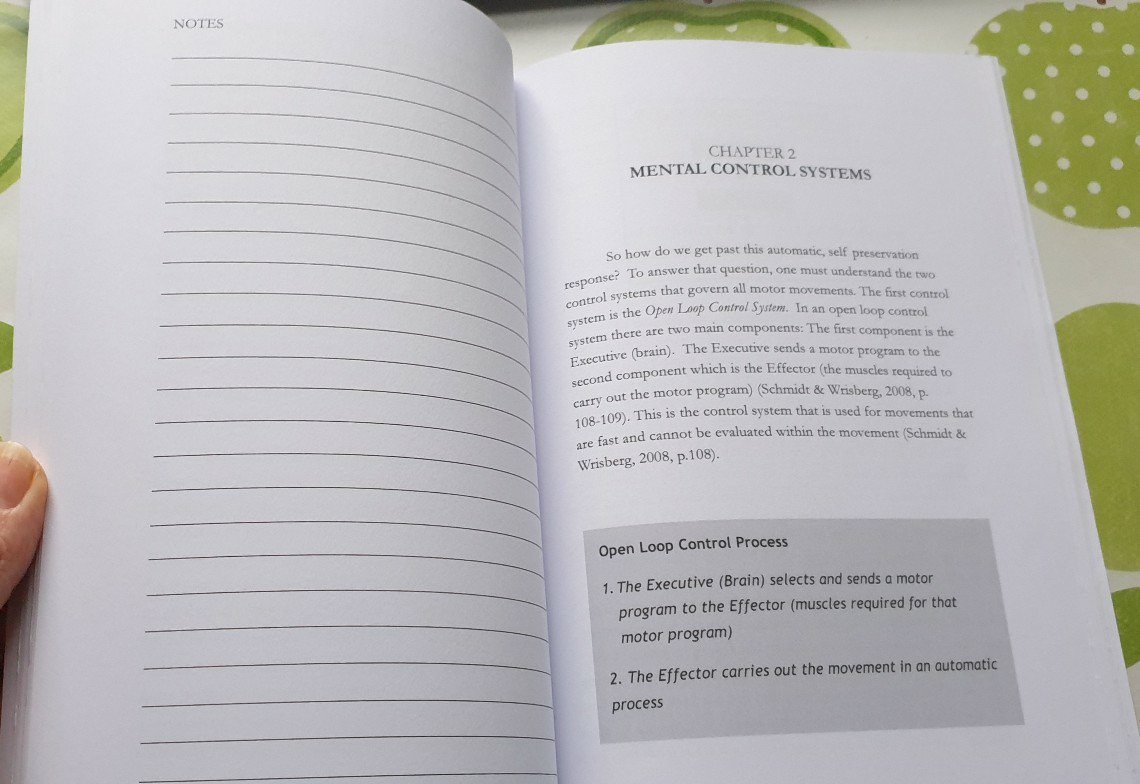
Another chapter
Another chapter

I feel you will get out of this book as much as you choose to invest in working through his ideas. So, don’t expect to read it and that be it. You will get more if you read and work with it over time.

Like owning a pair of walking boots. You need to wear them to bed them in. You need to work with this book to get the most from it.

It reads like a training manual for archers wanting to gain control of their shooting, with the option for you to annotate with your own notes and thoughts throughout the book. Hence the blank ruled pages for you to add your own notes and thoughts. I think this is an important part of how to use this book, as it is something for you to work with. Not just read, but work with. That work will take time and commitment.

This is something I try to get across to all my students when I am working with them on improvements to their shooting. They have to work for it. There is no magic arrow. Money spent on top-level equipment will only go so far. “All the gear and no idea” is a phrase I have heard about many sports including archery.

For that reason, you need to read this book, give yourself time to process what is being said and then practise the ideas Joel mentions.

I am a fan of the open and closed-loop process, though not sure that fan is quite the right word to use. I can see what Joel is alluding too when he discusses it. I use a phrase of feedback and feed blocks when I am explaining it to students, but the concepts are very similar.

A long time ago I learnt the importance of listening to the feedback your body is providing you. It is one of the reasons that I spend so much time teaching my students the importance of coming down or drawing down if the shot doesn’t feel right or controlled.

I know some traditional archers are not a fan on his shot control and feel things should be more fluid or instinctive. that’s fine, that is their perspective and opinion. It is so important to recognise that what suits one person is not necessarily going to fit with another person opinion or style. After all, archery is a very diverse discipline and opinions do vary.

I can understand why some who purchase this book may be disappointed when it arrives, possibly because they expect a large document or weighty tome. I think they may fail to understand the purpose of it. I see it as a training guide for your improvement. Like all training material, whether it be learning to drive, brain training or DIY, you have to apply it. many will want to rush out and apply what is read straight away, which is great. My only comment is that you need to give yourself time to adjust to these ideas.

I believe some people will feel this is overpriced for such a small book, but I feel they might be missing the point. It is not a text you simply read, it is a guide for you to work with, or at least that is how it came across to me.

Stay safe, stay well and thanks for reading.

Rob Shooting

Target Panic – Your journey starts now

So, I have come to the last of the articles on target panic. This will conclude the series and I will recap on a few things.
First off, I’d like to say thanks for sticking with me. I didn’t think it would take this long to get to the concluding post, but there has been a few things come up in 2020 no one expected. I’ve included a list here of all the posts ansd looking back I never thought it would run to 10 articles.

  1. Target Panic and the archer part 1
  2. Target Panic and the archer part 2
  3. Target Panic and the archer part 3
  4. Arrows role in overcoming target panic
  5. Target panic and how knowing our bows can help
  6. Before we start a quick reminder
  7. Target Panic techniques – drawing down
  8. Target panic techniques & blank boss shooting and Target face anxiety
  9. Target panic techniques – Draw, track, come down

Secondly, I’d like to say all the tactics, all the coping strategies, no matter how good they are, along with all the techniques are a waste of time and will fail. There, I’ve said it.

So, your immediate thought now is WHAT!! Why have you bothered to write all these articles? Why have I as a follower, spent the time reading them?

Well let me qualify what I have just said.
All the advice and the guidance is worth squat, it is completely pointless, doomed to failure even. If you don’t put work and effort in. If you don’t put the effort, commitment and work in. You, not me, but YOU. So it over to you now.
I said in the first post there is no magic arrows. It requires you to put the work in. To spend time trying the different techniques, not just once or twice, but over a few weeks. Then you can find ones that works consistently for you.
You can read every word ever written, watch every second of YouTube videos, listen to every minute of podcasts, but it will do you very little good. Why?
Simply because you need to apply this knowledge, you need to practise the techniques, apply the theory to yourself and your own situation.
I told you right at the start you would need a fair degree of patience and persistence and I meant it. Work for it and it will work for you.

I was listening to Sir Ken Robinson in one of his TED talks recently. In it he talks of engaging in the task but not fulfilling it. That struck a chord with me as I have seen so many people do this. He speaks of how you might be teaching in a room but are those people learning? For that matter is anyone learning or are they going through the motions? You might be coaching a group or individual at your club but are those individuals actually learning?
I can write hundreds even thousands of words, but if you as the reader, the archer, the student, don’t apply it then don’t expect to improve your situation. I don’t see it as a waste of my time as if one person finds this of use and it helps them then I’ve done some good. That was why I started this series of articles.

I’m going to reference another author John Hudson who writes of the survival triangle in this recent book How to Survive: Lessons for Everyday Life from the Extreme World. Hope > plan > work. This triangle of words is applicable to archery as any other activity in modern life.

Survival triangle

In these posts I have spoken of the shot sequence and how important I see it in helping to combat target panic or anxiety. Now I know it may sound strange, an instinctive archer talking about shot sequence so much. The reason I do is simple. The shot sequence as important to an instinctive archer as one who might be thought of as a technical or non-instinctive archer. An instinctive archer will want to feel the shot is right. But their brains / feelings can send wrong messages sometimes or when it doesn’t feel right, it can be hard to pin down the glitch. This is why I put emphasis on shot sequence.

If you know what you do and when you do it, you can work on getting it right every time. That is what you want to be able to do, get it right time after time.
Your brain always wants to be as effective and efficient as possible so it will do its best to speed processes up and take short cuts. This is not always what you want as sometimes those short cuts miss out important steps or become feed blocks.

Feedback v Feed Block

If you watch or read any material by Joel Turner, he talks of Open and Closed loop shooting. Well I tend to think of it as you either have a Feed block or Feedback. In the second example of a shot sequence back in the second article, I talk about “Does the draw up feeling right?” This is a feedback loop I have in my shot sequence to tell me if things are right. If they are and it feels right, then it is okay to continue otherwise stop and reset. It’s a way of stopping myself from executing a poor shot.
A feed block is when you get that feedback from your muscles or head and choose to block it out and continue with the shot. You want to avoid these as they don’t improve your situation. Work on developing the understanding the feedback your body, muscles and brain is giving you.

Spot it early

Learn to identify when you start to feel the butterflies in your gut start, before they turn into a target panic stampede of elephants. I feel these more often than people probably realise. The thing is when I feel it start I know what I have to do. I have tried and tested techniques now, but its’ taken me a long time to develop.
I’ll let you into a little secret. When I am on a peg there are times when I might be feeling a little uneasy about the shot I’m about to take. So, when I’m getting ready to shoot, I have a little mantra I say to myself to help me focus. It brings me back to the moment I am in and helps settle the nerves.
There are a few important elements. The terms, the phrasing and words used are positive not negative, reminding me of what I am and have been capable of. They are rhythmic and pull my focus to the moment in hand. I’ve known friends to write on the back of their bow hand “stay focused “.

There is an element of Mindfulness of focusing on the present current moment in time. For those of you who may not be familiar with mindfulness I have pulled up this definition.

“Mindfulness is the psychological process of purposely bringing one’s attention to experiences occurring in the present moment without judgment, which one can develop through the practice of meditation and through other training”
Wikipedia – https://en.wikipedia.org/wiki/Mindfulness

I have learnt to use the technique to bring my focus back to the process in hand, calming myself and taking the shot.

Going back to the first article I gave some examples of how target panic or shot anxiety can manifest. I am going to revisit these again but link them to strategies and techniques I have gone on to cover in subsequent articles.

  • As the archer approaches the peg they feel they have forgotten how to shoot, their brain goes blank. – this is where knowing your shot sequence, training your brain to know the process.
  • An archer may find it difficult to draw up on a target, with their bow feeling too heavy, they can feel like their muscles and brain aren’t communicating. Yet they can draw up perfectly well when not aiming on the target. – using the training techniques of drawing up and moving on off target
  • Archers may feel their kit is letting them down and be constantly altering the pressure on their button or adding / removing twists in their string. – remember the archers triangle and how knowing that your kit is right can reduce anxiety.

archers triangle graphic

The archers triangle

  • Some may be able to draw their bow, but release the string as soon as they have drawn up towards the target. Releasing the arrow long before they intend to or are on the target. They are effectively missing the aiming part entirely as they feel unable to hold on a target believing they must immediately release at full draw. – again, it is the training techniques and your time practising that will overcome this

Remember the definition of target Panic
“Target panic is a psychological—and perhaps neurological—condition experienced by many archers, both competitive and recreational.” (https://en.wikipedia.org/wiki/Target_panic)

And how I defined it.

It is a level of anxiety felt by the archer, which can either result in manifesting in physical feelings of unease, loss of muscle control or manifest in the lack of mental skills such as concentration or focus. The level of anxiety varies widely and can present itself on the field or at stages before.

You can overcome these feelings of anxiety, through practise and I mean dedicated practise time. Good practise is vital. Practise without effort, direction or discipline is useless in respect to overcoming target panic.
Anyway, that is it. I could go on far more, but I am going to stop here. Remember you aren’t in this alone, there are coaches and other archers out there more than willing to help. Myself included.
I really hope you have found these posts of use. Please let me know if it helps or if you would like some help.
Stay safe and thanks for reading.

Close up of Sharon shooting

Target panic techniques – blank boss shooting and Target face anxiety

So following a brief lapse in postings, I am returning to the topic of Target Panic or shot anxiety associated with shooting. I want to finish off the series of articles with posts on practical exercises you can undertake yourself to start you on the road of overcoming such anxiety.
For those that aren’t sure of what I mean when talking about shot anxiety, more commonly known as Target Panic, I thought it worth just listing the articles I have already written on this. These goes into more details of the nature of target panic and how you can start regaining control. My goal was to end the series looking at practical techniques you can apply.

Blank boss work versus target face fears

So having looked at drawing down as a technique in the last post, let us now look at another popular technique, blank boss shooting and discuss anxiety triggered by shooting target faces. Blank boss practice is one technique which some people swear by and others aren’t so keen on. For those that aren’t sure what I mean, here is a brief description.
This blank boss technique is when you fall back on practising your shot sequence and control while shooting at a boss with no target face on it i.e. the boss is blank, hence the name “blank boss”.
The technique is normally performed at mid-range distances, so 10 to 25 yards.
The advantage of this technique is it often is seen as removing the pressure the archer can feel when drawing upon a target face. I’ve heard this sometimes called being gold shy. For those interested the Push Podcast guys in Episode 128 – Joel Turner briefly discuss this.
Whilst this can be of benefit for the archer to focus on form, draw, release etc, there is a flip side to this technique. If the person has anxiety triggered by drawing up and locking on to the gold or central score zone of a 3D, then they may well be able to draw upon a blank boss, but when then faced with a target face their anxiety returns.
Don’t get me wrong I know this has helped some people but for me, this doesn’t work. I think this is because I need an identifiable point to aim for or more accurately to focus on. Without that spot I can’t focus, my concentration goes and eyes wander. Where your eyes go, the arrow follows. Its a similar thing when I shoot 3Ds with no identifiable markings to pick out, so I hate shooting things that are all one colour.
As I’ve said, some people do find this a useful technique to help overcome target panic, so I’m going to give you an example from one of my coaching experiences of how removing the target face can help.
Several years ago I was asked by a very good friend to offer some advice to his wife. She was struggling with confidence despite being a very capable archer. I started by asking her how she felt about her shooting and one topic she would return to was about the focus on target faces, as she tended to shoot at the face and not focus on a spot.
So I removed the target face from the boss and put a target pin, about 10 mm in diameter in the centre. That would be what she would be shooting at. A small spot in a large boss for her to focus on.
After spending some time talking through her shot sequence and ironing out a couple of areas to develop we started shooting. Initially starting at 5 yards she shot at the pin, using it as a focus point. Notice I’m saying focus point rather than aim and that choice of words is deliberate. The archer is struggling with focusing on a spot not aiming her bow.
Over the afternoon we gradually moved back until we reached 20 yards. All the time focusing on her form, with the pin simply being a focal point for her shooting.
By the end of the session, she had hit the pin from 20 yards using her English longbow.
Form and focus is key.
One thing this technique can be beneficial for is when the archer wishes to work on their form. When you couple this work with a lighter poundage draw weight bow then you can have some great results. With a lighter bow, you have time to draw and focus on the steps and actions you are performing.
It is worth remembering that when you are presented with a stressful situation and you feel the anxiety building, I have found that a good technique for coping is to focus on your form. Focus on the steps you consciously or unconsciously go through and the shot will come.
So that is part one, blank boss shooting, but the other aspect is target anxiety

Target face anxiety or gold shy

Strange as it may sound, but specific target faces can trigger target panic and corresponding increased anxiety for some people. You might wonder why is this the case? Well, take a moment to think about it. Sometimes we put pressure on ourselves based on previous experiences. What about the JVD Ermin or Jay, I know Sharon hated the Merlin Tiger face for a while. They can be seen as the targets some archers love to hate.
Remember I mentioned this concept in the third post when I talked about mindset and how if you say “I never hit this face.”, it will have a negative effect on how you approach the shot.

JVD Ermin target face

JVD Ermine target face

On our practise range I tend not to use commercially available target faces. Instead, I use circular pieces of card which are actually, the cardboard bases from pre-made pizza bases. They are about 8 inches in diameter and I then draw a black dot in the centre approximately two inches in diameter. This gives me a cheap relative effective target which is easily visible at longer distances.

Simple target face

Simple target face

So why use these other than being cheap and me being a skinflint? Well, there are a few advantages.
The faces are small enough for me to move around the boss. This means if I want to practise shooting at a low target I can. This is useful as there are a few 3D targets like the crocodile which has a low body silhouette.
Moving the target face round the boss means I don’t shoot out one area of the boss e.g. the centre, so prolonging the life of the boss.
It stops me focusing on specific target faces, whether these are animal faces used in big game rounds or roundall, with multicoloured rings. Instead, it has me focusing on a small spot no matter the distance.
Drawing horizontal and vertical lines through the centre of the spot also helps as I can use it as a guide for one exercise, which I’ll cover in a future post. First, let’s go back to what are the options when confronted with a target face you dislike?
Well if you are on a field course, friendly shoot or competition, the best thing you can do is take a breath, stay calm and smile. Smile! Yes, smile, as this immediately starts to get your brain away from negativity. As a side note, it can also confuse any of your competitors who might be watching you waiting for a reaction.
One method I know works as I and others have used it repeatedly is to mentally overlay the rogue target face with one you prefer.  I know this may sound a bit strange but let me explain this a bit more, based on my own experience.
On one of our old bag bosses, we draw 4 small black spots about an inch in diameter over the pre-existing marks. Imagine drawing 2 lines on the boss one horizontal and one vertical, one halfway up and one halfway across the boss. Effectively dividing it into 4 equal squares. Then in the centre of each square mark a black spot.
You might be able to see them on the white boss in the picture below.

Mybo bag target

Mybo bag target

We would have 5 arrows and would shoot at each spot until we hit it and then move onto the next. The goal is to shoot one arrow into each and have a spare in the quiver. We would start at 5 yards and move back to 15 yards. (5/7/10/12/15 yards) It’s a great practise method as it focuses your mind on a small spot, along with forcing you to shoot at targets at different heights.
The second advantage is when you are faced with a target you don’t like, say a JVD Jay or Ermin all I would do is ignore the face and image the black dot from the target boss.
Away from a competition, I have known archers to buy target faces they struggle with and shoot it to death on their practice bosses. Shooting the face until they don’t feel any negativity towards it. The ghosts of past shots having been laid to rest you good say.
The key is to find a system that works for you.
I hope this advice helps. Thanks for reading, stay safe and well.