target faces

Target panic techniques – Draw, track, come down

So I’ve covered a couple of techniques so far (drawing down and blank boss shooting) in this series of posts on target panic.
So the third technique I’m going to cover here is one I’ve adopted from Jay Kidwell’s excellent book “Instinctive archery insights“. I’ve written about his book before and would advise anyone who is interested in aspects of coaching or target panic to pick up a copy. It is a very easy read and offers some great insights. The book was recommend to me by another coach and I really should type up a full literature review on it for the site.

cover of Instinctive Archery Insights

Instinctive Archery Insights

There is a little preparation required for this approach and it is not something that I suggest you try with your normal draw weight bow. So one thing you will need is a lighter draw weight bow. I use a 16lb draw weight take down recurve with my students.
In addition to a light poundage bow, you will need a few modified target faces and a 6 sided dice. Okay, so I know this may sound a little strange, some would go as far as to say a bit far fetched, but stay with me. I have found that using a six sided dice can prove very helpful and no, I’m not talking about gambling or playing snakes and ladders. Likewise the simple modification to the target face will help promote focus.
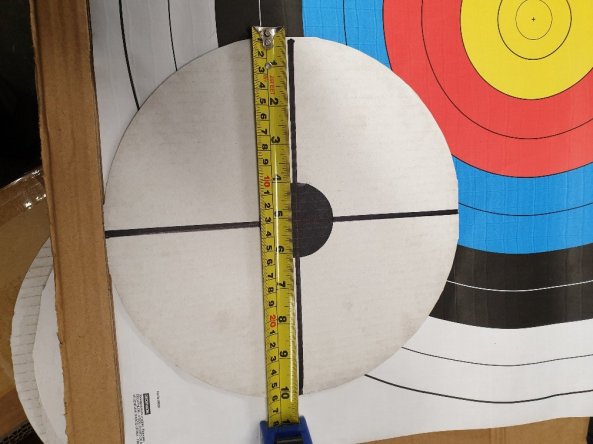
Simple target face with couple of lines added

Simple target face with couple of lines added, one horizontal and the other vertical.

The objective of this technique is to help the archer overcome the urge to release as soon as they have drawn up. Instead they develop the skill, neural pathways or retrain their brains to draw up and track onto and off the target. Overcoming the desire to release immediately the arrow is on the gold or when the archer thinks its on the gold.
Anyway back to how a six sided die can help along your with archery practice.
As many of us spend hours on the range training alone, it is very easy to fall into bad habits or repeating the same pattern again and again. In some ways we want to be able to repeat good form, but in this exercise we need to include a random factor. Hence the six sided die.
In Jays book he describes how a coach or shooting buddy call out a number, to denote the number of times you draw up and track across the target. There are a couple of important facts. The archer track across the target without releasing the arrow. Secondly they do it a number of times specified randomly so don’t form subconscious patterns.
To provide the random factor when alone I used the dice.

six sided dice in a clear box

Dice in a box

I modified the dice so there was no 1,5 or 6. This was easily done by sticking a blank label over the numbers. I wanted the die to show 1 four, 3 two’s and 2 threes. This may sound strange, but you don’t want too many higher numbers when performing the exercise as you would get fatigued, nor do you want a single occurrence.
I then housed the die in a small clear plastic tub large enough to allow the die to roll and clear enough to see the result.
So the second thing I done is modified a couple of targets by drawing lines on them through the centre, one vertically and one horizontally. When on the boss it gives the archer something to focus closely on when moving on and off the centre spot.

Remember, since you undertake these exercises multiple times, it is advisable for you to use a lighter draw weight bow.

In Jays book there are 3 exercises and rather than going into detail of how each of them work I’m going to explain how I use them and adapted them for my coaching style and students.

Step one

Me trying to remember to shoot

Me trying to remember to shoot

I’ll got through these step by step

  • First, fit one of the modified target faces to the boss so you have one line horizontal and another vertical.
  • Pick up you light draw weight bow and set yourself up at about 10 to 15 yards from the target boss.
  • Roll the die to get your random number, lets say 3.
  • Draw up and when they get to full draw and aimed / focused on the gold or in this case centre of the target, you move to the right to the edge of target and then  back to the centre. Once at the centre track left, again to the edge of the target. All the time maintaining full draw whilst not releasing. That is the crucial part, not releasing.
  • In this example  you would pass over the centre 3 times before coming down. Right, left, right and down.

The lines on the target provide a guide for movement. The theory is you are retraining your brain to be able to draw up,  centre on the target and then move off and back on without releasing. The movement to the left and right doesn’t have to be huge, ideally 3 to 4 inches at most.
The advantage of using the pizza base targets are they aren’t that large so you are tracking left and right only a little.
An alternative to this method is rather than tracking left to right, you track up and down, moving vertically through the centre. This is why there are both horizontal and vertical lines drawn on the face.
Try practising this technique for a few weeks and slowly it will help you build confidence and control.

The next step

So by this stage you have hopefully learnt to be able to draw up onto the target and move off it. A subtle development of this technique is when pass over the centre, you actually stop and hold on the centre for a moment.

From my experience these exercises work well, with the die providing a random number of reps you have  to perform.

Development

When you have mastered either or both of theses techniques you can progress to a slightly different version. In this version you combine the above exercise of moving over the centre spot of the target but on the final pass you lock onto the centre and you actually release the arrow.
When I am coaching these technique with students I recommend, they don’t perform them for long periods of time. Even with using a light draw weight bow there is quite a lot of strain on muscles, not to mention the concentration required. Ideally 15- 20 minutes seems to be optimum. Any longer and it can become tedious and the students tend to lose concentration.
The other thing is to practise these techniques over a few sessions, as it will take time for you to retrain your brain into being able to draw up, move on and off target spot etc. It is not something you can do once or twice for a couple weeks and then stop. Overcoming potentially years of subconscious neurological programming takes time and effort. So give yourself time to learn these skills. It does help if you practise them.

Thanks for reading.

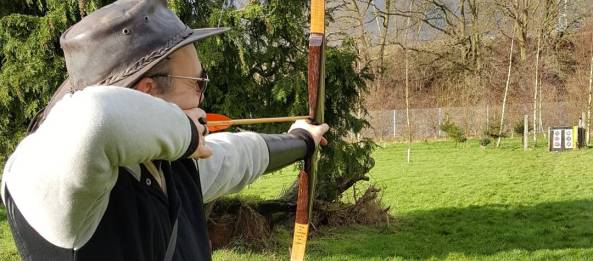
Close up of Sharon shooting

Target panic techniques – blank boss shooting and Target face anxiety

So following a brief lapse in postings, I am returning to the topic of Target Panic or shot anxiety associated with shooting. I want to finish off the series of articles with posts on practical exercises you can undertake yourself to start you on the road of overcoming such anxiety.
For those that aren’t sure of what I mean when talking about shot anxiety, more commonly known as Target Panic, I thought it worth just listing the articles I have already written on this. These goes into more details of the nature of target panic and how you can start regaining control. My goal was to end the series looking at practical techniques you can apply.

Blank boss work versus target face fears

So having looked at drawing down as a technique in the last post, let us now look at another popular technique, blank boss shooting and discuss anxiety triggered by shooting target faces. Blank boss practice is one technique which some people swear by and others aren’t so keen on. For those that aren’t sure what I mean, here is a brief description.
This blank boss technique is when you fall back on practising your shot sequence and control while shooting at a boss with no target face on it i.e. the boss is blank, hence the name “blank boss”.
The technique is normally performed at mid-range distances, so 10 to 25 yards.
The advantage of this technique is it often is seen as removing the pressure the archer can feel when drawing upon a target face. I’ve heard this sometimes called being gold shy. For those interested the Push Podcast guys in Episode 128 – Joel Turner briefly discuss this.
Whilst this can be of benefit for the archer to focus on form, draw, release etc, there is a flip side to this technique. If the person has anxiety triggered by drawing up and locking on to the gold or central score zone of a 3D, then they may well be able to draw upon a blank boss, but when then faced with a target face their anxiety returns.
Don’t get me wrong I know this has helped some people but for me, this doesn’t work. I think this is because I need an identifiable point to aim for or more accurately to focus on. Without that spot I can’t focus, my concentration goes and eyes wander. Where your eyes go, the arrow follows. Its a similar thing when I shoot 3Ds with no identifiable markings to pick out, so I hate shooting things that are all one colour.
As I’ve said, some people do find this a useful technique to help overcome target panic, so I’m going to give you an example from one of my coaching experiences of how removing the target face can help.
Several years ago I was asked by a very good friend to offer some advice to his wife. She was struggling with confidence despite being a very capable archer. I started by asking her how she felt about her shooting and one topic she would return to was about the focus on target faces, as she tended to shoot at the face and not focus on a spot.
So I removed the target face from the boss and put a target pin, about 10 mm in diameter in the centre. That would be what she would be shooting at. A small spot in a large boss for her to focus on.
After spending some time talking through her shot sequence and ironing out a couple of areas to develop we started shooting. Initially starting at 5 yards she shot at the pin, using it as a focus point. Notice I’m saying focus point rather than aim and that choice of words is deliberate. The archer is struggling with focusing on a spot not aiming her bow.
Over the afternoon we gradually moved back until we reached 20 yards. All the time focusing on her form, with the pin simply being a focal point for her shooting.
By the end of the session, she had hit the pin from 20 yards using her English longbow.
Form and focus is key.
One thing this technique can be beneficial for is when the archer wishes to work on their form. When you couple this work with a lighter poundage draw weight bow then you can have some great results. With a lighter bow, you have time to draw and focus on the steps and actions you are performing.
It is worth remembering that when you are presented with a stressful situation and you feel the anxiety building, I have found that a good technique for coping is to focus on your form. Focus on the steps you consciously or unconsciously go through and the shot will come.
So that is part one, blank boss shooting, but the other aspect is target anxiety

Target face anxiety or gold shy

Strange as it may sound, but specific target faces can trigger target panic and corresponding increased anxiety for some people. You might wonder why is this the case? Well, take a moment to think about it. Sometimes we put pressure on ourselves based on previous experiences. What about the JVD Ermin or Jay, I know Sharon hated the Merlin Tiger face for a while. They can be seen as the targets some archers love to hate.
Remember I mentioned this concept in the third post when I talked about mindset and how if you say “I never hit this face.”, it will have a negative effect on how you approach the shot.
JVD Ermin target face

JVD Ermine target face

On our practise range I tend not to use commercially available target faces. Instead, I use circular pieces of card which are actually, the cardboard bases from pre-made pizza bases. They are about 8 inches in diameter and I then draw a black dot in the centre approximately two inches in diameter. This gives me a cheap relative effective target which is easily visible at longer distances.
Simple target face

Simple target face

So why use these other than being cheap and me being a skinflint? Well, there are a few advantages.
The faces are small enough for me to move around the boss. This means if I want to practise shooting at a low target I can. This is useful as there are a few 3D targets like the crocodile which has a low body silhouette.
Moving the target face round the boss means I don’t shoot out one area of the boss e.g. the centre, so prolonging the life of the boss.
It stops me focusing on specific target faces, whether these are animal faces used in big game rounds or roundall, with multicoloured rings. Instead, it has me focusing on a small spot no matter the distance.
Drawing horizontal and vertical lines through the centre of the spot also helps as I can use it as a guide for one exercise, which I’ll cover in a future post. First, let’s go back to what are the options when confronted with a target face you dislike?
Well if you are on a field course, friendly shoot or competition, the best thing you can do is take a breath, stay calm and smile. Smile! Yes, smile, as this immediately starts to get your brain away from negativity. As a side note, it can also confuse any of your competitors who might be watching you waiting for a reaction.
One method I know works as I and others have used it repeatedly is to mentally overlay the rogue target face with one you prefer.  I know this may sound a bit strange but let me explain this a bit more, based on my own experience.
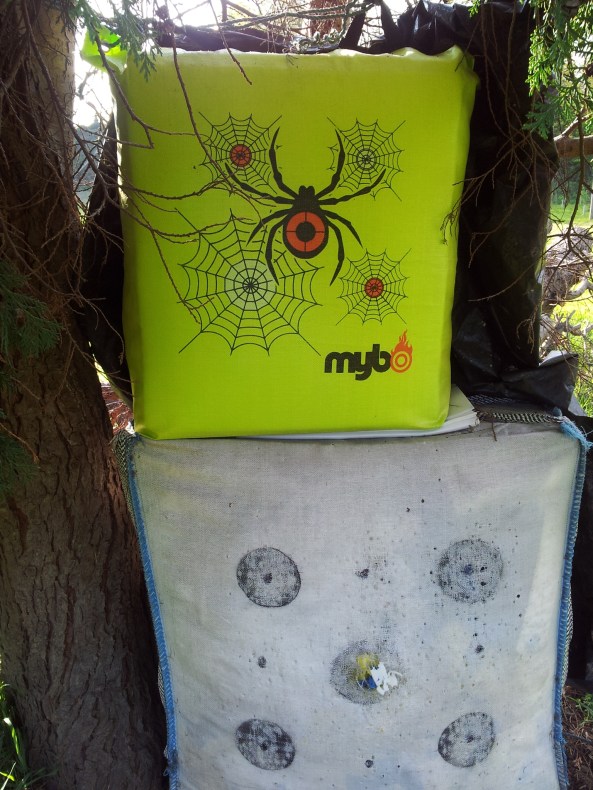
On one of our old bag bosses, we draw 4 small black spots about an inch in diameter over the pre-existing marks. Imagine drawing 2 lines on the boss one horizontal and one vertical, one halfway up and one halfway across the boss. Effectively dividing it into 4 equal squares. Then in the centre of each square mark a black spot.
You might be able to see them on the white boss in the picture below.
Mybo bag target

Mybo bag target

We would have 5 arrows and would shoot at each spot until we hit it and then move onto the next. The goal is to shoot one arrow into each and have a spare in the quiver. We would start at 5 yards and move back to 15 yards. (5/7/10/12/15 yards) It’s a great practise method as it focuses your mind on a small spot, along with forcing you to shoot at targets at different heights.
The second advantage is when you are faced with a target you don’t like, say a JVD Jay or Ermin all I would do is ignore the face and image the black dot from the target boss.
Away from a competition, I have known archers to buy target faces they struggle with and shoot it to death on their practice bosses. Shooting the face until they don’t feel any negativity towards it. The ghosts of past shots having been laid to rest you good say.
The key is to find a system that works for you.
I hope this advice helps. Thanks for reading, stay safe and well.
Me trying to remember to shoot

Target Panic techniques – drawing down

As promised we are going to start on the shooting techniques that can help with you overcoming target panic or anxiety when shooting.
So let’s look at one technique, which I feel is the best to start with and is a good one for any archer to develop whether suffering from target panic or not. Ironically it is something you probably did lots when you started but have maybe forgotten and thought is no longer needed. What am I talking about? The ability to draw down from a shot.
A while back I wrote a series of articles on what I thought were the “Hardest lessons to learn in Archery“. In those articles, I shared some coaching tips and ideas. One of these was on the skill of drawing down, sometimes called coming down from a shot. I’m going to revisit it here as it is a good technique to master when on the road to overcoming target panic. If you take nothing from this post, other than the thought of the importance of drawing down from a shot, fine believe me it’s going to help you.
First a quick definition -So drawing down is when you have drawn up your bow on your target, ready to release, and then lower it back down, without releasing the arrow and taking the shot.
Chances are you do it as a beginner when you first start, as it’s not uncommon for us to flick the arrow off the rest, normally because we are twisting the string, but as time progresses chances are you do it less and less often.
I would go as far as saying that learning to draw down your bow is probably my top tip for all archers, whether they suffer from anxiety, target panic or not. I firmly believe it is as equally important whether you shoot a trad bow or a compound. You have to be able to stop and come down from your shot safely.
I would like to share an example, which I feel ideal demonstrates the importance of practising this technique and how vital it can be.
When I was at a national tournament in a country park. This was a little over 4 years ago and I was about to shoot a 3D target about 15 yards away when a dog ran out in front of me!
I was at full draw, focusing on the target and about to release. In that split second, I reacted and followed my training and came down but it could have ended very differently.
The dog had been let off its lead by its owner on a public footpath running through the wood, after ignoring the warning signs to keep dogs on the lead due to the tournament. It was a close call and I was pretty shaken up and yes I did report the incident to the marshalling team.
It is quite common for those suffering from target panic to be unable to reach or hold at full draw, with many being unable to draw down. So building a training program that encourages it, developing it in such a way as it becomes a natural process is a good plan.
Think of it from this perspective, taking a shot is part physical, part mental. Over time your muscles develop in strength and flexibility, but your head is different. You think you may have learnt what to do. You’ve got yourself psyched up to take that shot and then at the last stage, you have to admit something is wrong or doesn’t feel right. That can feel like a big hit to your confidence, especially if people are watching. So the anxiety hits and you either release the string too early, as you can’t get to anchor or maybe do something else. If this behaviour persists then it becomes a habit and part of your shot sequence.

Train the brain

Okay now think of your brain as a computer and we train our brain through actions we undertake. If your brain believes every time you draw up on a target you have to shoot then it becomes very hard to stop this chain of events, even when you want or have to. If I hadn’t been able to stop when that dog ran out in front of me, well things could have been much worse.
Developing the ability of drawing down helps to program our brain, training it to know that just because we draw up onto a target doesn’t mean we have to shoot.
When drawing up to take your shot, there is the programming in your head or maybe I should say the expectation to release the arrow. In the back of your mind, you don’t want to admit that something is wrong or that you may have done something wrong.
One way you can overcome this problem is to condition yourself to draw down, or rather condition your head to accept that each time you draw up you don’t have to shoot.
An analogy – When you are driving a car and approaching a roundabout or junction, we might be able to arrive at said junction, observe no traffic and go. This is similar to us drawing up and encountering no problems, so we shoot. However, those of us who drive know we often have to stop at junctions due to the traffic we observe. Those observations provide information to us and are similar to drawing up and it feels wrong or uncomfortable.
Through repeated practise and experience of driving, we know we have to stop to avoid a collision. If we can do this when driving a car, which is far more complicated than shooting a bow, then we should be able to come down from a shot. Well, that’s the theory.

So what can you do?

One way of trying to overcome this mental block is to start programming your brain that
  1. The action of drawing up does not mean you have to shoot.
  2. The action of drawing down is normal.
There are a couple of effective ways of doing this. One method sees you using your normal bow, the other has you using a lighter draw weight. The techniques goal is to train yourself i.e. your brain during practising learns to not take each shot, i.e. removing the expectation that every time you draw up you have to shoot.

Step 1

So when you are shooting your normal bow and on the practise bosses, try this addition to your normal program. It’s really simple. Don’t shot your 3rd arrow immediately.
When you get to your 3rd arrow draw up as normal, anchor, settle aim and at the point, you would normally release the string, stop.
Instead of releasing, drawdown, go back to your ready position. Take you hand off the string, leave the arrow on the string and relax. Take a couple of breaths and then draw up and if it feels right take the shot.
So why do this?
Well it starts to condition your mind into that mindset we are wanting i.e when you draw up it does not mean you will have to always take the shot. Effectively you are retraining your brain to be more flexible.
This may sound strange but it helps build your muscle memory and gives you confidence, it helps to make you realise that you don’t always have to take the shot. This, in turn, goes a long way to improve your shot control. Don’t get me wrong, it won’t be easy. There are times you draw up and feel perfect, but if it is your third arrow come down and do it again. You might draw up and down 3 or 4 times but over time you will get used to the feel and not let it affect you.

Step 2

The other technique has you doing a similar exercise using a lighter weight bow, I have an 18lb recurve I use. With this method, you draw up, anchor and come down, then draw up anchor and shoot. Because you are effectively drawing up twice for each shot you need to use a lower draw weight bow, otherwise, you are going to get tired and fatigued very quickly. I find doing this for a couple of sets of 4 arrows works best.
The key point of this technique is for you to learn that just because you draw back your nocked arrow, it doesn’t mean you have to take the shot. It can be a hard lesson to learn, but when it works and it will with practise, it feels great. It feels like you have retaken control of the shot and your archery.
Try the technique and let me know if it works for you or if you have something else that works. I sincerely hope this has helped, please let me know what you think.
Thanks for reading and as I have said previously feel free to drop me a line with any questions or thoughts you might have.