Target boss repairs tip

From time to time your target bosses will be in need of repairs. We know this as we go through the process of inspecting and repairing our targets at the club. Sometimes this is a complete rebuild, other times the boss straps or banding simply needs tightening up. In the next few articles I will be providing some thoughts and advice on how I go about repairing targets.

Bit of a disclaimer here. I am no expert but I have used these techniques and found them to work, but please take care and use common sense.

For our layered foam target bosses we use these buckles for banding as it allows us to tighten the tension of the straps. It’s worth noting the straps can slacken up overtime as the foam gets shot out. The good thing is it’s easy to tighten them back up.

The only issue that can occur is if there isn’t enough banding to connect to the banding ratchet. To overcome this problem we came up with a quick solution of creating an extension strap. I can’t lay claim to coming up with this idea or technique entirely on my own and would like to thank Tony Parsons  for his help and advice.
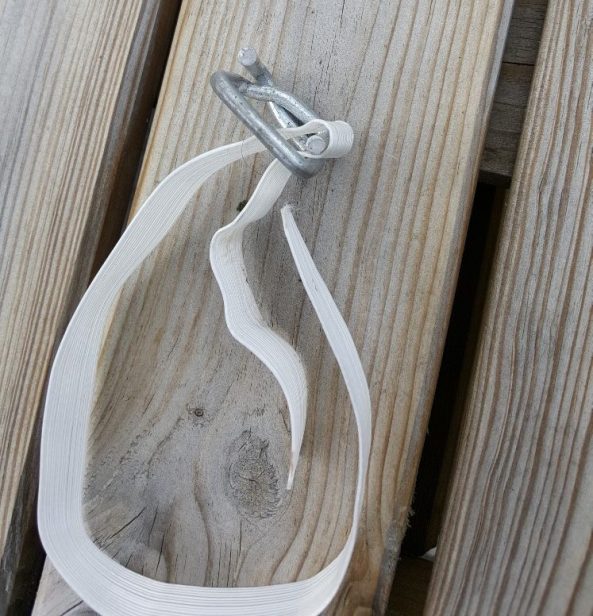
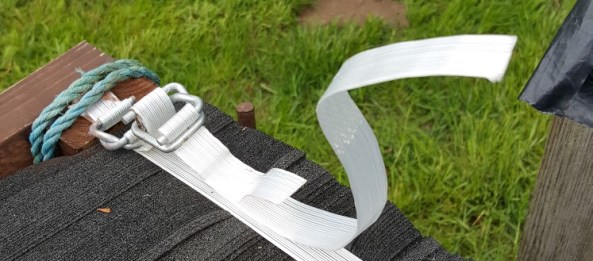
Buckle and extension strap

This is a length of about 12-14 inches with a buckle on the end. With a little luck there should be enough banding on the boss end to loop through the other side of the buckle.

You might want to use a pair of pliers to pull the end through as shown below.

You can then use the extended length of strapping in the bander to tighten the boss straps.

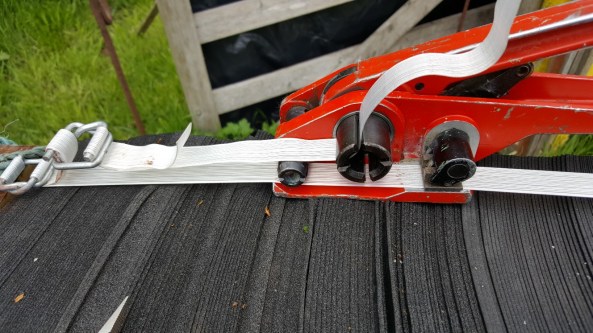
Be careful with using this technique as if there is insufficient banding on the buckle it can slip off.

Another added advantage of this method and the buckles is if you are careful you can tighten the bosses in situ on the course by just taking the banding ratchet and extension length.

Don’t over compress the bosses as we’ve found light poundage junior bows struggle to penetrate and arrows can bounce back.

Any  comments or thoughts let me know.

Thanks for reading.
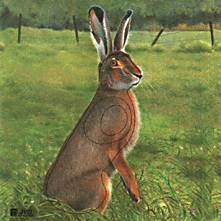
JVD Hare target face

Preparing target faces – a couple of quick tips

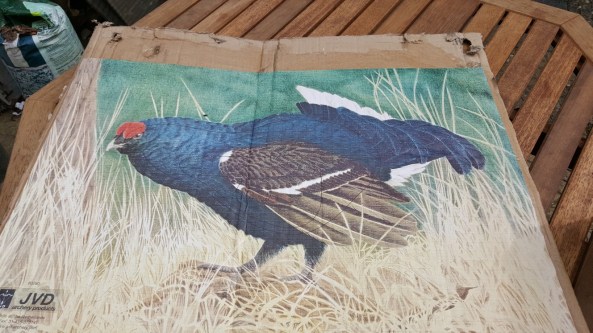
I thought I’d share a tip or two on preparing target faces for competitions. We are in the process of pasting up a load of faces for a couple of competitions the club is running in a few weeks. Fortunately it’s been pretty warm so they have been drying real fast.

target face

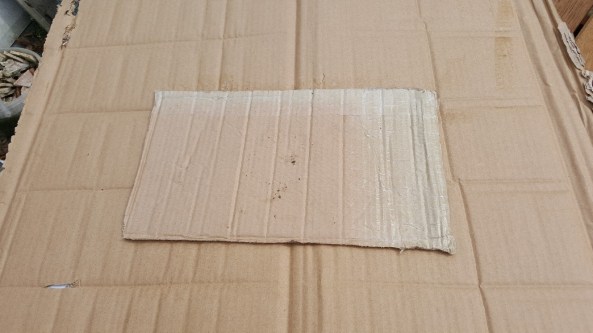
Like many other clubs we glue the target faces onto corrugated cardboard so they last longer on the day, usually using some form of  PVA glue. One thing we’ve learnt is the centre of the target or the highest scoring zone gets shot out quite quickly. To try and make the faces last longer we paste an extra layer of cardboard behind the centre to help it keep it’s strength.

Card on the back

It seems to work and helps the faces last a little longer on the day. I’ve known other clubs to paste a layer of fabric on the back to do much the same thing.

We also paint a layer of PVA over the top of the face to help waterproof it. The only problem with doing this we’ve encountered is if you get the mix of PVA to water wrong, you can end up with a slight white sheen over the faces.  So it is a bit of trial and error I’m afraid as different PVA seems to prefer different mix.

Hope this helps and thanks for reading.


Bow weights for beginners and Juniors

At a recent coaching course I was co-running, the question of bow draw weights for beginners and junior archers was raised. This is both a very important question and a complex one, with no easy answer.
The true answer is partly dependent on what age the archer is when they start along with their physical development. Everyone is different and trying to standardise and prescribe anything in stone simply doesn’t work. So here are some points to consider to help you decide.
  • If you start with too high a poundage in draw weight  for the newbie they can become fatigued quickly and their form will suffer as the archer struggles to cope.
  • Too heavy a mass weight can tire the arms of young archers, resulting in dropping their arm.
  • Another factor that is worth considering is how some young archers develop in height earlier than others but this does not mean they have muscle development for longer draws.
There are other elements that play a part here too, such as peer pressure which can occur when coaching a group or even a family if there are two siblings that try to compete with one another. Peer pressure can cause anxiety and increased stress associated with being watched and not doing as well as others or drawing the same poundage as their fellow archers.
I was lucky enough to be shown the specifications that the scouting organisation in the UK use which provides some good guidance on potential draw weights for different age ranges.
Age Range Maximum bow weight at start of course Maximum draw weight by end of the course
Up to 12 yrs old 14 lbs 16 lbs
13-14 16 lbs 18 lbs
15-16 18 lbs 22 lbs
17-18 20 lbs 24 lbs
19+ 20 lbs 24 lbs

I have to say I am a fan of using small “jelly bows” that are very low draw weight and light in hand. Ideal for under 10 year old. We bought a couple of these from Merlin Archery (https://www.merlinarchery.co.uk/ek-crusader-bow-kit.html) though we don’t use the arrows provided.

On take down recurves I start low 10lb or 12lb and let them see how it feels. We have a selection of limbs which we can swap out and have found this of great benefit. Again we bought some bows from Merlin – the Core Pulse in both 54 inch and 64 inch.
When I get the opportunity I will write up a review of these bows in the near future.
The best advice I can give anyone is start with a low draw weight and light bow. If they aren’t having to fight the bow or struggle holding the mass weight they are more likely to learn and in turn succeed.
Thanks for reading.