As promised we are going to start on the shooting techniques that can help with you overcoming target panic or anxiety when shooting.
So let’s look at one technique, which I feel is the best to start with and is a good one for any archer to develop whether suffering from target panic or not. Ironically it is something you probably did lots when you started but have maybe forgotten and thought is no longer needed. What am I talking about? The ability to draw down from a shot.
A while back I wrote a series of articles on what I thought were the “Hardest lessons to learn in Archery“. In those articles, I shared some coaching tips and ideas. One of these was on the skill of drawing down, sometimes called coming down from a shot. I’m going to revisit it here as it is a good technique to master when on the road to overcoming target panic. If you take nothing from this post, other than the thought of the importance of drawing down from a shot, fine believe me it’s going to help you.
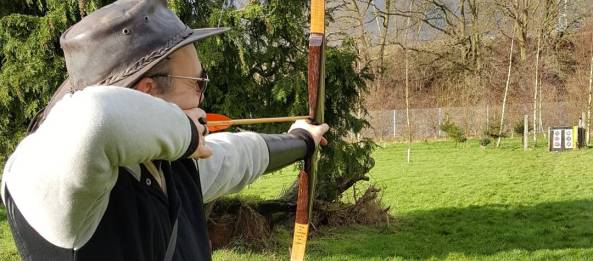
First a quick definition -So drawing down is when you have drawn up your bow on your target, ready to release, and then lower it back down, without releasing the arrow and taking the shot.
Chances are you do it as a beginner when you first start, as it’s not uncommon for us to flick the arrow off the rest, normally because we are twisting the string, but as time progresses chances are you do it less and less often.
I would go as far as saying that learning to draw down your bow is probably my top tip for all archers, whether they suffer from anxiety, target panic or not. I firmly believe it is as equally important whether you shoot a trad bow or a compound. You have to be able to stop and come down from your shot safely.
I would like to share an example, which I feel ideal demonstrates the importance of practising this technique and how vital it can be.
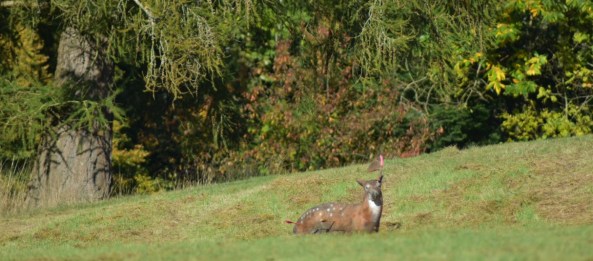
When I was at a national tournament in a country park. This was a little over 4 years ago and I was about to shoot a 3D target about 15 yards away when a dog ran out in front of me!
I was at full draw, focusing on the target and about to release. In that split second, I reacted and followed my training and came down but it could have ended very differently.
The dog had been let off its lead by its owner on a public footpath running through the wood, after ignoring the warning signs to keep dogs on the lead due to the tournament. It was a close call and I was pretty shaken up and yes I did report the incident to the marshalling team.
It is quite common for those suffering from target panic to be unable to reach or hold at full draw, with many being unable to draw down. So building a training program that encourages it, developing it in such a way as it becomes a natural process is a good plan.
Think of it from this perspective, taking a shot is part physical, part mental. Over time your muscles develop in strength and flexibility, but your head is different. You think you may have learnt what to do. You’ve got yourself psyched up to take that shot and then at the last stage, you have to admit something is wrong or doesn’t feel right. That can feel like a big hit to your confidence, especially if people are watching. So the anxiety hits and you either release the string too early, as you can’t get to anchor or maybe do something else. If this behaviour persists then it becomes a habit and part of your shot sequence.
Train the brain
Okay now think of your brain as a computer and we train our brain through actions we undertake. If your brain believes every time you draw up on a target you have to shoot then it becomes very hard to stop this chain of events, even when you want or have to. If I hadn’t been able to stop when that dog ran out in front of me, well things could have been much worse.
Developing the ability of drawing down helps to program our brain, training it to know that just because we draw up onto a target doesn’t mean we have to shoot.
When drawing up to take your shot, there is the programming in your head or maybe I should say the expectation to release the arrow. In the back of your mind, you don’t want to admit that something is wrong or that you may have done something wrong.
One way you can overcome this problem is to condition yourself to draw down, or rather condition your head to accept that each time you draw up you don’t have to shoot.
An analogy – When you are driving a car and approaching a roundabout or junction, we might be able to arrive at said junction, observe no traffic and go. This is similar to us drawing up and encountering no problems, so we shoot. However, those of us who drive know we often have to stop at junctions due to the traffic we observe. Those observations provide information to us and are similar to drawing up and it feels wrong or uncomfortable.
Through repeated practise and experience of driving, we know we have to stop to avoid a collision. If we can do this when driving a car, which is far more complicated than shooting a bow, then we should be able to come down from a shot. Well, that’s the theory.
So what can you do?
One way of trying to overcome this mental block is to start programming your brain that
-
The action of drawing up does not mean you have to shoot.
-
The action of drawing down is normal.
There are a couple of effective ways of doing this. One method sees you using your normal bow, the other has you using a lighter draw weight. The techniques goal is to train yourself i.e. your brain during practising learns to not take each shot, i.e. removing the expectation that every time you draw up you have to shoot.
Step 1
So when you are shooting your normal bow and on the practise bosses, try this addition to your normal program. It’s really simple. Don’t shot your 3rd arrow immediately.
When you get to your 3rd arrow draw up as normal, anchor, settle aim and at the point, you would normally release the string, stop.
Instead of releasing, drawdown, go back to your ready position. Take you hand off the string, leave the arrow on the string and relax. Take a couple of breaths and then draw up and if it feels right take the shot.
So why do this?
Well it starts to condition your mind into that mindset we are wanting i.e when you draw up it does not mean you will have to always take the shot. Effectively you are retraining your brain to be more flexible.
This may sound strange but it helps build your muscle memory and gives you confidence, it helps to make you realise that you don’t always have to take the shot. This, in turn, goes a long way to improve your shot control. Don’t get me wrong, it won’t be easy. There are times you draw up and feel perfect, but if it is your third arrow come down and do it again. You might draw up and down 3 or 4 times but over time you will get used to the feel and not let it affect you.
Step 2
The other technique has you doing a similar exercise using a lighter weight bow, I have an 18lb recurve I use. With this method, you draw up, anchor and come down, then draw up anchor and shoot. Because you are effectively drawing up twice for each shot you need to use a lower draw weight bow, otherwise, you are going to get tired and fatigued very quickly. I find doing this for a couple of sets of 4 arrows works best.
The key point of this technique is for you to learn that just because you draw back your nocked arrow, it doesn’t mean you have to take the shot. It can be a hard lesson to learn, but when it works and it will with practise, it feels great. It feels like you have retaken control of the shot and your archery.
Try the technique and let me know if it works for you or if you have something else that works. I sincerely hope this has helped, please let me know what you think.
Thanks for reading and as I have said previously feel free to drop me a line with any questions or thoughts you might have.








 My Archery Experiences