Injury and archery

I’m sure many reading this have seen photos of injuries associated with archery. Some of you may have been injured yourself or patched people up.

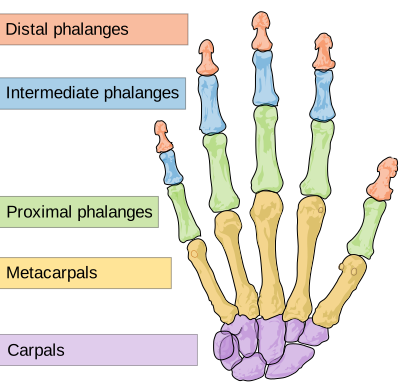
Sharon recently injured her right hand in a bicycling accident. On further investigation at hospital it transpired she had fractured her ring finger either side of the first joint.

Sharons hand

Sharons’ hand, the swelling and bruising has gone down.

For those of you with medical knowledge it is the intermediate phalanges and proximal phalanges  which I think is the metacarphalangeal joint.

Though this is a minor injury. The bone is not broken all the way across, but is broken in 2 places, it will result in no shooting for minimum 4-6 weeks as the bones knit back together. She is not a happy archer and keeps hinting at stringing bow in couple of weeks. To which she gets a stern telling off.

  • Don’t rush back and expect to perform at same level.
  • Give your body time to heal – rushing back to shoot may result in complicating your injury

Putting pressure on healing limbs or muscles is BAD idea. Consider this. When you draw up you are putting pressure on your 3 fingers. Depending on your personal draw and technique you might exert slightly more pressure on say your ring finger than your index or vice-versa. Either way, if one is injured you must give time for your body to heal.

Sharon Shooting

Sharon Shooting a few weeks ago

I presently have a not very happy archer, but I would rather a not very happy archer for a couple of weeks than an injured archer for a few months.

Thanks for reading

How to measure your draw length?

I’ve had a couple of people ask about how you measure your draw length and what length to make arrows?

There are a couple of ways of measuring draw length, I know Jordan Sequillion has posted a method on her site. The one I feel works best is using a measuring stick or measuring arrow.

You can buy them from most archery suppliers but I made mine. In essence, mine is an unused arrow shaft which I have glued a nock in one end and then marked up in one inch intervals. To make it easier to read I’ve painted the increments in contrasting colours.

Measuring Arrow

Homemade Measuring Arrow

Get the archer to draw up 3-4 times and then coming down obviously without releasing the measuring arrow. (make sure they are in a safe environment so on the range pointing towards the target boss just encased they accidentally release)

Full Draw

Archer at Full Draw

Ensure they are drawing to their normal anchor point each time, this way you can ensure the measurement is correct.

You can then see easily what there draw length is and the technique can be used for all pretty much all styles of bow, though please be careful when trying this with a compound bow, since it is easy to release the measuring arrow when you come down from full draw.

Here is a couple of additional tips.

Camera Phone – Use your camera phone to capture a couple of images of them at full draw. This will make easier to check the measuring later.

Rubber band or Tape – If you don’t have a camera to hand try using a piece of tape or rubber band at what you think is their draw and then have them draw up a couple more times. This way you can see if it is in the right spot.

If they are a beginner add another inch on as shown in this photograph below.

Measuring Arrow

White tape shows potential arrow length

I tend to recommend a slightly longer arrow if shooting woods and field archery. simply as in winter months you might be wearing a glove on bow arm and it gives you a little more clearance. Also should you lose the pile or snap the tip-off you might be able to taper the end back down and still have a usable arrow.

For competition I tend to cut them exact leaving no “spare”, if I lose the tip the arrow is added to the wood pile for the fire 😦

The other useful thing with using this method is spotting archers who either overdraw or overdraw and then collapse slightly. But I’ll cover this in more detail in my next posting.

Thanks for reading, any questions let me know.

What arrows for beginner?

Early this week Sharon was asked by an archery friend what arrows she thought would be good for her brother. What an easy question to answer … NOT 😉

She asked me and my response was to suggest she found out some more information first

The type of arrow is dependent on numerous factors many of which I’ve covered but in short

  • Draw Length
  • Bow weight
  • Club rules
  • Bow Style – compound, recurve, longbow etc
  • Purpose – hunting/target/field etc

Shooting an arrow that is not matched to your draw length and poundage can be dangerous as it may snap under the pressure if the wrong poundage, or you might draw it off the arrow rest if too short. Beginners often find their draw length increases as they get more used to shooting, so make sure any arrows allow for this.

Likewise too light an arrow can damage your bow as there is insufficient strength and weight in the arrow to cope with the energy from the limbs, resulting in damaged limbs.

General rule of thumb is the longer the draw length and the heavier the bow draw weight you end up going for stronger arrows ie the numbers higher. This is explained best here, taken from the Easton Arrow site

The four-digit number refers to the outside diameter and wall thickness of the shaft. The first two numbers are the outside diameter in 64ths of an inch. The second two numbers are the wall thickness in thousands of an inch.

For example, a 2514 shaft would be 25/64th of an inch in diameter and .014 of an inch wall thickness. OD and wall thickness are the two variables in controlling spine for aluminum arrows.

http://www.eastonarchery.com/frequently-asked-questions

Quick point on club rules. Some clubs do not allow archers to use carbon arrows, others ban beginners from using them. Personally I am not a fan of beginners using carbon arrows simply because I prefer them to use alloys. Alloys are easier to find if lost, if they glance off a tree they might be slightly bent but can’t be straightened, they don’t break / shatter leaving carbon shards. This topic is covered in the recent stick and string podcast

For complete beginners I tend to use Easton Neo alloy shafts, they are 1618 and at full length 32 inches. They are great arrows for low poundage bows, up to about 24-26lb at 28″ above that they get a bit whippy.

Easton Neo

Easton Neo

Another good arrow for a slightly more experienced archer is the Easton Jazz.  They range from 14130  to 1916. I tend to find most beginners find the 1816 work well from their first bows that come in about 26lb-30lb.

Easton Jazz

Easton Jazz

Here is a link to Easton Arrows selection chart http://www.eastonarchery.com/uploads/files/52_target-sel-chart.pdf  this will help work out whats best for your bow.

As the archer progress good alloy arrows are the Easton x7  (think they are 1614 going from memory) which Sharon uses (recurve 38lbs and 26″, yes 26″ not 28″) and work well for the field archery we do. I’ve got some XX75 that are pretty robust too, but I tend to shoot wooden arrows more.

There are loads of really useful sites out there and a wealth of help in local clubs, so do a few searches and if you can try different arrows before you buy. Jordan Sequillion blog site covers this well as do others like Charlies

Please note I have no alliance or connection with any of the shops or manufacturers I mention here, other than being a customer. So I have no vested interest in this other that trying to help an offer my opinion.

I hope this is of interest and if you have any questions drop me a line. Always happy to help if I can. Thanks for reading.