
What you need is a length of card board about 3 foot 6 inches in length and about six inches wide. This may sound a little Blue Peter but it does work. (For anyone who was not raised in the UK, Blue Peter is a long running TV program famous for making stuff with double sided sticky tape, especially in the early 70s and 80s).
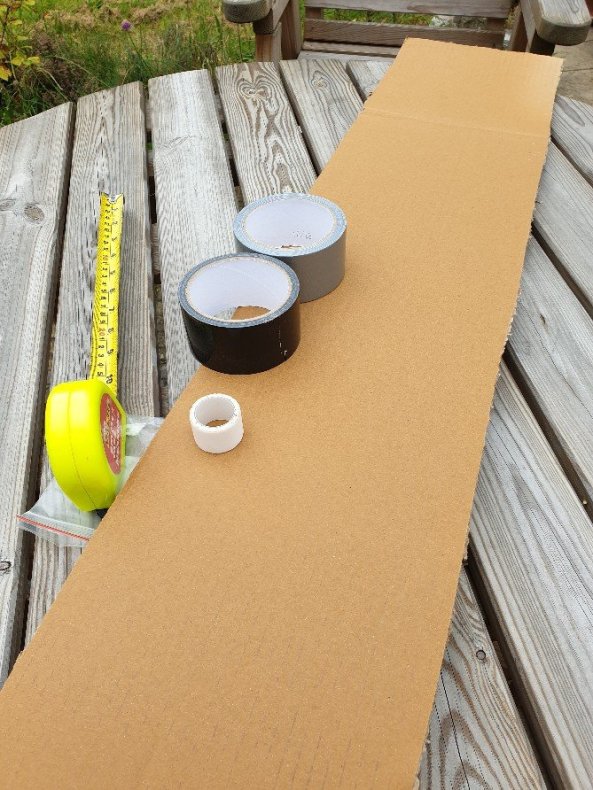
3 colours of tape and card board
The idea is similar to the concept I shared the other week with using a bamboo pole to help distance.
My practice bosses as 3ft tall so by making the card 6 inches longer I can attach the card on top of the boss.
In my example I applied a strip of grey tape down the centre of the cardboard along its length.

Grey tape
I then added 6 inch strips of black tape alternating so you had a strip of black then a 6 inch gap showing grey.

Marking out 6 inch sections
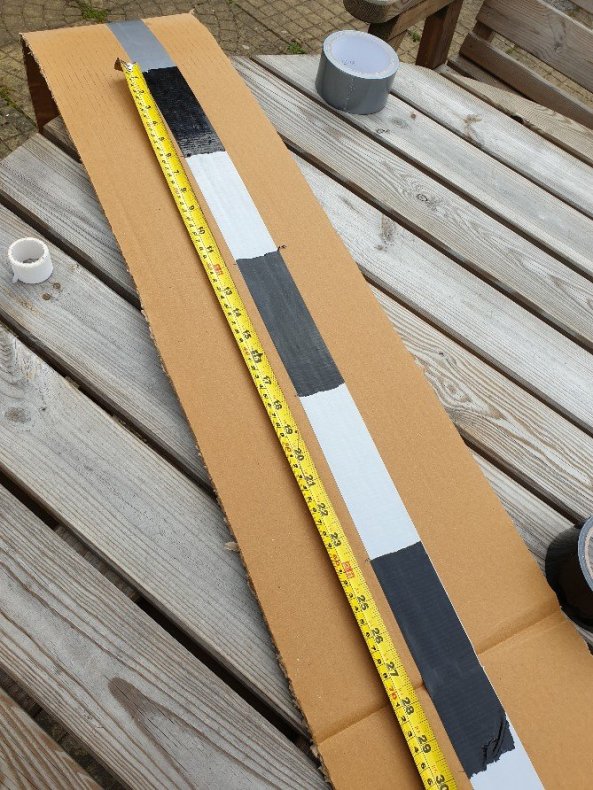
The idea being to alternate black and grey so the archer can us it to aid distance and aiming. Some might want to use 4 inch sections but I keep it to 6 so it ties into the bamboo cane method.

White tape
The last thing is to apply a strip of white tape down the centre of the black and grey tape. Cheap masking tape works perfectly for this.
The white tape is what you will be shooting at. The coloured tape is there to aid in distance judgement and to act as a contrast.

Card on the boss
So how do you use this?
Fix the target to the boss and then at 5 yards shoot a set of arrows. I normally shoot 4 arrows in a set when I’m practicing.
I start at lower part of the boss, bottom 6 inches and try and get my arrows in a vertical line gradually moving up the boss and in the white tape.
When I’ve reached the top of the boss I repeat the exercise but moving down from the top of the boss.
The focus is on you being able to put your arrows in the white tape consistently.
When that’s done I move back to my next distance and repeat. I’ll usually do this to about 15 yards or so. Reapplying white tape when needed.
Past 20 yards I focus on my arrows being in the silver or back tape. The way I look at it is if I am in the tape at this distance I’m hoping I should be in the highest score zone when shooting on a course.
The technique is not that dissimilar to one my first archery coach used to use where they would dangle a coloured ribbon down the boss and aim for that.
If you really want to challenge yourself try replacing the white tape with string and ensure each of your arrows are touching it.
So why do this?
Not all scoring zones are central to the boss. If you look at different target faces or 3Ds the height off the ground varies. You might be shooting a deer 3D where the kills 24 inches or more off the ground. With the next target being a 3D crocodile where the highest scoring zones inches off the ground.
I recall one championship where the paper face ermine was on ground level about 8ft away.

Paper Ermin
So this technique helps you focus on keeping your line and adjusting for height.
It also aids you in bending at the waste, sometimes called tea-potting. If you recall the children’s nursery rhyme “I’m a little teapot” that is where it gets it name from.
By the way the keen eyed among you will notice the target doesn’t have the white tape on it. This is because I took the photograph and then realised I hadn’t applied the tape. So I went back and applied it so you had a photograph of what it should look like.
Thanks for reading.



 My Archery Experiences