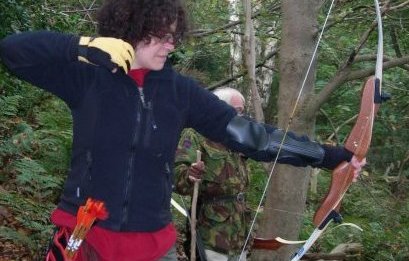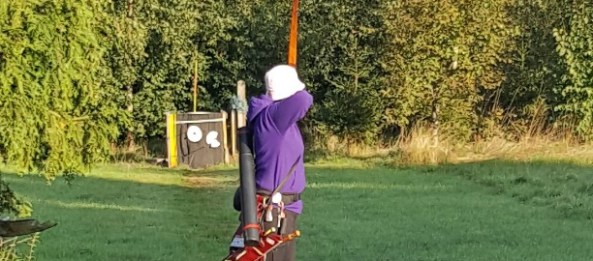
Sharon on the range

Before we start a quick reminder

So we have looked at two sides of the archers triangle, that of the arrow and bow. Now let’s look at what many see as the hardest element to gain control of, the archer.

archers triangle graphic

The archers triangle

Before we dive into this I want you to think for a moment about your mindset and how you approach these ideas.
It’s good to be optimistic when it comes to combating target panic but you have to temper this with a level of realism. So please be realistic in what you can achieve with the time you have available. Try and plan your activities so your time is used effectively and efficiently. Just like you need to allocate time for tuning your bow or making arrows you need to give yourself time to practice these techniques.
You will need to consider planning your time effectively. Don’t just go out and shoot lots of arrows believing it will cure your anxiety. It might build your muscle strength but I doubt it will solve the anxiety you feel.  Consider the fact that shooting 100 poor shots does not work as well as 30 well executed shots.

So think about practice regime and exercises you can do to help build confidence and resolve. Working on your chosen techniques whether these be focusing on your own form, shot sequence steps or exercises like drawing down off a shot have to be factored into your training regime.

view of the range

view of the range

Consider carefully how much time you can allocate to the techniques I will suggest. It may well require you to allocate 20 to 30 minutes a session in the early stages to get used to the drills. This is the sort of commitment required in the early stages.
Once you have regained control its still worth practicing the techniques every few sessions partly so they remain fresh in your mind and partly because they can help you remain in control.
Your objective is not to hit the target but to gain control over your target panic / shot anxietyremember this. Don’t let your focus move to hitting the gold, it has to be on control.
Too often we focus and perceive success as making the shot score highly. That is an outcome from solving the anxiety, your true goal is to take back control of the shot.

Physical Practise is one way but remember we are training your brain too. I mentioned in the previous article about mindset and changing the way you think about things. This includes how we consider things such as how we recall what we consider to be good or bad shots, productive or unproductive practice. Often when we start experiencing target panic we tend to recall the poor shots, what we consider bad ones. These prey on your mind, possibly because you missed a shot or scored less than you wanted. In reality the shot has gone, its in the past. remember to learn from it and move on.
You may have heard of the phrase “Making mistakes is not failure unless you let it be.” or something similar.
I firmly believe that making mistakes should not be viewed as a failure as it can provide a great learning experience. The reality is if we don’t learn from our mistakes we are likely to repeat them. Think of this for a moment. Shooting the wrong spine of arrow and identifying this only comes about from the mistake of shooting the wrong arrows in the first place.
Where archery is concerned this is very important to remember as you might try a technique and it doesn’t gell with you for whatever reason. The crucial thing to remember is you’ve tried something and made a step in gaining back control.
One way you can think of it is as if you are going to a new restaurant. You decide to try something new on the menu that sounds interesting. You might like it or you might hate it, without trying you’ll never know.

Getting good at something takes practice.
Getting better at doing the same thing takes more good practice.
Getting to a level where you are a master, can take a lifetime.

This is true if you are field archer, target shooter, fisherman, golfer or even a surgeon.
It is equally true of physical and mental practices. They take time to learn and for you to develop.

Natural Aptitude and learnt skill

Basic talent or natural aptitude only goes so far, after that its perseverance and good practice. Someone with natural talent will often start off well or ahead of another who has to work on shooting a bow. The thing is the person who is a “natural” may struggle later in their progression as they may have relied on their talent rather than developing skill. I’ve seen it time and time before affect the archers confidence as they start to struggle, wondering why it’s become so hard all of a sudden.

Modern fix, quick fix

In a modern world where people are always looking for short cuts or quick answers to fix complex issues the concept of spending time ensuring we learn the skill properly is sometimes overlooked.
Increasingly society looks for the easy fast solution. Here is a fact, target panic requires time to overcome. There maybe some quick tips that can help you find your right road, which is why I started writing these articles but there are no shortcuts or magic arrow.
The important thing to remember is effort can work and will work if the effort is focused.
Knowledge and effort makes a difference or at least it can if effort is directed and focused correctly. These posts are here to help you gain some insight and ideas on how to focus on the correct way for you.
Be kind to yourself and give yourself time. You might have been struggling with anxiety for years so don’t expect to learn to control it in hours. Remember in the second post I said there were 3 things

Put some work in – there are no magic arrows that solve everything or a secret draw technique that quells the nerves.
Remember one size doesn’t fit all – what works for one person may or may not work for you.
Be patient – it takes time to work out what helps you and this means time spent working at it too.

In the next couple of posts I’m going to cover a few techniques that can help.

  • Blank boss work
  • Target fear (where specific target faces trigger anxiety)
  • Drawing down
  • Drawing up but not shooting immediately

I might throw a few other ideas in the mix too. I hope these ideas will help.
Thanks for reading

Some thoughts on the first bits and pieces a new archer should buy

Quick break from my series on target panic to revisit a topic which I think will be of interest to many.

Several years ago I wrote a post offering advice on what equipment newbies should consider purchasing, before buying their first bow. Since I have been working with several new archers in the recent months I thought it a good time to revisit this post and update it where necessary.

As a coach I often get asked by my students about buying a bow. How much do they cost? What should I got for?  Where do you recommend I go?  I’ve seen one on E-Bay is it any good? I always reply by saying wait a few weeks or even a couple of months before you buy one. In that time use the club equipment for until you have a better idea of what is suitable for you.
But sooner or later your students will want to purchase their own bow (which is great don’t get me wrong) but there are a few things that might be worth getting first. So I have put this post together to offer some thoughts.

First things for any new archer to buy (before a bow) should be
Whistle – What a whistle? What’s that got to do with archery? Well put simply it’s for safety calls and is a necessity for insurance on some club sites including ours. All members of the NFAS should have a whistle on them so they can signal if necessary.

A tab or glove of their own. Normally I recommend a beginner starts with using a tab to protect their fingers. As they progress I have them trying both a tab and glove, along with trying different sizes and shapes until they find something they prefer. Recently I’ve found several students opting for a glove which I think is partly due to the colder weather.

This is the single thickness tab

This is the single thickness tab


Personally I think a tab is best, though it took me ages to find one that I was completely comfortable with. I feel tabs are easier on their fingers and promotes good finger position on the string.

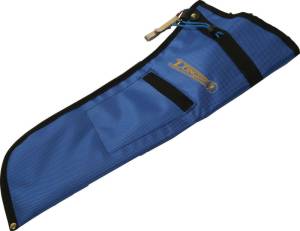
Quiver, you can pay a small fortune for some quivers, but when you are starting out go for something simple. So long as it will hold 4-6 arrows and is comfortable to carry on your belt it’s a winner. Quick note about back quivers here. I’ve tried back quivers, several in fact and never found one I was happy with so have stuck with a field quiver. I know some people  love them but for your first quiver, keep it simple.

simple quiver image

simple quiver

Some quivers will have a pocket or pouch on them which can very be useful for holder a whistle, stringer, spare string.

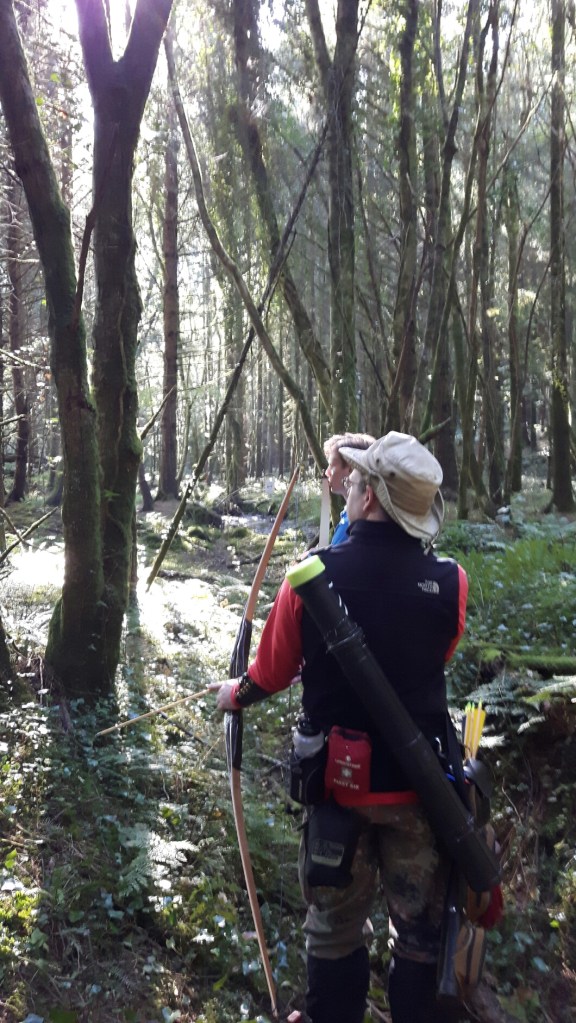
Top Top – pick up an arrow tube to store arrows when not in quiver. I carry 3 or 4 arrows in my quiver and the rest are in an arrow tube on my back. Safe, dry and there if I need them. You can use an extendable poster tube, which are cheaper, just make sure you drop some foam in the bottom of the tube to protect it and stop arrows puncturing the plastic. 

Rob trying to judge distance to a shot

Rob trying to judge distance to a shot

An arm bracer or arm guard that fits. What I mean is it doesn’t fall down the arm or is so tight it cuts off circulation to your arm. Like quivers there are loads of different designs, some that go all the way up the arm, others that only cover the forearm. Some are plain others are covered in intricate designs carved into the leather. At the end of the day function is more important, so get one that fits, works and you like.

Arrow puller, while not the most glamorous of archery elements they do makes life easier for drawing arrows, allowing you to grip the shaft more easily, especially on cold days.
Arrow rake – no matter how good you are, sooner or later you will be needing one for finding those arrows that fall short (a cheap decorating roller can be used, once modified for the purpose )

What kind of bow should I buy?

I will cover this in more detail in a separate post but what I will say is in my opinion for a first bow the most sensible option is the take down recurve practise bow.
They are relatively cheap (£55-£75 depending on where you get them), so if they don’t stick with the hobby it’s not such a huge investment. Also you might be able to pick one up from club member who has progressed. The advantage of a takedown is the limbs can be upgraded to heavier poundage as archer develop their strength and skill (I did this after a few months myself, with some shops giving a discount if you trade your old limbs in). Worth noting that not all limbs fit all bows, but I will go into more details in a future post about fittings and ILF bows (International Limb Fittings).
I have found the bows are forgiving to use which is what you want as a beginner.
Such bows come in a vast variety of sizes, shapes, poundage so good for all abilities, heights, draw lengths etc. so are easy to find one suitable for all shapes and sizes of archer.
As I said I will cover this in more details in the next post.

Thanks for reading

sharon - old bow

Low poundage bows are not a waste of time or money

So before I start let me wish everyone a very Happy New Year. I hope you all had a fantastic Christmas and are looking forward to the new year, full of archery.

I wanted to start this year by addressing a question that has arisen through recent coaching sessions, that of the use of light draw weight bows.

In many of the techniques I’ve mentioned over the years and will be in these articles on target anxiety or target panic, I’ve sited, you are best using a light poundage bow, rather than your normal draw weight.
This is something I believe is of huge benefit for archers whether they are new to the hobby or experienced.
Bows of relatively light draw weight, say 18lbs provide a useful tool for an archer, as from personal experience I find them heavy enough to allow the person to execute proper back tension, whilst being light enough poundage for them not to have to be fighting to hold it at full draw. I’ve used light draw bows myself when I’ve been struggling with my form or recovering from a shoulder injury so I know it works.
Another advantage with these bows is it allows the archer time to focus on improving different elements such as draw up, release or anchoring more easily. By shooting the lighter draw weight, it allows you to develop good posture, overall form, release, etc. All these elements then go to give you confidence in your ability and shot sequence. In turn building confidence in your shooting when you transit to your normal weight bow.
Think back to when you started shooting. Chances are you didn’t start with a heavy draw weight bow? I’m guessing you started with a lower draw weight bow, so you could develop your skills and muscles, without straining yourself. So does it not make sense to revisit these bows when you are developing your confidence and techniques to overcome target panic?
Remember using these bows is less about being strong and/or hitting the bullseye at 40 yards, it’s about learning to control your anxiety.
I have a couple of such bows in my coaching arsenal that have helped more archers than I can remember. They are simple 18lb takedown recurves, one ILF for those more used to shooting that style and one with wooden riser and simple bolt-in limbs for those who prefer the feel of a wooden riser. I quite enjoy using these bows myself at times to keep my form and technique solid. For those interested, I normally shoot a 45lb flatbow.
Sadly I’ve seen an implied stigma from some archers when you suggest using a lighter bow, as though they see its a failure or not macho. It’s not an indication of failure and this mentality is something I get very annoyed about. So in short and a message to those that think that, grow up.

N.B. Just a quick point here. If you are fighting to draw and hold your bow at full draw, then chances are you are over bowed i.e. the draw weight is too high.

Thanks for reading