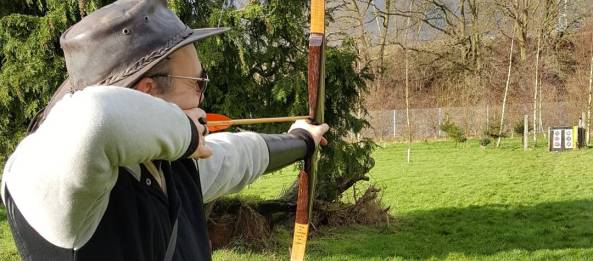
Me trying to remember to shoot

Hardest lessons to learn in Archery – Drawing down

So for the first of the “Hardest lessons to learn in Archery” articles I promised I am going to go with one of the most popular topics drawing down, sometimes called coming down from a shot. These articles are designed to help archers and are based on a survey and poll I posted on Facebook and Tumblr, where I asked what archers found the hardest.
So drawing down is when you have drawn up to your target, ready to release, but know something is wrong. for one reason or another it doesn’t feel right,  but you still take the shot usually with negative results of a miss and knowing you shouldn’t have taken the shot. For some reason you can’t hit that reset button, finding it impossible to draw down your bow and start again.
So why is it so hard? Why can’t we just hit the magic reset button and draw down?
You do it as a beginner when you first start.
Well think of it from this point of view, taking a shot is part physical part mental. Your muscles know what to do but your head is different. You’ve got yourself psyched up to take that shot and then at the last stage, you have to admit something is wrong or doesn’t feel right. That can feel like a big hit to your confidence, especially if people are watching.
Why might you need to draw down?
when we start down our archery path, it’s not uncommon for us to flick the arrow off the rest, normally because we are twisting the string. As we progress and skills develop this happens less often, but maybe other things happen.
You might see movement behind the target, that catches your eye, distracting you from the shot.
When drawing up to take your shot, there is the programming in your head or maybe I should say the expectation to release the arrow. In back of your mind you don’t want to admit that something is wrong or that you may have done something wrong.
One way you can try to overcome this problem is to condition yourself to draw down, or rather condition your head to accept that each time you draw up you don’t have to shoot.
So what can you do?
One way of trying to overcome this mental block is to start programming your brain that the action of drawing down is normal. An effective way of doing this s to train yourself when practising to not to take each shot, i.e. every time you draw up does not result in a taking a shoot.
So when you are on the practise bosses, try this addition to your normal program, don’t shot your 3rd arrow immediately.
Allow me to explain, when you get to shoot the 3rd arrow draw up as normal, anchor, settle aim and at the point you would normally release the string, don’t.
Instead draw down, go back to your ready position. Take you hand off the string and relax. Take a couple of breaths and then draw up and if it feels right take the shot. So why do this?
Well it starts to condition your mind into that mind set that  when you draw up it does not mean you will have to always take the shot. Effectively retraining your brain.
This may sound strange but builds your muscle memory and gets your confidence, it helps to make you realise that you don’t always have to take the shot. It goes a long way to improve your control.
Don’t get me wrong as it won’t be easy. There are times you draw up and feel perfect, but if it is your third arrow come down and do it again. You might draw up 2 ,3, 4 or more times but over time you will get used to the feel and not let it effect you.
Try to remember just because you draw back doesn’t mean you have to take the shot.
It is a hard lesson to learn, but when it works and it will with practise, it feels great. It feels like you have retaken control of the shot and your archery.
Try the technique and let me know if it works for you or if you have something else that works. I sincerely hope this has helped, please let me know what you think.
As always Thanks for reading.
Finished arrows in the sun

Equipment Review – Goblin Snot Paint

Goblin Snot paints

Goblin Snot paints

Okay, so this is not one of the most pleasant sounding products I have encountered, but if you can look past the name you can have pretty decent paint.
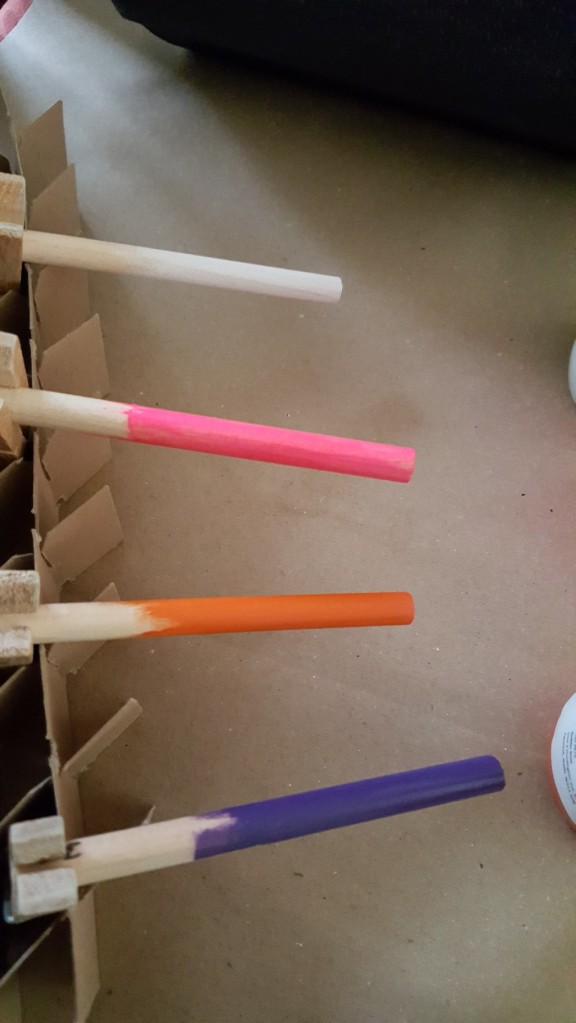
Lee Ankers of Heritage Longbows was kind enough to provide me with same sample colours (pink, white, orange and purple) to try out. There are obviously other colours but these would prove to provide a good selection as it offered both light colours and darker shades. If you check out their website for full colour list of what is available. (https://www.heritagelongbows.com/).
Before I applied them to the shafts that would become arrows I tried the paints out on some off cuts to get used to applicator and how many coats might be needed.
Samples after one coat

Samples after one coat

I did have a play at applying the paint to a pre varnished shaft, which worked petty well giving an even coat but it didn’t seem to adhere as well. I did find if I then applied a couple of coats of clear varnish over the top it did protect the paint.
I applied the paints to the bare wooden Port Orford Cedar shafts, after giving them a quick sand to remove any dust of rough patches.
First stage - orange being applied

First stage – orange being applied

Since Sharon wanted two contrasting colours on her arrows, I used masking tape to avoid me covering areas I wanted to cover in a different colour and to form an edge.
Second stage with the pink being applied

Second stage with the pink being applied

Firstly I have to admit I really like the purple. I’ve never been a huge fan of the colour in the past, but it works well for contrast. I’ve made up a few arrows with purple cresting and bright yellow fletchings and they work really well, as the contrast means you can see the arrows in flight and stand out in a number of target faces really well.
Bit dark, but purple shaft with bat wing fletching

Bit dark, but purple shaft with bat wing fletching

The orange and purple go on very easily and after a couple of coats, you can a good deep colour and covering. The white and pink need a little more work, taking three to four coats to get a consistent covering, which is expected really as being a lighter colour.
I’ve included a few photos of the arrows I made up for Sharon with the pink and orange as these happen to be matching to her fletching colours. The orange had two coats and the pink three or four.
I left the paint to dry for a couple of hours between coats, giving a very light sanding to ensure a clean smooth surface for each of the coats.
The paint goes on easily enough, once you get the hang of using the applicator, which has a sponge on the top of the bottle.
One tip is not to squeeze the bottle to much as you’ll end up with loads coming out. (Yes, this happened to me and fortunately I had put some old newspaper down just in case as I have been know to make a slight mess).
I’ve varnished with a clear acrylic varnish from a local model / hobby craft store.
Close up of a couple of finished arrows

Close up of a couple of finished arrows

Another tip would be to take your time when applying to make sure you have an even application.
Finished arrows in the sun

Finished arrows in the sun

Overall I think they work pretty well, being easy to apply and drying evenly.
Thanks for reading.
First Aid Kit

Carry a simple first aid kit

It is the time of year when the days have been getting longer and we are out more often. Some will be out on two day shoots, camping in some beautiful British countryside, or maybe course laying in readiness for the shoot.  The downside of the warmer days is it results in me having to start taking antihistamine tablets due to slight hay fever and possibility of insect bites.
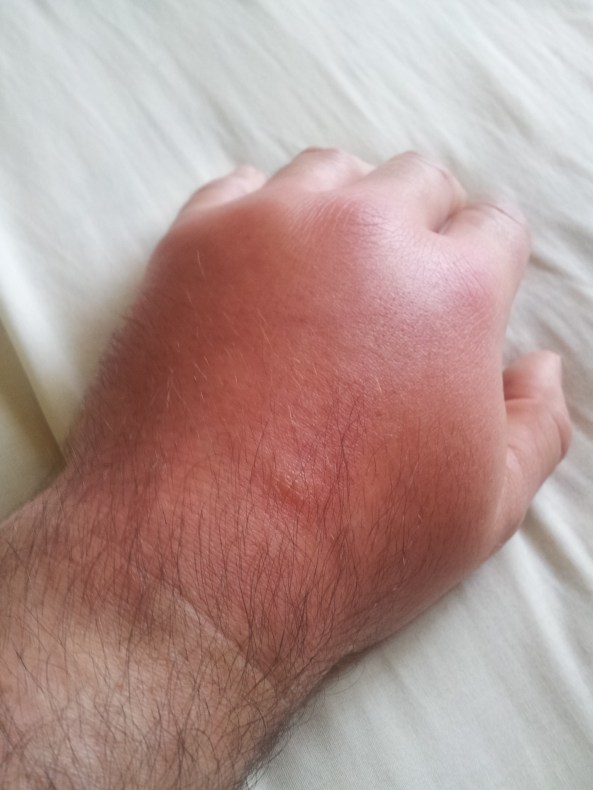
I’m pretty lucky, as I’ve been bitten or stung by most things including a swarm of angry bees one time when we disturbed a nest putting in a new target. The only bug that tends to result in a very bad reaction are horse fly bites and those I really react badly too. You can see below how my hand swelled up after a few hours, following one. Luckily I got my wedding ring off before the fingers swelled up too much or I might have had to have it cut off. (The ring not the finger)
horsefly bite

horsefly bite = very swollen hand

It is also when I go through the first aid kit on my quiver belt to check things are still in date. I do it every year and whether camping, skiing, hiking or enjoying field archery I always carry a simple first aid kit, either in my backpack, day sack or on my quiver belt. It doesn’t take up much space and weighs nearly nothing.
Top tip – put everything contained within the kit into waterproof zip bags. It keeps the kit together and more importantly dry.
The kit is pretty basic, the sort you can pick up from most outdoor stores with a few extra items, I’ve added  like antiseptic wipes, spare micropore tape, antihistamine cream, dehydration sachets etc. I’ve also added in a tick removing tool, as the numbers of ticks seem to be on the increase and we as field archers tend to frequent areas infested with the little things.
When asked why I bother carrying one as the organisers are bound to have something I tend to reply saying “It’s one of those things you hope to never have to use but am glad to carry”.
Thanks for reading.