Setting up a target boss

target boss in garden

Setting up a boss is a common activity, but requires some thought and care to ensure it is done correctly and safely whether this be on a course or as in this example in the garden. In this article I will try and cover some of the things to consider.

Target

Target set up and ready?

Here you can see a boss having been erected ready for practise. Looks good?

One commonly made mistake when setting up a boss is forgetting to check where the metal binding for the plastic strapping is located.
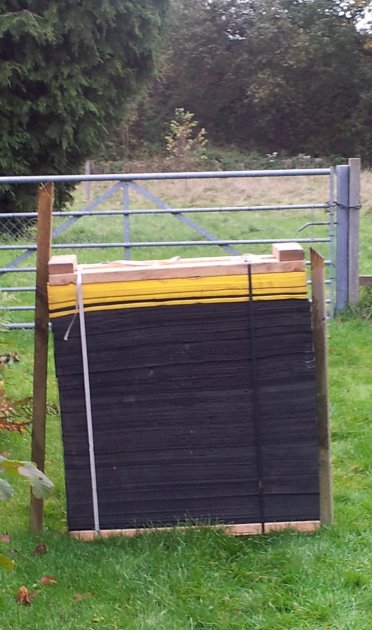
closeup

These should always be on the back of the boss and never facing the direction of the shot.

Why?

The binding can damage arrow tips if they are hit. I have also seen arrows shot from a compound bow hit one of these metal fastenings and bounce straight back some 15 yards landing at the archers feet.

You should also ensure the wood frame of the boss is always to the side and not on top or bottom.

Why?

If the arrow falls low, it will run the risk of hitting and embedding itself in the wooden frame, which is likely to  result in some work to extract.

If the arrow impacts at the top of the boss it runs the risk of deflecting off in any direction . So rotate the boss to ensure the wood frames are on the side of the boss.
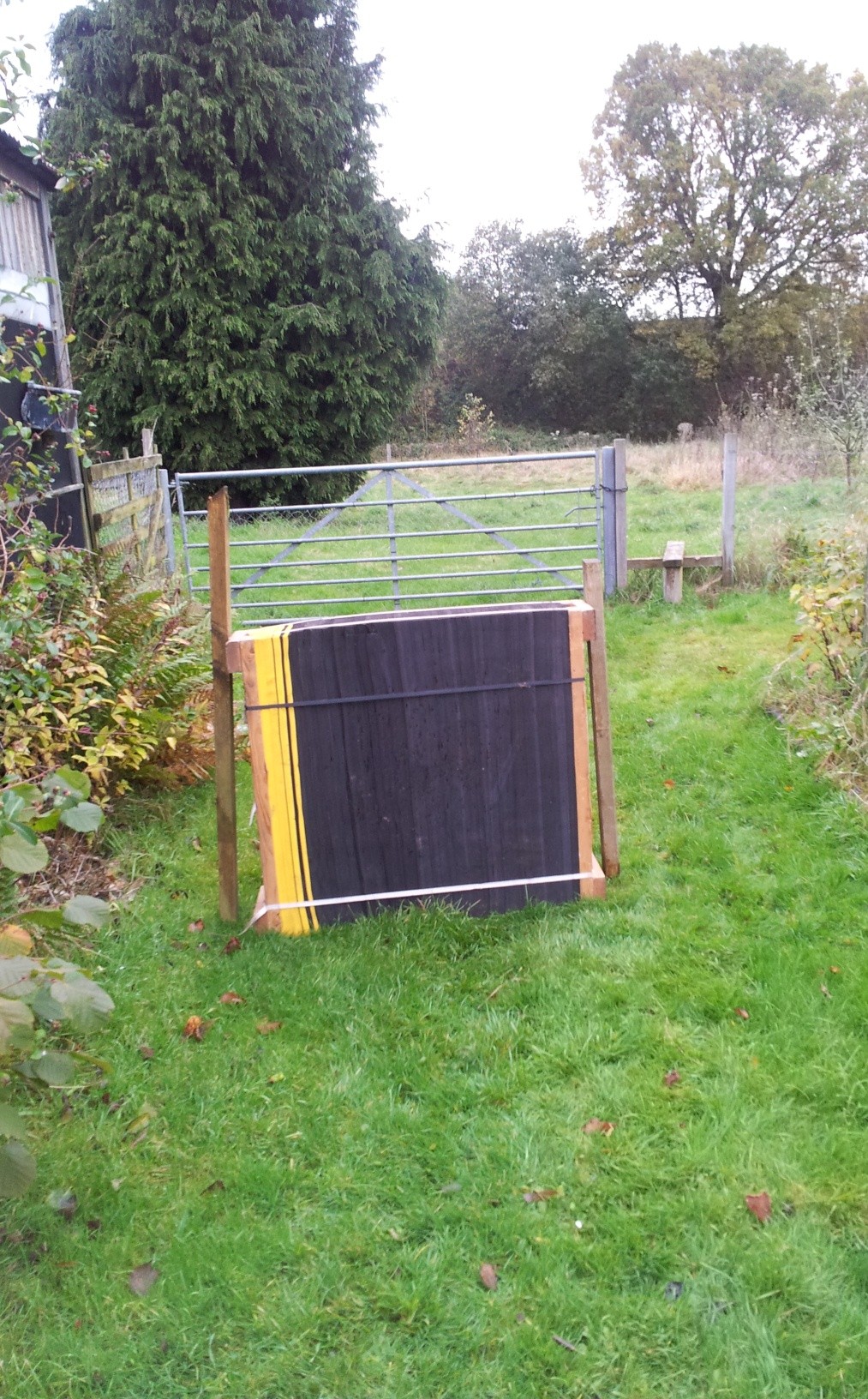
Target Boss

Target Boss

Location, location, location – no not the property program commonly seen in UK.

Look at the space surrounding the boss – there appears to be a stile behind and to the right of the boss, does this mean there is a footpath?

What about the space behind the boss with regards to overshoot. A safe over shoot area is vital for any target positioning.

N.B. we own the field beyond the gate and the boss usually lives in the field.

Any  there any other risks?

Well yes there are. There is a building to the side so you wouldn’t be able to see people approaching from that direction.

The metal gate is also a risk as if an arrow misses the boss and hits the gate it is likely to deflect in any direction.

Securing the boss to the stakes is vital to ensure it doesn’t topple over when arrows are removed. It is worth considering whether the stakes need to be proud of the boss. Also try to put them to the side or rear of the boss frame so as to avoid or limit the number of arrows hitting them.

Those are a few thoughts and tips to consider when positioning practise bosses. Have you got any further advice or tips?

We are fortunate in owning the field and knowing there is no public access or routes to it other than via our boundary.

I hope you find this article of interest and if you have any comments let me know. Thanks for reading.

Archery Panda – Eats shoots and leaves

I’m guessing most with not associate Pandas with Archery, but you might be surprised.

Pandas are not just a kung fu warriors

kung fu panda

Or symbol of world wildlife fund

WWF Logo

But I have heard the phrase Panda used to describe some archers. In respect to the exact phrase “Eats, Shoots & Leaves”  which comes from the book title Eats, Shoots & Leave: The Zero Tolerance Approach to Punctuation written by Lynne Truss

So what is an archery panda?

Well it is based round what some people see as a question of archery etiquette. I have little doubt that archery etiquette has been discussed at numerous clubs, events or gathering of archers. What is thought of as acceptable or unacceptable.

As I understand it the phrase describes  “an archer who turns up at a shoot ground, has a bite to eat before the start. Then he or she, shoots round the course and departs before any prize giving or results are announced.”

Eats,  Shoots and Leaves

So what’s wrong with this? If you know you’ve no medal chances why stick around?

From the discussion I have had or heard it is arguably an etiquette thing. You wouldn’t turn up at a friends house party, eat some food, have a brief chat then leave without saying goodbye. So why do it at a shoot?

The other thought is that you should stick around and show your support of other archers, especially the juniors. Added to this is the show of thanks to the organisers of the event.

Granted there are people who will have to leave early, due to work, or life commitments. There are also times when I’ve shot so badly the last  thing I want to do is stick around but it is something I do to show support for the archers there.

So what do people think? Have you come across archery Pandas?

Thanks for reading.

What to do during winter months

First of all, Happy New year to all readers.

Okay, so the winter months are here, short days and long nights with not much chance of shooting.

If you are a gardener you could be reading seed catalogues for the next growing year, if you are a warm weather lover you could be looking at holiday brochures, but if you are an archer what do you do?

Well you could be practising indoors if you have the option and facilities.

or

You might be cross referencing the latest catalogues and internet sites to work out the best combination of carbon arrows for the bow (think this is the closest we get to checking seed catalogues). I know this is something Sharon is doing at present in her quest to find some carbon arrows for next season.

or

Something you might find useful to do is review targets?

What do I mean? Don’t they all look the same? After all a circular target is the same day in day out. Well yes, if you are shooting at a circular target.  But in the field archery I shoot you aren’t shooting circular targets. I’m shooting either 3D animal targets or animal paper faces.

How is it scored?

Well if you hit with your first arrow you can score 20 points for a kill shot and 16 points for wound (if you get an inner kit you score 24 points)

If you miss with your first arrow you are allowed to take another shot from the second peg.  If you hit, you can score 14 points for a kill shot and 10 points for wound (if you get an inner kit you score 14 points i.e. no difference now as the bonus points are only if you hit with first arrow).

If you miss with your second arrow you can take a third and final shot from the last peg. From there you can score 8 points for a kill shot and 4 points for wound (if you get an inner kit you score 8 points)

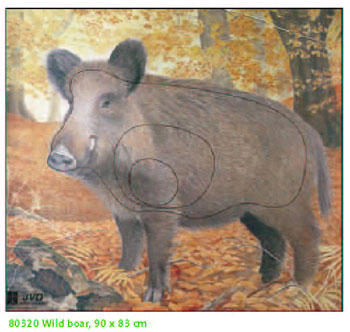
JVD Boar

JVD Boar

The image above shows clearly the 3 scoring zones. The outer most line is the wound line. The next in is the kill line and the smallest is the inner kill.

As you can see not all the animal scores on paper faces so if you hit a leg, you don’t get anything.

There are now hundreds of animal faces and 3D targets on the market (JVD, Martin, Delta and Maple Leaf to name a few)  and if a course is laid well you should never be faced with the same target face on a shoot.  Also new target faces are always arriving on the market,  Merlin Archery in the UK have recently produced some fantastic quality paper target faces.

Target face - merlin boar

Merlin Boar

Another good target they produce is their ram.

target face - merlin ram

Merlin Ram

The only downside I have found with these faces, is they tend to reflect light so be careful course layers and try to avoid putting them in direct sunlight. Think they are changing this in next batch.

The problem with having all these faces, is trying to remember them all and know where the key high scoring areas are. In the NFAS only a few bow classes can use memory aids  such as booklets of targets faces or phone apps. For the rest of us we have to try and remember.

I’ve lost track of how many different boar or deer faces are on the market at present. All slightly different in size and shape. Some are life size others are reduced.

Likewise there are hundreds of different 3D targets out there too.

3d javalina

3d Javalina

A good tip I have been given is to aim for the leg line when shooting a 3D target, as if you drop low you are still in the leg. Downside of this means you aren’t in the highest scoring areas, but at least you don’t blank the target.

3d Turkey

3d Turkey

Anyway it is something to do, whilst we wait for the longer days and the season to start

As always thanks for reading and good luck for 2013.