Removing broken wood tip from inside pile

Thought those of you, who like me shoot wooden arrows and sometimes have the misfortune to break the pile off might find this a useful tip. No pun intended.

Quite often I find my arrows break directly behind the pile, leaving a small piece of wood inside the pile which can be difficult to remove especially if you want to reuse the pile.
I know some people drill the wood out and others simply throw away the pile.
Well I thought I would show how I remove the broken piece of wood.

Tools required

Tools required

The tools required are
1 x long wood screw 2 1/2″ is ideal (cross head)
1 x screwdriver
1 x gas stove or gas ring
1-2 x pliers
1 x small pot or basin of water
Step 1
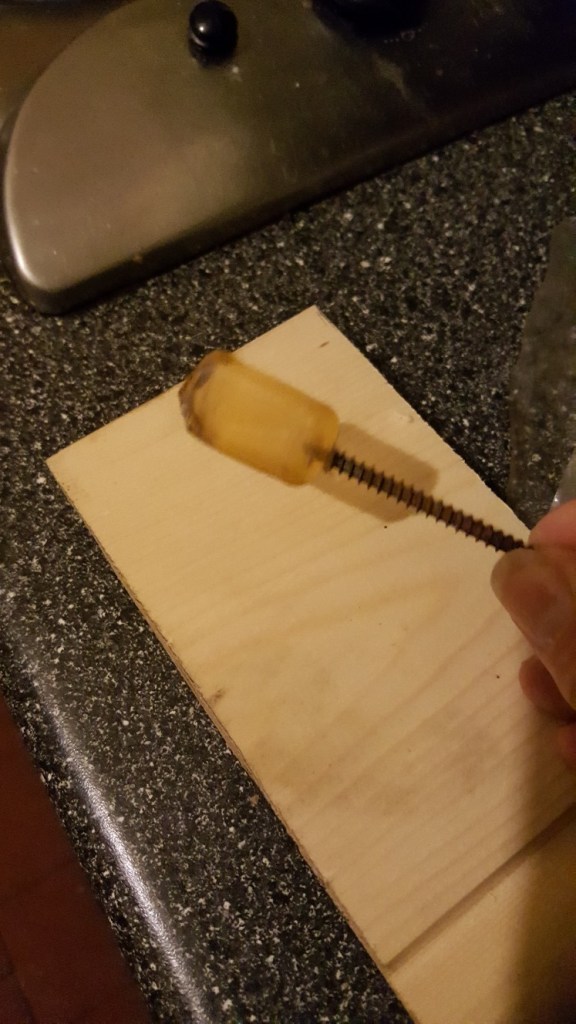
First stage is to carefully take the screw and screw it into the wood still in the pile.
Screw into wood

Screw into wood

Step 2 
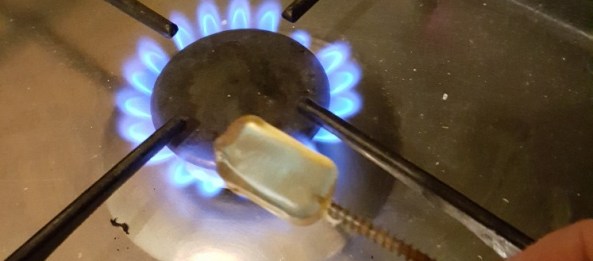
Once the screw is secured in the wood, you need to heat the pile up as this breaks down the glue securing the wood to the pile.
Holding it by the screw you can heat the pile using the gas ring. It should only take 10-20 seconds.
Word of warning here. 
I usually use screw on piles, but if you have taper fit or parrell fit you can have the piles pop off as the glue and gases in the glue expand under the heat.
The reason I mention this is on one occasion when removing a pile I left it in the ring to heat up too long as I worked on another. I heard a loud pop and saw the pile shoot across the kitchen towards the window and the screw and wood went in another direction. Fortunately no one was  injured and nothing was broken (otherwise I think Sharon might have injured me)
Heating the pile

Heating the pile

The other thing to be careful of is to not let the wood burn as this will not only smoke the kitchen out possibly triggering a smoke detector but also make it harder to remove the wood.
It’s worth doing this in a well ventilated room as the glue can stinks, especially the two part epoxy I use. How long you keep it in the flame will vary depending on the glue. Hot melt, melts quickly whilst some epoxy ones might take 20 seconds. It’s a bit of trial and error here.

Step 3
Holding the now heated pile  in the pliers (don’t grab it with your hand as it will be hot) take the screw driver and continue to screw the screw into the wood.
You should find that because the glue has melted and lost adhesion to the pile the screw will force the wood free. Resulting in the wood remaining on the screw and free of the pile.

Wood remains on pile

Wood remains on pile

Step 4 
Drop the pile and screw into a pot of cold water to cool.  Once cool you can dry the pile.
You might need to clean out the inside of the pile of glue residue with a bit of wire wool or I find an old shaft tapered down and screwed in and out a couple of times works well to dislodge any residue.
The easiest way to remove the wood from the screw is to hold the wood in the pliers and then using the screw driver “unscrew” it.
Hope you find this useful.
Thanks for reading.

Making and doing archery madness

I firmly believe that a successful club is more than just a field or wood and group of people who shoot there.
A good club supports its members, nurturing and developing their skills and interests. I believe it should also be somewhat of a social gathering.

It is very easy for a newbie archer to get lost and confused with friendly offers of advice or to be too nervous or embarrassed to ask for help. Ideally you want new members to be intimidated as little as possible but not everyone has the confidence to ask questions or seek advice.

Learn from the past
Many years ago, I was a member of the Black Arrow club in Derby. In fact it was the  first ever archery club we joined. Kevin the club chairman and Cherrie the Secretary organised a making and doing session for all the new members who had joined. It gave all present the opportunity to learn the basics of arrow making, string making and how to serve strings. It proved a great success being both instructional and social with Cherrie and Pete (her partner) providing food for all.
Over the Christmas holiday of 2014 Sharon and I organised a similar event at our house, with the objective of giving a few of the newbies some guidance on making or repairing arrows and a variety of other topics.
It proved to be a very sociable afternoon  and evening, helped by the contributions of everyone who came and Sharon’s expert cooking. Yes, not only is she a cracking shot but also a great cook.

Nigel showing his expertise on straightening wooden arrows.

Nigel showing his expertise on straightening wooden arrows.

We covered topics of how to make wooden arrows including fletching arrows, attaching piles and nocks. Having a number of experienced archers there proved really useful as each explained how their technique was slightly different from each other enabling a great spectrum of knowledge to be displayed and discussed.  The discussion on whether to varnish the arrow prior to fletching or fletch then varnish was one hotly debated topic. An equally debated topic was the merits of different glues for attaching piles to wooden shafts with some preferring  hot melt over epoxy glues. All the advice and comments were provided freely and in a relaxed atmosphere.

Jason showing how to use fletching tape

Jason showing how to use fletching tape

Whilst arrow making was going on in one room, arrow straightening of aluminium arrows using our straightening jig was being demonstrated in another. There was also just enough space to demonstrate applying serving to a bow string.

Discussions went on long into the night on different techniques and it was a very sociable evening. Our thanks to all who contributed their time and advice.

Greta making her first arrows

Greta making her first arrows

With everyone at the wood the following day even more discussions took place, this time with archers showing off their arrows they had made previously and again citing the merits of varnishing first or other such topics.

So if you have the opportunity to run something similar to this at your club go for it. It doesn’t take much planning and benefits can be huge.

Thanks for reading and to all those that attended. Special thanks to Kevin and Cherrie who set the bar so high all those years ago.
Oh, Kevin if you are reading this remember the glue.

Balance point of arrows – or a simple hack

A friend posted this on our clubs Facebook site and I thought it was a really simple and great idea, so I thought I would share it with all my readers, but as I said to him on Sunday. “I hope its not your best carving knife.

life hack for arrow balancing

life hack for arrow balancing

When trying to identify the balance point of your newly made wooden arrows it can prove very fiddly and there are lots of people and sites that suggest you can bend a piece of metal at a right angle etc. and use that. Well here is a very simple and quick way of doing this. Only one piece of advice take care and not to damage the arrow on the blade if its sharp…
As the “designer”  says is a “Simple hack and I’m sure you’ve all got this already. I was looking for a way to mark the balance point of my arrows and came up with the “ram a sharp knife into a block of wood” method.
Patent pending.
Surprising how different they all are!” Nice one Campbell
Thanks for reading.