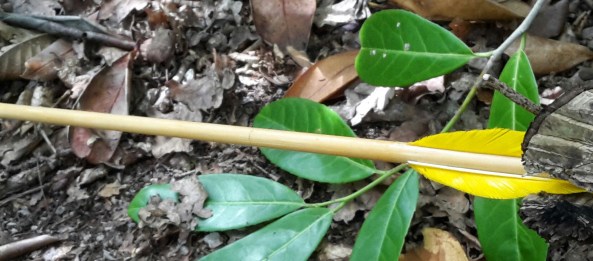

Forest of arrows
In the previous posts, I talked about personal confidence and your mindset. In the next couple of articles, I am going to look at the role of equipment setup and how these can affect your confidence in both positive and negative ways. As ever if you have any questions or queries drop me a line.
How can we build self-confidence?
Well, that is not an easy question as there are so many different potential answers. From my perspective, I’m going to use something I call the Archer’s triangle, to help break this down into manageable elements.

The archers triangle
The triangle is what I see as the three key elements that are relevant for all archers, whether you are a target archer, hunter or field shooter. It consists of three components, Archer, Arrow and Bow. These three need to work together successfully for the best outcome. I am not saying they all have to be perfect, but they do have to work together. Since there are three I have always thought of them as the three sides of a triangle.
Arrow – all elements from shaft construction, spinning, point weight, length, etc.
Bow – covering bow mass weight, draw weight, length, brace height, etc.
Archer – cover draw dynamic, shot sequence, mindset, draw length, release, etc.
Building personal confidence i.e. the Archer element takes time and practise, but we can build confidence via the other two sides, slightly more quickly. So I’m going to summaries some ideas on the Arrow and Bow aspects initially.
Don’t worry I’m not ignoring the Archer element or how we build the archers confidence. I will cover this. but initially I want to focus on the kit aspects and provide a few ideas on how you can develop confidence through your kit set up.
Building confidence with arrows
So we are going to start with our projectiles, whether wood, carbon or aluminium. Arrows are a vital component for all archers. For this reason, I want to offer you a thought “If you don’t have confidence in how your equipment will behave, then you will find every shot doubly challenging?”
Think about this for a moment. If your quiver is full of arrows of different lengths, weights, spines then do you think each arrow is likely to perform in the same way?
A quick Google search will provide you with a bewildering amount of information on arrows, how-to guides on construction techniques, what works, what doesn’t work, etc. So I’m not going to cover that. What I am going to outline is how making my arrows helped me build confidence in their performance and behaviour. This, in turn, gave me confidence when shooting them.
You could argue that this is from the perspective of a traditional archer, making mostly wooden arrows, with feather fletchings, but I feel it is just as applicable for all archers, whether you are shooting Easton X7, XX75 or Easton Carbon Ones. So here goes.
Over the years I’ve probably spent hours making and tuning my wooden arrows to the different bows I shoot. Trying different combinations of arrow spine, arrow length, pile weight, fletching size and shape, matching total arrow weight, etc. I would document all this in various notebooks so I could refer back to them. Then I would shoot the combinations for a couple of weeks to properly test them at different distances and in varying weather conditions. If they worked fantastic, if not back to the drawing board and start again with the next set of variable until I found a combination that worked.
Sure I made mistakes along the way, that’s part of learning. I firmly believe that making mistakes should not be viewed as a failure. It can provide a great learning experience if we let it. Too many times I’ve seen people not learn from mistakes only to repeat them.
I found the process of making the arrows strangely relaxing after a day spent in front of a computer screen. The ability to focus on the single task of construction and stages involved in construction brought an element of mindfulness.
I also feel all this work paid dividends in two ways. I developed skills in making arrows, which I have been able to apply and teach to others. Secondly and more importantly, it meant I developed confidence in the arrow set up and how they would behave.
I may have told you this story before, but I believe it is worth another outing and helps to highlight how not being aware of your kits variances can affect your anxiety.
An archer came to me for some coaching. Their goal was to increase their consistency, especially at longer distances where they struggled most. They felt a lack of confidence shooting at distance and couldn’t understand why sometimes things worked and others times they would go high and next time low.
Reviewing their form and shot execution showed them to have a strong and consistent routine. It was only when I reviewed their equipment did an answer appear as to why they were struggling. Their arrows had a huge variance in mass weight, with the heaviest being over 100 grains more than the lightest. This would explain why over longer distances, 35 yards plus, the archer would see completely different results depending on which arrow they used. This leads them to believe it was something they were doing wrong, which had the effect of causing anxiety and loss of confidence.
Top Tip – pickup a digital grain scale so you can weigh your arrows easily. They are quite inexpensive and can be easily picked up off the internet or local archery shop. I wrote an article a while back on my use of them. Make sure they will weigh items in grains.
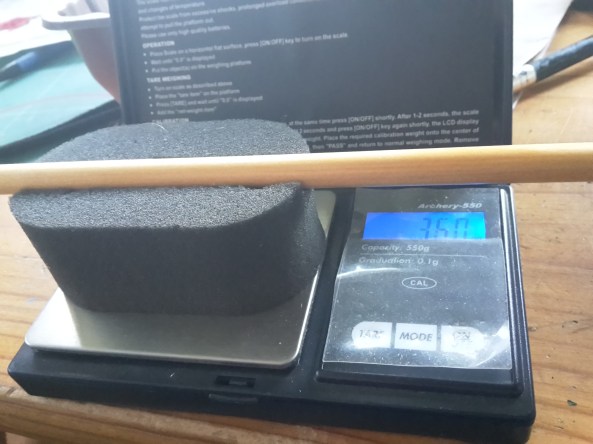
Grain scales with sponge
Obviously, there are far more potential variations in shaft weight, arrow spinning etc when making wooden arrows due to the nature of the materials. When compared with constructing arrows from machined aluminium or carbon, where the manufacturing tolerances are far more predictable. Gaining consistency in your arrow set up is vital and is one reason so many people use carbon.
You might feel you don’t have the skills to build your own arrows, but everyone can develop these skills. If nothing else you can review and check the length and weight of your arrows to ensure a level of consistency.
Grouping by weight
I group my arrows into batches by weight so all the ones I shoot are closely matched, whether they are used for first, second or thirds. So 12 of my arrows might weigh in at 460 to 480 grains. I would group all the ones from 460 to 470 grains together and have a separate grouping of 470 to 480 grains.
Unlike some archers, I don’t use my lightest arrows for my first arrows (normally the longest shots), working down to my third arrows being the heaviest (normally the closest). I prefer to know they are all in the same weight range and hence will perform consistently.
Monitoring
The thing to remember is that arrows wear out over time, especially wooden arrows. Eventually, the fibres in the shaft will no longer keep their strength, following constantly impacting targets or the ground. This is sometimes called shooting the heart out of the arrow. This can have an effect on the archer as you can quickly lose confidence in yourself if you feel you are doing everything right but your arrows aren’t flying well.
For this reason, I suggest you monitor your arrows and check they are remaining straight and undamaged. This is vital for all archers to consider, especially when shooting carbon arrows as these too can fail and sometimes in quite dramatic manners. I’ve seen some carbon arrows explode when released from the bow due to the archer not being aware the arrow is damaged and the stresses involved at the point of release caused a catastrophic failure.
Like wooden arrows, aluminium shafts can become damaged and dented over time; resulting in less than ideal flight trajectory, so it’s worth keeping track of them too. Sharon used to find the Easton X7 a great arrow when shooting barebow as they could take a hit or two without deforming. Which provided her with confidence in their performance.
Thanks for reading and as I have said previously, feel free to drop me a line with any questions or thoughts you might have on topics I am covering.


 My Archery Experiences