
Quick break from my series on target panic to revisit a topic which I think will be of interest to many.
Several years ago I wrote a post offering advice on what equipment newbies should consider purchasing, before buying their first bow. Since I have been working with several new archers in the recent months I thought it a good time to revisit this post and update it where necessary.
As a coach I often get asked by my students about buying a bow. How much do they cost? What should I got for? Where do you recommend I go? I’ve seen one on E-Bay is it any good? I always reply by saying wait a few weeks or even a couple of months before you buy one. In that time use the club equipment for until you have a better idea of what is suitable for you.
But sooner or later your students will want to purchase their own bow (which is great don’t get me wrong) but there are a few things that might be worth getting first. So I have put this post together to offer some thoughts.
First things for any new archer to buy (before a bow) should be
Whistle – What a whistle? What’s that got to do with archery? Well put simply it’s for safety calls and is a necessity for insurance on some club sites including ours. All members of the NFAS should have a whistle on them so they can signal if necessary.
A tab or glove of their own. Normally I recommend a beginner starts with using a tab to protect their fingers. As they progress I have them trying both a tab and glove, along with trying different sizes and shapes until they find something they prefer. Recently I’ve found several students opting for a glove which I think is partly due to the colder weather.

This is the single thickness tab
Personally I think a tab is best, though it took me ages to find one that I was completely comfortable with. I feel tabs are easier on their fingers and promotes good finger position on the string.
Quiver, you can pay a small fortune for some quivers, but when you are starting out go for something simple. So long as it will hold 4-6 arrows and is comfortable to carry on your belt it’s a winner. Quick note about back quivers here. I’ve tried back quivers, several in fact and never found one I was happy with so have stuck with a field quiver. I know some people love them but for your first quiver, keep it simple.
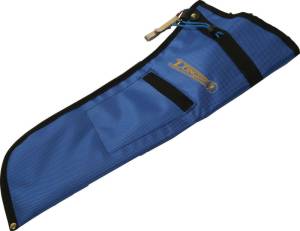
simple quiver
Some quivers will have a pocket or pouch on them which can very be useful for holder a whistle, stringer, spare string.
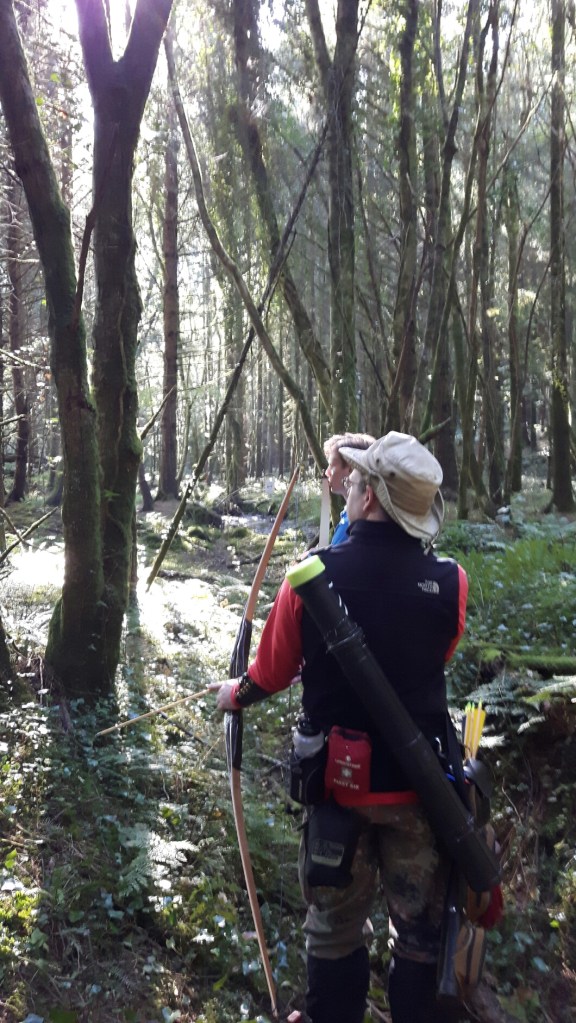
Top Top – pick up an arrow tube to store arrows when not in quiver. I carry 3 or 4 arrows in my quiver and the rest are in an arrow tube on my back. Safe, dry and there if I need them. You can use an extendable poster tube, which are cheaper, just make sure you drop some foam in the bottom of the tube to protect it and stop arrows puncturing the plastic.
Rob trying to judge distance to a shot
An arm bracer or arm guard that fits. What I mean is it doesn’t fall down the arm or is so tight it cuts off circulation to your arm. Like quivers there are loads of different designs, some that go all the way up the arm, others that only cover the forearm. Some are plain others are covered in intricate designs carved into the leather. At the end of the day function is more important, so get one that fits, works and you like.
Arrow puller, while not the most glamorous of archery elements they do makes life easier for drawing arrows, allowing you to grip the shaft more easily, especially on cold days.
Arrow rake – no matter how good you are, sooner or later you will be needing one for finding those arrows that fall short (a cheap decorating roller can be used, once modified for the purpose )
What kind of bow should I buy?
I will cover this in more detail in a separate post but what I will say is in my opinion for a first bow the most sensible option is the take down recurve practise bow.
They are relatively cheap (£55-£75 depending on where you get them), so if they don’t stick with the hobby it’s not such a huge investment. Also you might be able to pick one up from club member who has progressed. The advantage of a takedown is the limbs can be upgraded to heavier poundage as archer develop their strength and skill (I did this after a few months myself, with some shops giving a discount if you trade your old limbs in). Worth noting that not all limbs fit all bows, but I will go into more details in a future post about fittings and ILF bows (International Limb Fittings).
I have found the bows are forgiving to use which is what you want as a beginner.
Such bows come in a vast variety of sizes, shapes, poundage so good for all abilities, heights, draw lengths etc. so are easy to find one suitable for all shapes and sizes of archer.
As I said I will cover this in more details in the next post.
Thanks for reading


 My Archery Experiences